


After a serious maritime accident, the path to recovery can seem overwhelming. You’re facing physical pain, emotional stress, and a growing stack of medical bills. A critical question arises: How do you quantify the full impact of an injury? At BoatLaw, LLP, we understand that a fair recovery goes far beyond simply adding up receipts. It requires a deep, comprehensive understanding of how the incident has altered every facet of your life.
As our partner, Nick Neidzwski, explains, “In any personal injury case, our client is our greatest resource.” To secure the maximum compensation you deserve, we must first understand who you were before the accident. This client-centered approach is the foundation of our strategy for calculating damages.
The Foundation: Establishing Your Quality of Life Before the Incident
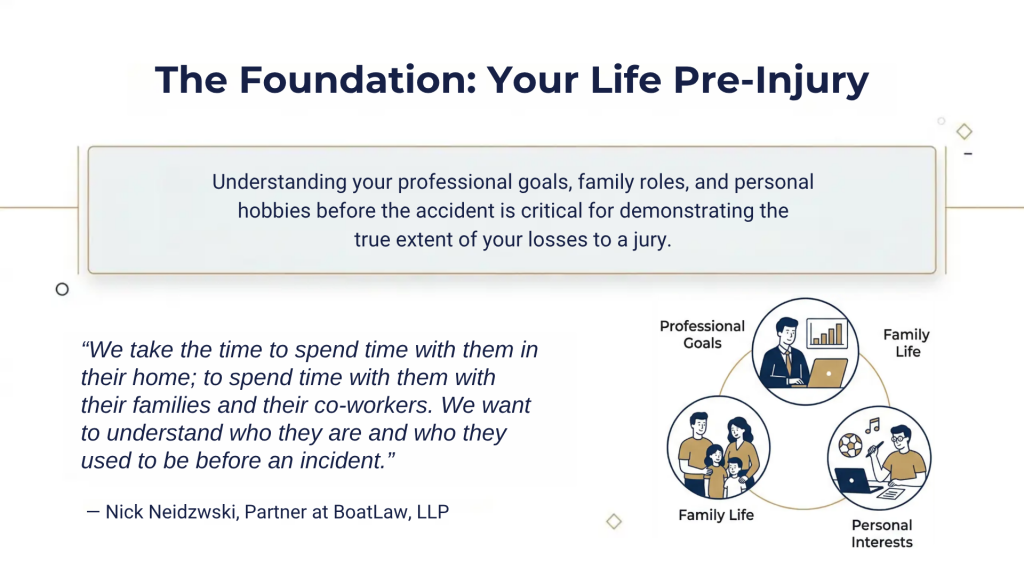
To accurately calculate damages, we must paint a clear picture of your life pre-injury. This isn’t just a formality; it is the most critical element in demonstrating the true extent of your losses to a judge, jury, mediator, or opposing counsel. We invest the necessary time to build this complete narrative.
We take the time to spend time with our clients in their home, and with their families and their co-workers. We want to understand who they are and who they used to be before an incident.
This holistic investigation allows us to understand:
- Your professional life: What were your career goals? What was your income trajectory? Where did you see yourself in five or ten years?
- Your family life: What activities did you enjoy with your loved ones? How has your role within the family changed?
- Your personal life: What were your hobbies, passions, and sports? What brought you joy and fulfillment?
Only by comprehensively understanding what has been taken from you can we effectively argue for the compensation needed to help you rebuild.
Categories of Damages in a Maritime Injury Case
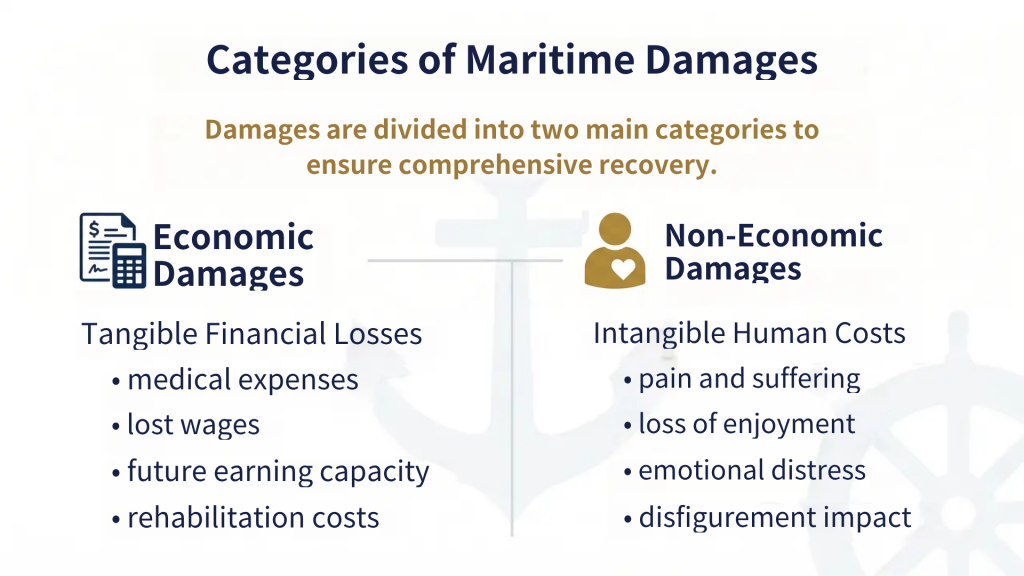
In maritime personal injury cases, damages are generally divided into two main categories: economic and non-economic. A thorough claim addresses both to ensure a comprehensive recovery that covers tangible financial losses and the profound, intangible human costs of an injury.
Economic Damages: The Quantifiable Costs
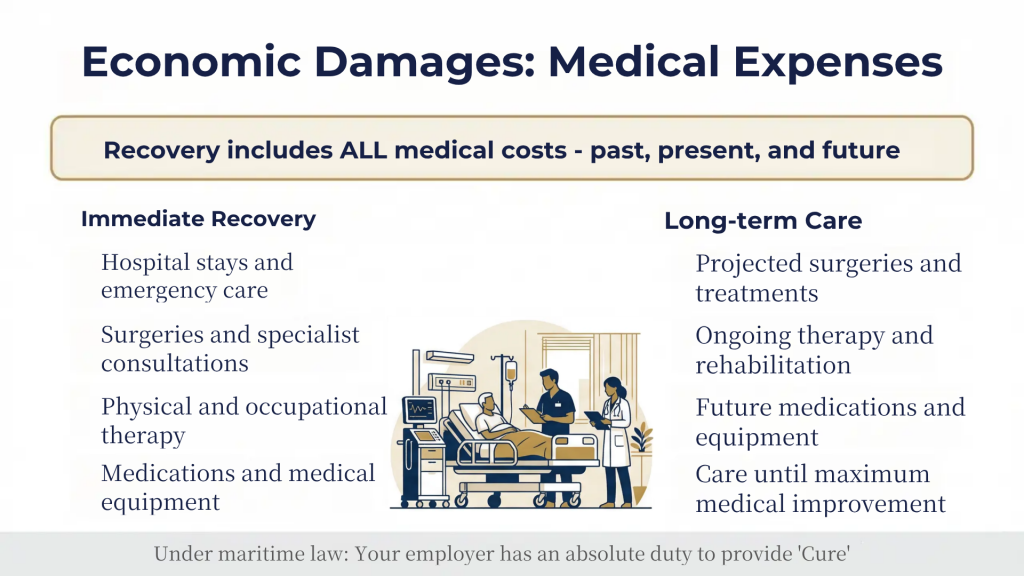
Economic damages are the measurable financial losses resulting from your injury. Our goal is to recover every dollar you have lost and will lose due to the accident.
Medical Expenses (Past and Future)
Medical bills are often the most immediate and daunting financial burden. We seek to recover all costs related to your medical care, including:
- Hospital stays and surgeries
- Doctor’s visits and specialist consultations
- Physical and occupational therapy
- Medications and medical equipment
- Future medical care, including projected surgeries or long-term treatment
Under general maritime law, this is related to the concept of “cure,” an employer’s absolute duty to provide medical care to a seaman injured in the service of the vessel until they reach “maximum medical improvement.”
Lost Wages and Loss of Earning Capacity
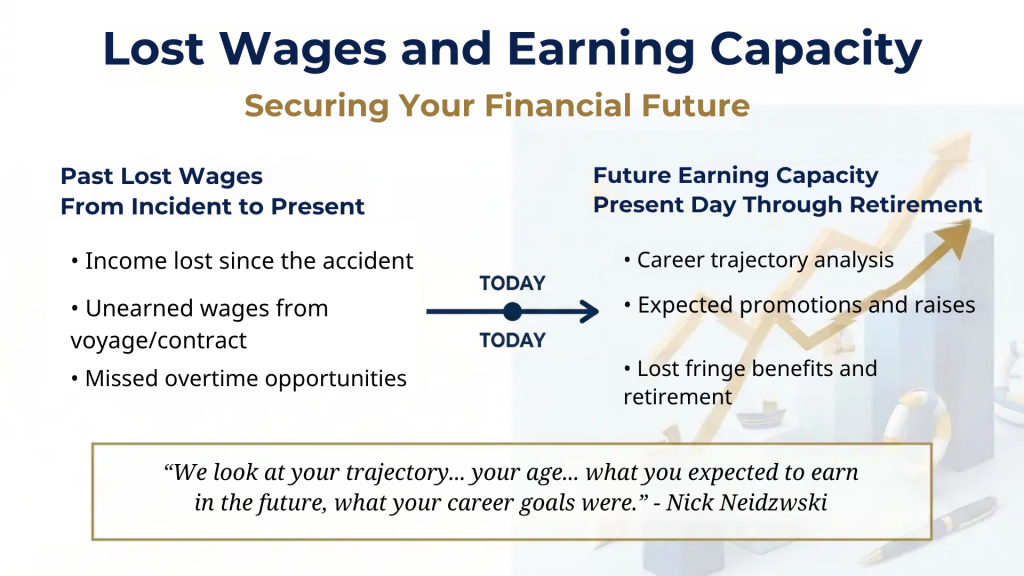
A serious injury can devastate your ability to earn a living. We pursue compensation for both past and future income loss.
- Lost Wages: This covers the income you lost from the time of the incident to the present day. Under maritime law, this can also include “unearned wages,” which are the wages you would have earned until the end of your voyage or contract.
- Loss of Earning Capacity: This is a forward-looking calculation of the income you will lose from today through your expected working life. We look at your trajectory, your age, what kind of job you had, what you earned in the past, what you expected to earn in the future, what your career goals were, etc.
To establish this loss, we often work with economic and vocational experts. They help project your lost income stream, factoring in promotions, cost-of-living adjustments, and lost fringe benefits like health insurance and retirement contributions.
Retraining and Vocational Rehabilitation
If you can no longer perform your previous job, you may need to start a new career. The costs associated with this transition are recoverable damages. We consider whether you need to:
- Go back to college or trade school
- Learn a new vocation or skill set
- Transition from physical labor to an office environment
These costs are a direct result of the injury and are essential for securing your financial future.
Non-Economic Damages
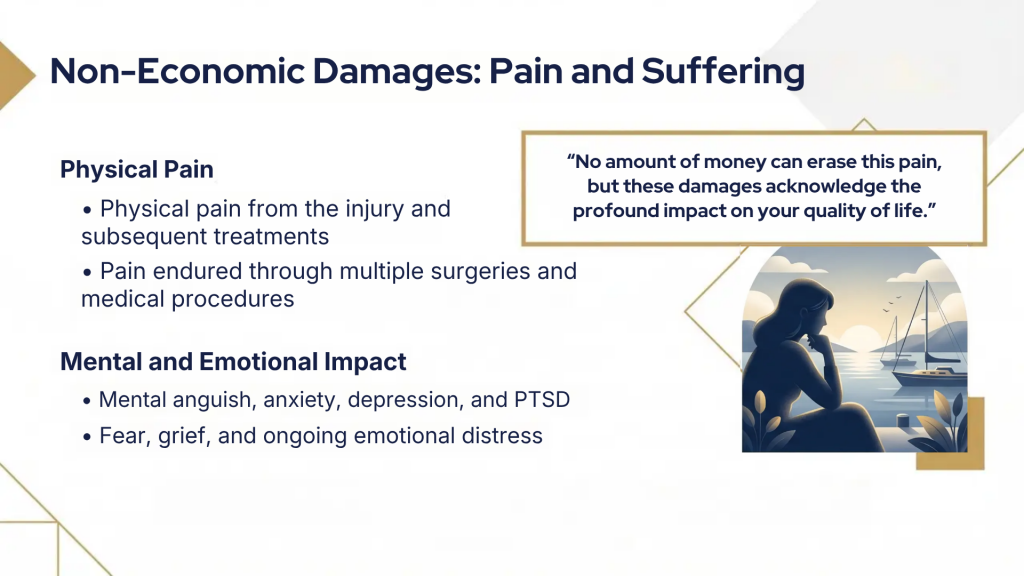
Non-economic damages compensate for the intangible, but very real, human suffering caused by an injury. While no amount of money can erase this pain, these damages acknowledge the profound impact on your quality of life.
Pain and Suffering
This is compensation for the physical pain and emotional distress you have endured and may continue to endure. Maybe you needed to go through one surgery, or multiple surgeries. All of these factors are relevant to putting a number on your pain and suffering. This category includes:
- Physical pain from the injury and subsequent treatments.
- Mental anguish, anxiety, depression, and PTSD.
- Fear, grief, and emotional distress.
Proving these damages requires detailed medical records, testimony from you and your family, and expert opinions to illustrate the full extent of your suffering.
Loss of Enjoyment of Life
This damage category addresses your diminished ability to participate in and enjoy life’s activities. We work to show how the injury has prevented you from pursuing hobbies, sports, family activities, and social interactions that were important to you before the incident. This is about compensating for the loss of the life you once lived.
Disfigurement and Humiliation
Permanent scarring, loss of a limb, or other visible disfigurements can cause significant embarrassment and humiliation. These damages are intended to compensate for the emotional and psychological impact of living with a permanent physical reminder of the accident.
Unique Considerations in Maritime Law
Maritime law, including the Jones Act and general maritime law, provides specific rights and remedies for injured workers. Understanding these is crucial to maximizing your claim.
Maintenance and Cure
Beyond damages for negligence, an injured seaman is entitled to maintenance and cure regardless of who was at fault for the injury.
- Maintenance: A daily stipend to cover your basic living expenses (rent/mortgage, utilities, food) while you are recovering.
- Cure: The payment of your reasonable and necessary medical expenses.
While this is an absolute right, employers and their insurance companies often attempt to underpay these benefits. An experienced maritime attorney ensures you receive the full amount you are owed.
Proving Negligence and Unseaworthiness
To recover the full range of economic and non-economic damages, we must typically prove that your injury was caused by your employer’s negligence or the vessel’s unseaworthiness.
- Negligence (Jones Act): The Jones Act allows seamen to sue their employers for injuries resulting from negligence. The standard of proof is low—we only need to show that the employer’s negligence played any part, “even the slightest,” in causing the injury.
- Unseaworthiness (General Maritime Law): A vessel owner has an absolute duty to provide a “seaworthy” vessel, meaning the ship and its equipment must be reasonably fit for their intended purpose. An injury caused by an unseaworthy condition makes the vessel owner strictly liable for the injury.
Get Help Calculating Your Potential Damages After a Maritime Injury

Calculating damages in a maritime injury case is a complex process that requires experience, diligence, and a deep commitment to the client. The insurance company will try to minimize your claim, but our firm is dedicated to telling your full story to ensure you receive the compensation you need to protect your future.
If you have been injured in a maritime accident, contact the dedicated attorneys at BoatLaw, LLP. We represent injured maritime workers along the West Coast, with offices in Washington, Oregon, and California, and serve clients in Alaska, Arizona, and Florida. Let us fight for you.

Douglas R. Williams was raised in a military family. After retiring from the armed forces, his father sailed as the chief medical officer with many of the most popular cruise lines, including Holland America Line, Carnival Cruise Line, Disney Cruise Line, and Norwegian Cruise Line. When not in school, Doug spent a good part of his youth in the crew quarters sailing with his father on cruise ships. He developed a practical knowledge of the maritime industry from a young age. Learn More here.