

How a Limitation of Liability Act Maritime Lawyer Protects Your Rights After an Accident
TLDR: Key Takeaways
- The Limitation of Liability Act of 1851 allows vessel owners to limit their financial liability to the post-accident value of the ship.
- Owners frequently file these claims in federal court immediately following a tragedy, often confusing and intimidating injured workers.
- In a limitation action, there is typically no right to a jury trial, as the case is handled by a federal judge in admiralty.
- BoatLaw, LLP is experienced in the practice of “staying” these actions, allowing you to move your claim to a state or federal court where a jury can hear your story.
A “Relic” from 1851 That Still Impacts Modern Maritime Injury Claims
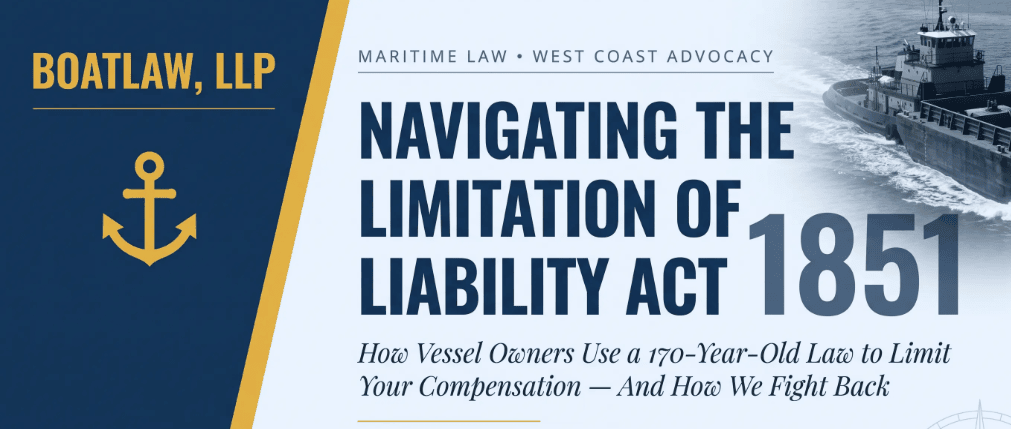
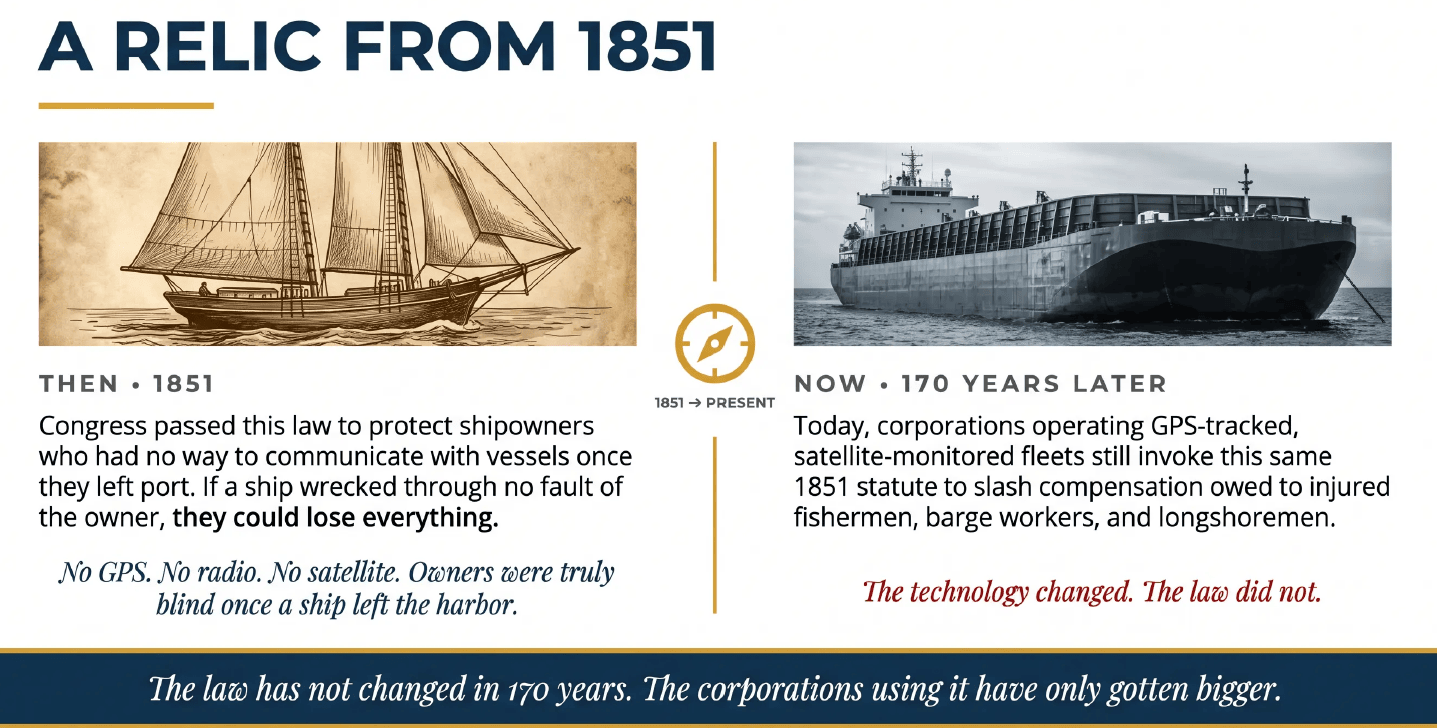
Congress passed the Limitation of Liability Act in 1851 to encourage the growth of the American shipping industry. Back then, shipowners had no way of communicating with their captains once a vessel left port. If a ship crashed or sank, the owner could lose their entire fortune through no fault of their own. While technology has changed—we now have GPS, satellite phones, and real-time monitoring—the law has not. Today, massive corporations still use this 170-year-old statute to limit what they must pay for harm caused to fishermen, barge workers, and longshoremen.
When an incident occurs, the vessel owner can petition a federal maritime court to limit their liability to the “post-incident value” of the vessel plus the “pending freight” (the money earned from the voyage). If a vessel sinks, that number is often zero. This means that even if a worker suffers a life-altering injury, the owner may argue that they owe nothing more than the value of a sunken hull.
“The Limitation of Liability Act is often the most callous maneuver a vessel owner can make. They proactively sue the victims of a tragedy to ensure those victims never get a day in front of a jury.” — Doug Williams, Partner at BoatLaw, LLP.
The Confusion of Being “Sued” After a Maritime Tragedy
One of the most distressing parts of any maritime injury claim involving the Limitation Act is the procedural “reversal” of the case. In a standard personal injury case, you sue the negligent party. In a limitation action, the vessel owner—the defendant—files a lawsuit proactively soon after the incident. They are required to give notice to potential claimants and deposit the value of the vessel in court.
Suddenly, an injured worker or a grieving family is served with a limitation complaint in federal court. This often leads to significant (and reasonable!) confusion. You might wonder, “Why am I being served with a lawsuit when I’m the one who was hurt?” At BoatLaw, LLP, we have handled a variety of limitation of liability cases up and down the West Coast, from Bellingham to Los Angeles. We know that this tactic is designed to intimidate you into accepting a smaller settlement. Our job is to stand as a shield between you and the corporation’s legal team.
Don’t Let a 19th-Century Law Limit Your Future
If you’ve been served with a limitation complaint, the clock is ticking. You must meet specific federal deadlines to protect your right to compensation.
The Critical Deadline: Why You Must Act Fast
Once the vessel owner makes their deposit and gives notice, a federal judge will set a specific deadline for anyone affected by the incident to file their claims. This includes the injured workers themselves or the families of those who lost their lives. If you miss this deadline, you could be barred from ever seeking compensation for your injuries or the loss of your loved one.
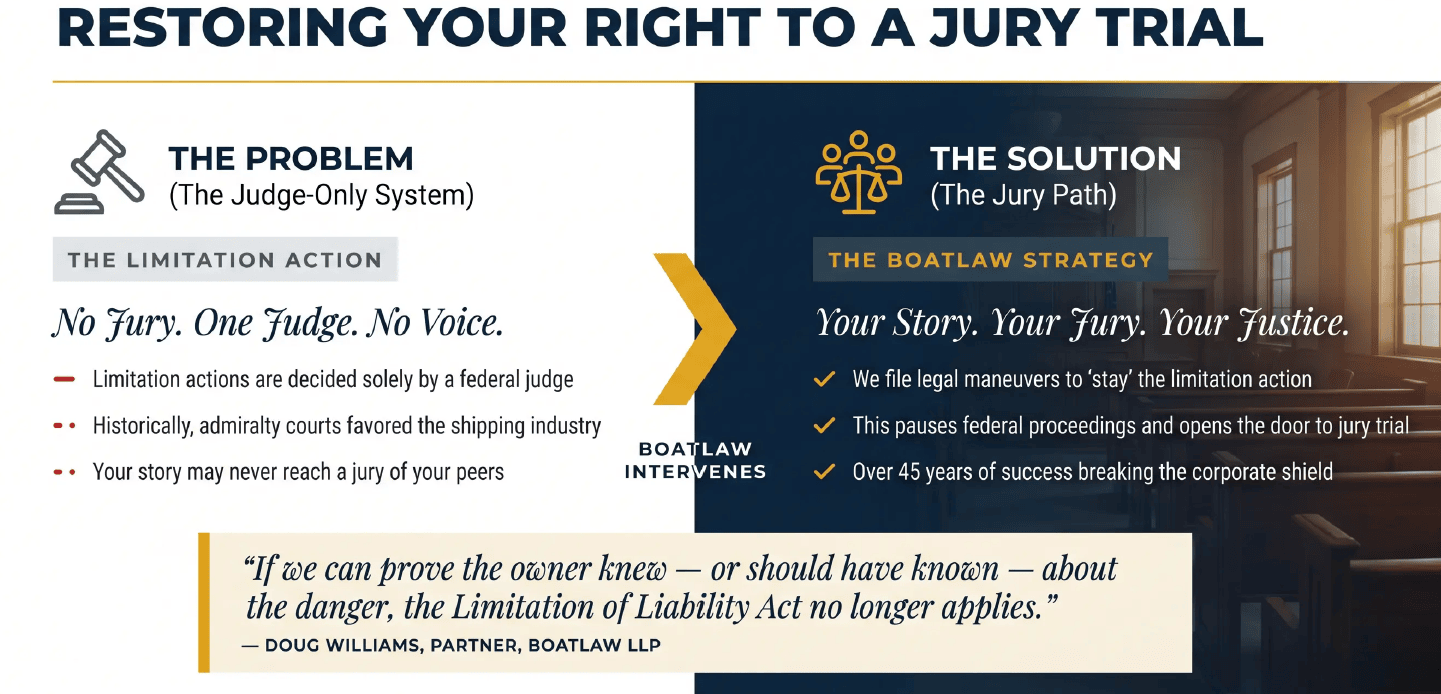
This is where the expertise of a Jones Act attorney becomes vital. We ensure that your claim is filed correctly within the limitation action. However, simply filing the claim is not enough. We also look for avenues to “stay” the limitation action. Staying the action essentially pauses the federal proceedings, allowing us to pursue your case in state or federal court where you have the right to a jury trial.
Restoring Your Right to a Jury Trial
A major disadvantage for workers in a limitation action is that there is no right to a jury trial. The case is decided solely by a federal judge. Historically, judges in these actions were often protective of the shipping industry. To get justice, you want your story heard by a jury of your peers—people who understand the physical toll of maritime work and the value of a human life.
Our legal team, led by Doug Williams and Nick Neidzwski, has over 45 years of success in fighting these limitation claims. We use specific legal maneuvers to break the “concourse” of the limitation action, restoring your right to a jury. We investigate whether the vessel owner had “privity or knowledge” of the negligence or unseaworthy condition that caused the accident. If we can prove the owner knew (or should have known) about the danger, the Limitation of Liability Act no longer applies, and the owner is responsible for the full extent of the damages.
Why BoatLaw, LLP is the Choice for Maritime Workers
Since 1977, BoatLaw, LLP has fought for justice for maritime workers in Washington, Oregon, Alaska, California, and Florida. Our attorneys share a lifelong love of the sea, and we understand the blue-collar way of life because we live it. Whether you were injured on a fishing vessel, tug, barge, or oil rig, you need an advocate who has the experience to represent your rights against the largest shipping companies in the world.
We operate on a contingency-fee basis. This means there are no upfront costs to you. We don’t get paid unless we win your case. When you are represented by BoatLaw, you aren’t just getting a lawyer; you’re getting a team that has spent decades defeating the Limitation of Liability Act in courts up and down the West Coast.
Ready to Fight Back? Contact BoatLaw, LLP Today.
If a vessel owner is trying to limit their liability for your injury, you need a powerful advocate on your side. We have the experience to stay limitation actions and get your case before a jury.
Call us today at 360-671-6711 or fill out our online form for a free, confidential consultation.

Nicholas J. Neidzwski is a trial attorney who handles maritime and personal injury litigation. Appearing for plaintiffs in state and federal courts throughout Washington, California, Oregon, Alaska, and other jurisdictions. Nick’s litigation experience includes the successful resolution of various Jones Act, general maritime, and product liability cases on behalf of many different individuals. Nick was named a Rising Star annually by Super Lawyers from 2016 through 2025, and was named a Super Lawyer in 2026. Learn more here.