

What is a Section 905(b) claim? A Section 905(b) claim is a specific third-party personal injury lawsuit authorized under the Longshore and Harbor Workers’ Compensation Act (LHWCA). It allows injured harbor workers, longshoremen, and shipyard personnel to sue a vessel owner for negligence to recover full tort damages beyond standard LHWCA statutory benefits.
When you are hurt on the job at a port, shipyard, or marine terminal, relying solely on standard workers’ compensation rarely covers the true scope of your losses. For harbor workers and longshoremen, statutory benefits under the Longshore and Harbor Workers’ Compensation Act cover medical bills and a portion of lost wages. However, they do not account for pain, suffering, emotional distress, or lost future earning capacity.
Fortunately, the law provides another path to financial recovery. Under Section 905(b) of the LHWCA, maritime workers injured by the negligence of a vessel or its crew can file a third-party lawsuit against the vessel owner. Partnering with experienced maritime injury attorneys is critical to navigating these complex federal claims and securing the total compensation you deserve.
Understanding the LHWCA: Statutory Benefits vs. Full Tort Recovery
The Longshore and Harbor Workers’ Compensation Act provides crucial protections for non-seamen working on or near navigable waters. Knowing how statutory benefits interact with third-party claims is key to maximizing your financial recovery after a dockside or vessel accident.
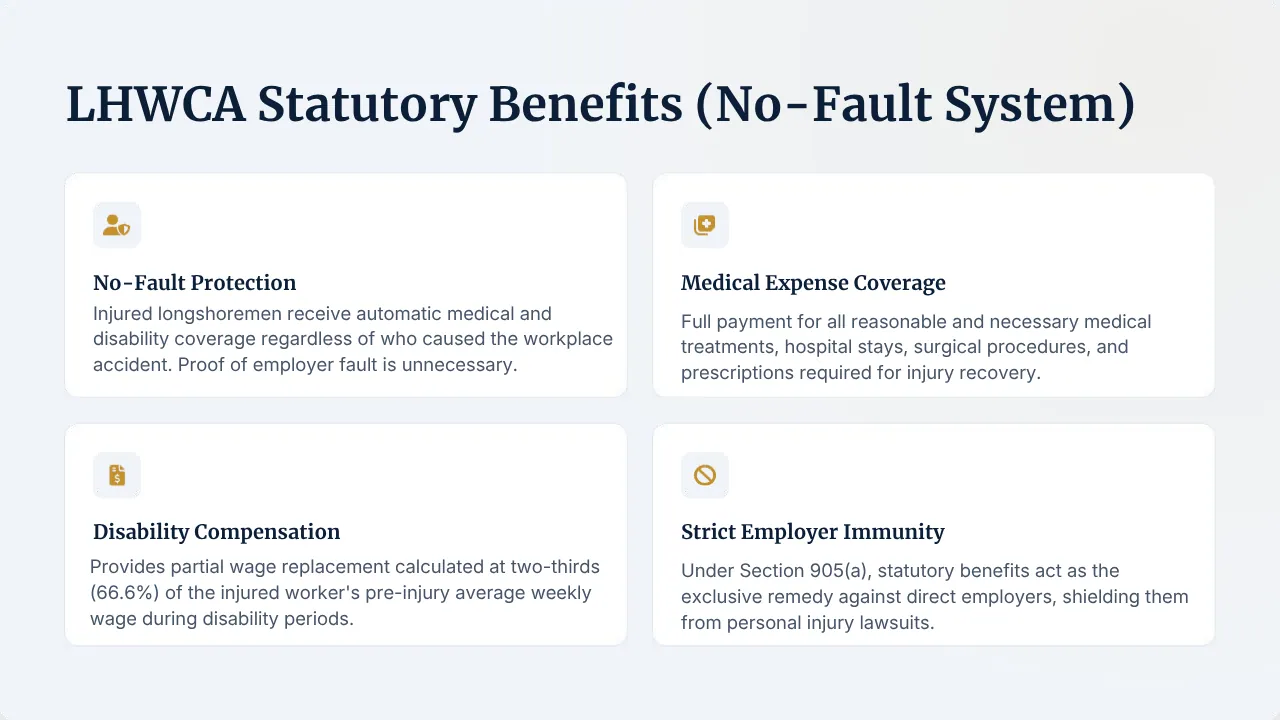
LHWCA Statutory Benefits (No-Fault Compensation)
The LHWCA serves as a specialized workers’ compensation system for longshoremen, ship repairers, shipbuilders, and harbor construction workers. Key aspects include:
- No-Fault Protection: You do not need to prove your employer was at fault to receive benefits.
- Medical Expense Coverage: Full payment for necessary medical treatment related to the workplace injury.
- Disability Compensation: Partial wage replacement, typically calculated at two-thirds of your average weekly wage.
- Strict Remedy Limitations: Under Section 905(a) of the LHWCA, you cannot file a personal injury lawsuit against your direct employer.
Section 905(b) Third-Party Recovery (Fault-Based Tort Claims)
While Section 905(a) shields direct employers from lawsuits, Section 905(b) creates an explicit exception when a third party, specifically a vessel owner, is at fault for your injury. Third-party claims allow injured longshoremen to pursue:
- Full Lost Earnings: 100% replacement of past and future lost wages, including lost overtime and benefits.
- Pain and Suffering: Compensation for physical pain, mental anguish, and reduced quality of life.
- Loss of Future Earning Capacity: Recovery for permanent disability that limits your ability to work in the maritime industry.
When Can a Longshore Worker Sue a Vessel Owner Under Section 905(b)?
To successfully hold a vessel owner liable under Section 905(b), an injured maritime worker must prove that the vessel owner breached one of the specific legal duties owed to land-based harbor personnel. These legal standards were established by the U.S. Supreme Court in the landmark case Scindia Steam Navigation Co. v. De Los Santos (1981).
“The vessel owes to the stevedore and his longshoremen employees the duty to exercise ordinary care under the circumstances to have the ship and its equipment in such condition that an expert and experienced stevedore will be able by the exercise of reasonable care to carry on its cargo operations with reasonable safety.”
Under the Scindia standard, vessel owners owe longshore workers three primary duties:
1. The Turn-Over Duty
Before turning the vessel over to the stevedoring company or repair crew, the vessel owner must ensure the ship and its equipment are in a reasonably safe condition. The owner must also warn workers of hidden hazards that are known (or should be known) to the crew and are not obvious to an experienced longshoreman.
2. The Active Control Duty
If the vessel’s crew retains active control over any portion of the ship, equipment, or working area during cargo or repair operations, the owner has a duty to exercise reasonable care to prevent injuries in those specific areas.
3. The Duty to Intervene
Generally, vessel owners are not required to constantly supervise independent stevedoring operations. However, if the ship owner or crew becomes aware that a dangerous condition exists and knows that the stevedore is failing to protect the workers from that danger, the vessel owner has an affirmative legal duty to step in and correct the hazard.
 Common Hazards Leading to 905(b) Vessel Owner Liability
 Common Hazards Leading to 905(b) Vessel Owner Liability
Longshore work and harbor operations are inherently dangerous, but vessel negligence drastically increases the risk of catastrophic injury. Section 905(b) claims often arise from conditions such as:
- Defective Ship Equipment: Unsafe winches, broken cranes, faulty gangways, or defective hatches supplied by the vessel.
- Slippery and Unsafe Decks: Oil leaks, grease buildup, or unaddressed ice accumulation on ship decks and transit walkways.
- Unsafe Cargo Stowage: Poorly secured or improperly stowed cargo loaded at a previous port that collapses during discharge.
- Inadequate Lighting: Poorly lit cargo holds or dark working spaces that obscure dangerous drop-offs and hazards.
- Vessel Crew Negligence: Careless operation of ship-board equipment by the vessel’s crew while longshoremen are on board.
BoatLaw, LLP: Decades of Proven Success in Maritime Injury Claims
Establishing vessel owner negligence under federal maritime law requires aggressive investigation and deep knowledge of port operations. At BoatLaw, LLP, our maritime attorneys have represented longshoremen, dockworkers, and shipyard personnel across the West Coast and nationwide for almost 50 years.
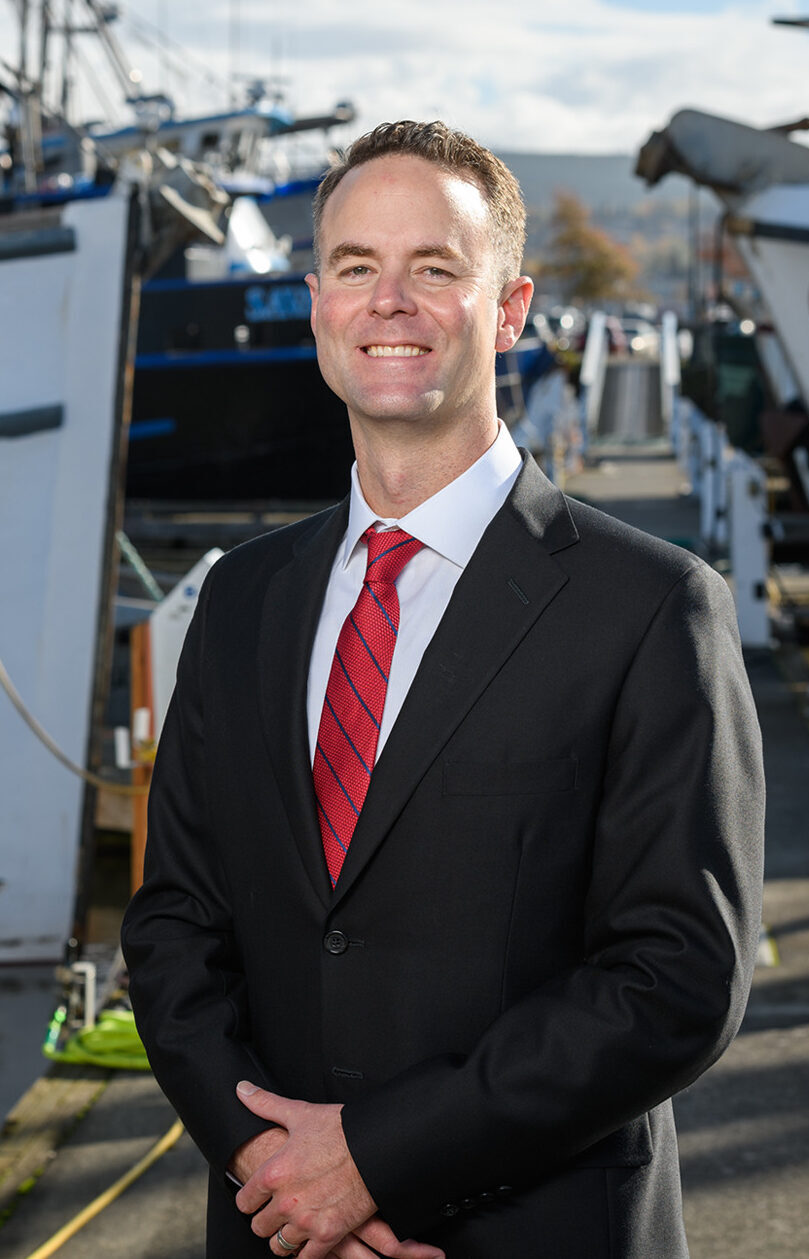
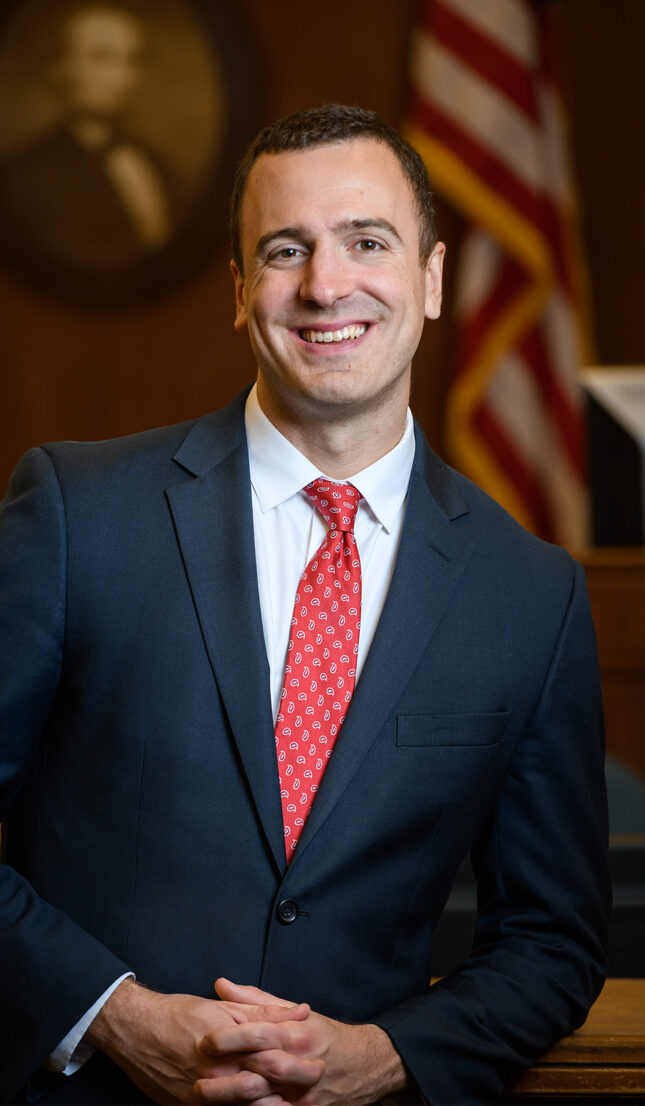
Founded in 1977, our firm brings decades of hands-on maritime experience to every case. Attorneys Doug Williams and Nick Neidzwski share a lifelong connection to the water and an unyielding commitment to fighting for injured workers against powerful shipping lines and international vessel owners.
We handle every maritime injury case on a contingency-fee basis. That means you pay zero upfront costs and no legal fees unless we win your case and recover compensation for you. Our legal team aggressively investigates vessel logs, inspects ship equipment, and holds negligent vessel owners accountable in courts across Washington, Oregon, Alaska, California, and Florida.
Frequently Asked Questions About Section 905(b) Maritime Claims
Can I collect LHWCA benefits and file a 905(b) lawsuit at the same time?
Yes. You can receive no-fault LHWCA medical and wage benefits from your employer while simultaneously pursuing a third-party Section 905(b) lawsuit against the vessel owner. If your 905(b) suit is successful, the LHWCA insurance carrier may hold a lien to recover statutory benefits paid out, but the remaining settlement or trial award belongs to you.
How long do I have to file a Section 905(b) lawsuit?
The statute of limitations for maritime personal injury claims, including Section 905(b) actions against a vessel owner, is generally three years from the date of the injury under federal maritime law (46 U.S.C. § 30106). Missing this legal deadline will forfeit your right to sue.
What if I was partially at fault for my injury on the vessel?
Federal maritime law applies the rule of comparative fault. If you were partially at fault for the accident, your compensation will be reduced by your percentage of responsibility. You are not barred from recovering damages simply because you made an error.
Maritime Safety Statistic: According to the U.S. Bureau of Labor Statistics, the marine cargo handling industry consistently experiences injury rates significantly higher than the national private industry average, recording an incidence rate of 4.2 nonfatal injuries and illnesses per 100 full-time workers in recent reporting years.
(Source: U.S. Bureau of Labor Statistics)
Call 1-800-BOATLAW today for a free review of your case. If our attorneys determine that BoatLaw may be able to assist you, a member of our legal team will reach out shortly to schedule a free, no-obligation consultation with an experienced maritime attorney.
Legal Disclaimer
The information provided is for educational and informational purposes only. The information on this website is not intended as legal advice and should not be used as a substitute for consulting a licensed attorney. Legal outcomes and laws can vary by jurisdiction, and only a qualified lawyer can provide guidance tailored to your situation.

Douglas R. Williams was raised in a military family. After retiring from the armed forces, his father sailed as the chief medical officer with many of the most popular cruise lines, including Holland America Line, Carnival Cruise Line, Disney Cruise Line, and Norwegian Cruise Line. When not in school, Doug spent a good part of his youth in the crew quarters sailing with his father on cruise ships. He developed a practical knowledge of the maritime industry from a young age. Learn More here.