

For millions of travelers, a cruise represents the ultimate escape: a floating resort designed for relaxation, exploration, and stress-free adventure. However, when negligence turns a dream vacation into a tragedy, injured passengers and grieving families are suddenly thrust into a highly specialized, confusing legal landscape. Filing a claim against a major cruise line is nothing like a standard land-based personal injury lawsuit. It requires navigating complex maritime treaties, restrictive passenger ticket contracts, and federal admiralty laws that have been shaped over centuries.
If you or a loved one has suffered an accident or a fatal event at sea, securing an experienced cruise ship injury attorney is the critical first step toward protecting your rights. At BoatLaw, LLP, our legal team has spent nearly 50 years championing the rights of the injured across the Pacific Northwest, California, Alaska, and nationwide. We understand how these massive corporations operate and what the law allows when passengers are harmed on the water.
What is a Cruise Ship Injury Claim?
“Unlike traditional personal injury cases, cruise ship claims involve international treaties, specialized maritime codes, and strict, highly unusual filing deadlines.”
A cruise ship injury claim is a civil action brought by an injured passenger or their estate against a cruise line. These claims arise from accidents caused by the vessel operator’s failure to exercise reasonable care under the circumstances. Crucially, these cases are governed by federal maritime law rather than the state laws where you live or where you boarded the ship. Because the injury occurs on navigable waters, maritime law dictates everything from the standard of care to where your lawsuit must be filed.
The Cruise Ticket Contract: The Shipowner’s Shield
When you purchase a cruise ticket, you are not just buying passage; you are legally signing a binding contract. Tucked deep within the fine print of these passenger agreements are restrictive clauses designed to limit the cruise line’s liability and discourage lawsuits. These contracts almost always contain three critical provisions:
1. Shortened Time Limits
While standard state personal injury claims often carry a two to four-year statute of limitations, federal maritime law permits cruise lines to contractually shorten your filing window. In almost every major passenger contract (including Carnival, Royal Caribbean, Norwegian, and Disney), you must provide the cruise line with a formal written notice of your claim within six months of the accident and file your formal lawsuit within one year. Waiting even a day past these strict deadlines will bar your recovery forever.
2. Forum Selection Clauses
You cannot simply sue a cruise line in your home county or state court. Ticket contracts include “forum selection clauses” that mandate where all lawsuits must be filed. For example, even if you are a Washington resident who boarded a ship in Seattle, if the contract designates the U.S. District Court for the Southern District of Florida in Miami as the exclusive forum, your cruise ship injury attorney must file the case in Miami.
3. Choice of Law Provisions
These clauses determine which legal framework will govern the dispute. In almost all passenger cases involving U.S.-based cruise lines, federal general maritime law applies.
Passenger Accidents and Common Maritime Injuries
A cruise ship is effectively a “moving city,” presenting unique hazards that do not exist on land. When shipowners or crew members fail to maintain safe conditions, catastrophic injuries can occur. Our firm represents individuals who have suffered severe harm due to a wide range of onboard and offshore hazards, including:
- Slips, Trips, and Falls: Wet decks, un-mopped spills in dining areas, poorly lit stairwells, and lack of handrails can lead to severe fractures, traumatic brain injuries, and spinal trauma.
- Offboard Excursion Accidents: Cruise lines regularly promote shore excursions. If a passenger is injured during a third-party excursion that the cruise line vetted, marketed, or operated, the cruise line can sometimes be held responsible under theories of negligent selection or joint venture.
- Medical Malpractice: Shipboard medical centers are often understaffed or equipped with inadequate medical resources. When ship doctors or nurses provide substandard care or fail to timely evacuate a passenger experiencing a critical emergency, the consequences can be fatal.
- Assaults and Physical Harm: Cruise lines have a strict duty to protect passengers from foreseeable physical harm. This includes protecting guests from physical or sexual assaults committed by crew members or other passengers due to inadequate security or negligent hiring.
Understanding Cruise Ship Wrongful Death Law
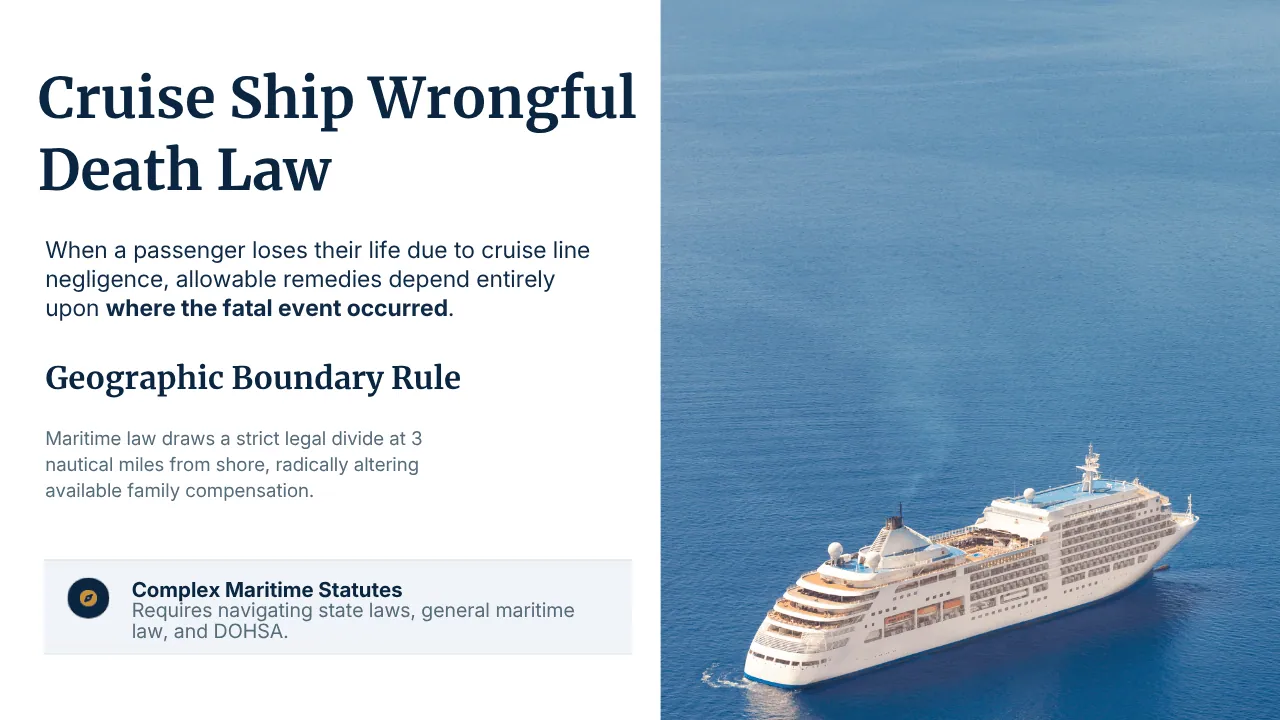
When a passenger loses their life due to a cruise line’s negligence, the legal remedies available to the surviving family depend heavily on exactly where the fatal event occurred. This is one of the most complex areas of maritime law, requiring the counsel of a skilled cruise ship wrongful death lawyer to navigate properly.
Fatalities Within Territorial Waters
If a fatal accident occurs within state territorial waters (typically within three nautical miles of the shore), general maritime law governs the claim. Under this framework, the deceased’s personal representative can bring a wrongful death action. In certain cases, state wrongful death statutes may supplement general maritime law to allow for the recovery of non-economic damages, such as loss of companionship and emotional distress, provided the incident did not involve commercial vessel navigation.
The Death on the High Seas Act (DOHSA)
If the death occurs on the “high seas”—defined as more than three nautical miles from the shores of the United States—the claim is strictly governed by the Death on the High Seas Act (DOHSA). DOHSA is a highly restrictive federal statute. It preempts state law and limits recovery exclusively to pecuniary (financial) losses.
Under DOHSA, surviving family members can recover:
- Loss of financial support and household services
- Loss of parental care, nurture, and guidance
- Pre-death medical bills and reasonable funeral expenses
Crucially, DOHSA does not allow families to recover non-economic damages, such as mental anguish, grief, or loss of consortium. Because of these tight restrictions, working with an aggressive cruise ship wrongful death lawyer is essential to meticulously document and maximize every allowable financial loss.
Why You Need a Dedicated Maritime Law Firm
General personal injury lawyers who primarily handle car accidents are rarely equipped to battle multi-billion-dollar cruise lines in federal court. Cruise lines employ formidable, highly experienced legal defense teams specifically trained to exploit maritime loopholes and dismiss passenger claims on technicalities.
At BoatLaw LLP, maritime law is not just a branch of our practice — it has been our sole focus since 1977. Led by veteran maritime attorneys Douglas Williams and Nick Neidzwski, our firm brings almost 50 years of trial-tested experience and a lifelong love of the sea to every case. We understand how to fight back against unfair ticket contract clauses, conduct rigorous investigations, and present compelling evidence in federal courts across Washington, Oregon, California, Alaska, and Florida.
We work entirely on a contingency-fee basis. This means there are absolutely no upfront, out-of-pocket costs for you. We only get paid if we successfully secure compensation for you or your family, ensuring that financial distress never stands in the way of justice.
If you or a loved one was injured on a cruise ship, do not let the clock run out on your rights. Call 1-800-BOATLAW today for a free review of your case. If our attorneys determine that BoatLaw may be able to assist you, a member of our legal team will reach out shortly to schedule a free, no-obligation consultation with an experienced maritime attorney.

Nicholas J. Neidzwski is a trial attorney who handles maritime and personal injury litigation. Appearing for plaintiffs in state and federal courts throughout Washington, California, Oregon, Alaska, and other jurisdictions. Nick’s litigation experience includes the successful resolution of various Jones Act, general maritime, and product liability cases on behalf of many different individuals. Nick was named a Rising Star by Super Lawyers every year from 2016 through 2025, and was named a Super Lawyer in 2026. Learn more here.