

The maritime industry is a global enterprise, powered by hardworking men and women from every corner of the world. A common and dangerous misconception, however, is that the powerful legal protections afforded to injured seamen under United States law are reserved exclusively for American citizens. This is not the case. Many foreign maritime workers who suffer career-ending injuries find they have a right to seek justice in U.S. courts.
This article will demystify the complex legal questions surrounding the rights of foreign seamen, explaining when and how U.S. law, particularly the Jones Act, can apply to their personal injury claims. Understanding these rights is the critical first step toward securing the compensation you deserve.
Do Foreign Seamen Qualify for Jones Act Status?
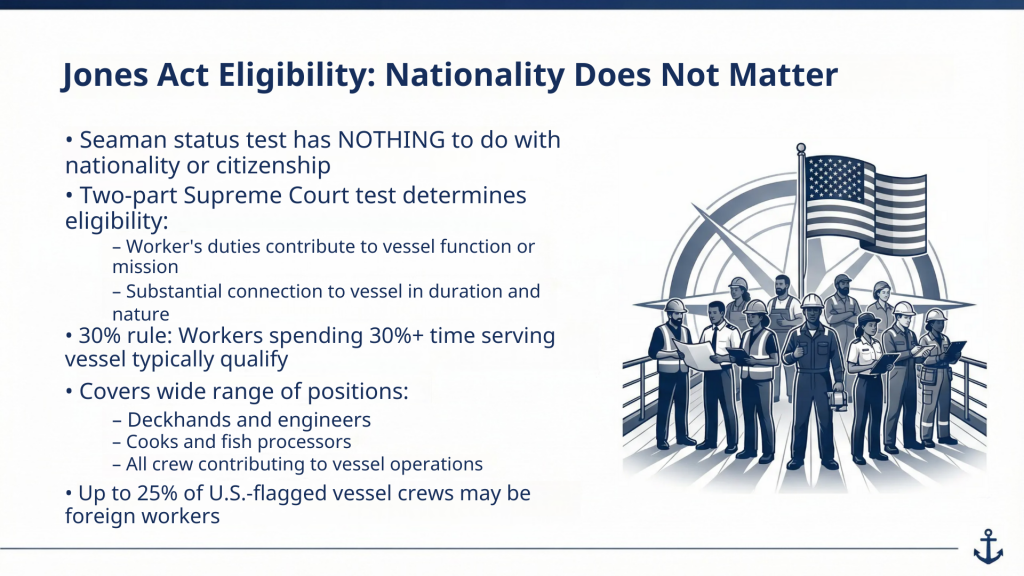
The first question in any maritime injury case is whether the worker qualifies as a “seaman.” This determination is the gateway to the protections of the Jones Act. Crucially, the test for seaman status has nothing to do with nationality.
“Noticeably absent in the test for Jones Act seaman status is [a requirement of] U.S citizenship or residency…”
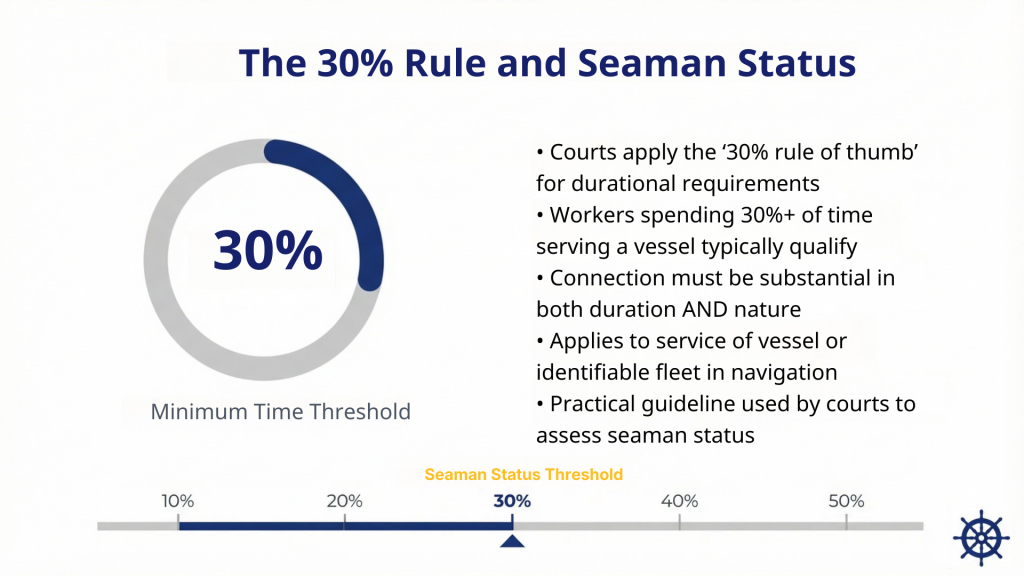
To qualify as a Jones Act seaman, an employee must satisfy a two-part test established by the U.S. Supreme Court. First, the employee’s duties must contribute to the function of the vessel or to the accomplishment of its mission. Second, the employee must have a connection to a vessel (or an identifiable fleet of vessels) in navigation that is substantial in both its duration and its nature. Courts often use a “rule of thumb” that a worker who spends at least 30% of their time in the service of a vessel meets the durational requirement.
This test covers a wide range of workers, from deckhands and engineers to cooks and fish processors. If you meet this legal standard, you are a Jones Act seaman under U.S. law, regardless of the country listed on your passport.
The Critical Choice-of-Law Analysis for Foreign Seamen
Even if a foreign worker qualifies as a seaman, a second, more complex legal battle often follows: determining which country’s laws apply to the injury claim. This “choice-of-law” analysis is frequently the most heavily contested issue in cases involving foreign seamen.
“…foreign seamen injured in U.S ports or injured aboard U.S vessels are too often dissuaded from pursuing civil actions in the United States…”
Shipowners and their insurance companies often try to have cases dismissed from U.S. courts, arguing that the laws of another country, which may offer far fewer protections and less compensation to injured workers, should apply to injured workers’ claims. However, a series of landmark Supreme Court cases has established a framework for courts to use when forced to decide this issue, ensuring that foreign companies with substantial ties to the United States cannot easily escape their legal responsibilities to their employees who lack U.S. citizenship.
Key Factors Courts Consider: The Lauritzen-Rhoditis Test
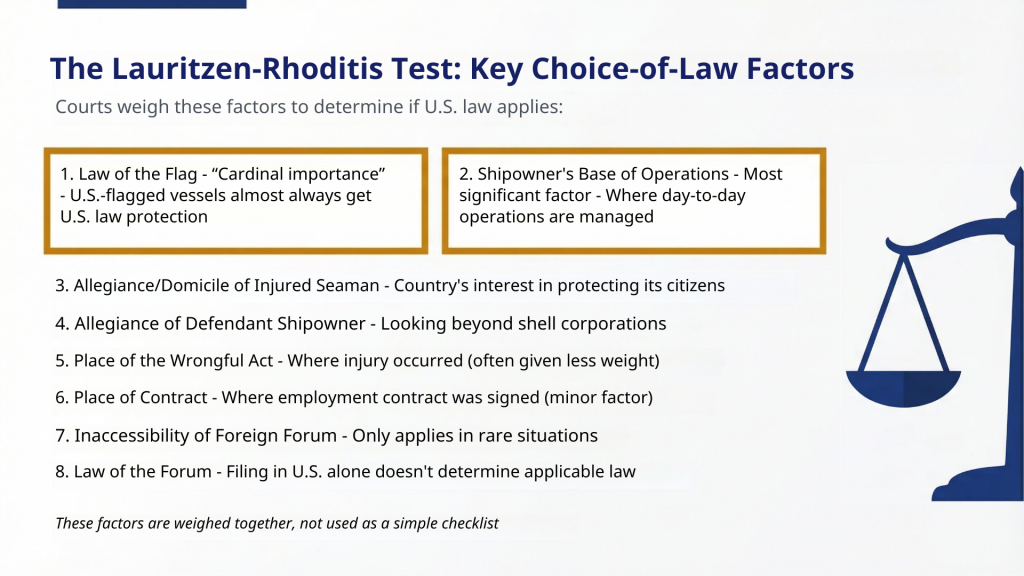
In the seminal case of Lauritzen v. Larsen, 345 U.S. 571 (1953), the Supreme Court outlined seven factors to guide the choice-of-law decision. An eighth, and often decisive, factor was added in Hellenic Lines, Ltd. v. Rhoditis, 398 U.S. 306 (1970). These factors are not a simple checklist; they are evaluated holistically by the court to determine if the United States has a sufficient interest in the claim to justify the application of U.S. law. The Rhoditis Court, discussing Lauritzen, wrote that “The Lauritzen test, however, is not a mechanical one. We indicated that the flag that a ship flies may, at times, alone be sufficient… Moreover, the list of seven factors in Lauritzen was not intended as exhaustive… the shipowner’s base of operations is another factor of importance in determining whether the Jones Act is applicable; and there well may be others.“
“The application of U.S law to a foreign seaman’s case often hinges on the flag of the vessel and the defendant’s base of operations…”
The key factors include:
- The Law of the Flag: The nationality of the vessel, determined by the flag it flies, is considered “of cardinal importance” in determining whether a seaman injured aboard a given vessel will be covered by the Jones Act. A seaman injured on a U.S.-flagged vessel is almost always entitled to Jones Act protections, regardless of where the injury occurred or the seaman’s nationality.
- The Shipowner’s Base of Operations: This factor, added in Rhoditis, has become one of the most significant considerations for U.S. courts tasked with deciding whether to apply U.S. law to a given case. If a shipowner, even a foreign corporation, manages its day-to-day operations from the United States, U.S. courts may determine that U.S. law is applicable to lawsuits involving that shipowner. The Rhoditis Court summed up its analysis as follows: “[The shipowner’s] base of operations is New York. The [subject vessel] was not a casual visitor; rather, it and many of its sister ships were earning income from cargo originating or terminating here. We see no reason whatsoever to give the Jones Act a strained construction so that this alien owner, engaged in an extensive business operation in this country, may have an advantage over citizens engaged in the same business by allowing him to escape the obligations and responsibility of a Jones Act ’employer.’ The flag, the nationality of the seaman, the fact that his employment contract was Greek, and that he might be compensated there are in the totality of the circumstances of this case minor weights in the scales compared with the substantial and continuing contacts that this alien owner has with this country.” This analysis clearly demonstrates that even a significant factor like the flag a vessel flies is still only one factor of many, and courts may give more consideration to other factors, such as the shipowner’s base of operations.
- The Allegiance or Domicile of the Injured Seaman: Generally speaking, countries have an interest in protecting their own citizens, so courts will consider this factor.
- The Allegiance of the Defendant Shipowner: Courts will look beyond “shell corporations” to determine the true nationality and control of the vessel’s owner.
- The Place of the Wrongful Act: Where an injury occurred is often given less weight than other factors considered by courts. Even if an injury occurs in U.S. waters, this fact alone is not sufficient to apply U.S. law to the encompassing incident.
- The Place of Contract: The location of the actual contract signing is generally not considered by courts. This was justified by the Lauritzen Court as follows: “The place of contracting in this instance, as is usual to such contracts, was fortuitous. A seaman takes his employment, like his fun, where he finds it; a ship takes on crew in any port where it needs them. The practical effect of making the lex loci contractus [Latin legal principle meaning “the law of the place where the contract is made”] govern all tort claims during the service would be to subject a ship to a multitude of systems of law, to put some of the crew in a more advantageous position than others, and not unlikely in the long run to diminish hirings in ports of countries that take best care of their seamen.” The Lauritzen Court ultimately concluded that place of contract is largely irrelevant to an analysis of whether U.S. law should govern: “We do not think the place of contract is a substantial influence in the choice between competing laws to govern a maritime tort.”
- The Inaccessibility of a Foreign Forum: The theory behind this factor is that a foreign country’s judicial system may be so corrupt or unstable that a seaman would be deprived of any meaningful remedy if forced to bring their claims in that country. In Lauritzen, the Court found that this factor did not weigh in favor of applying U.S. law because the seaman in question was from Denmark: “Confining ourselves to the case in hand, we do not find this seaman disadvantaged in obtaining his remedy under Danish law from being in New York instead of Denmark. The Danish compensation system does not necessitate delayed, prolonged, expensive and uncertain litigation.” This analysis implies that U.S. courts might consider foreign forums “inaccessible” to the extent that they may “necessitate delayed, prolonged, expensive and uncertain litigation”.
- The Law of the Forum: The fact that a lawsuit was filed in the U.S. is not, by itself, a reason to apply U.S. law to the facts giving rise to the lawsuit.
The “Base of Operations” Doctrine: Looking Beyond the Flag
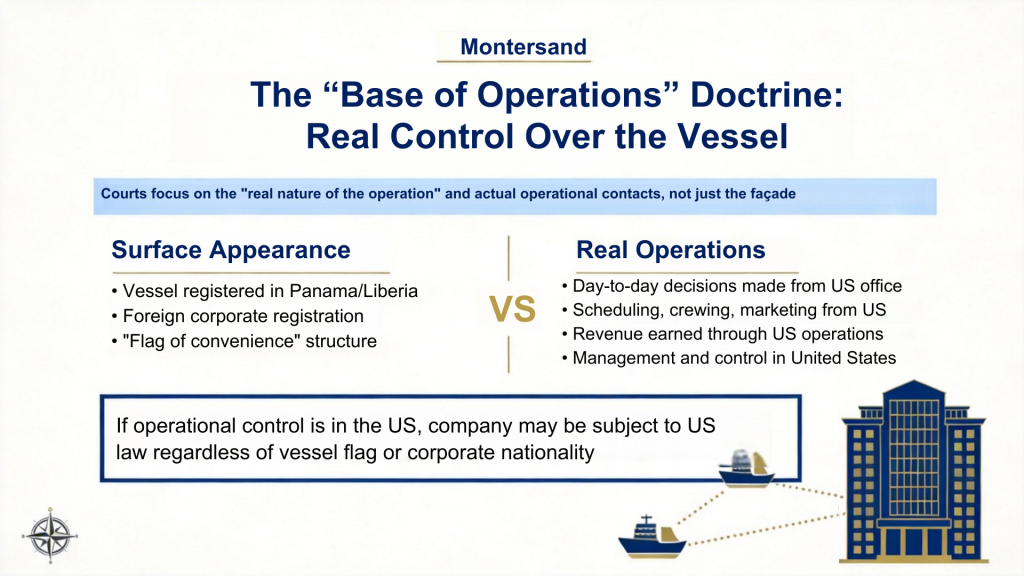
Modern shipping companies often use complex corporate structures, registering their vessels in countries like Panama or Liberia to take advantage of lower taxes and lax regulations. These are known as “flags of convenience.” Recognizing this reality, U.S. courts have increasingly focused on where the company’s real power and control lies.
“…sometimes a vessel owner based in the United States will have its vessels flagged from different countries courts however will focus typically on the base of the defendant’s operation and if it is in the United States there is a very good chance that a court will apply U.S law…”
The U.S. Supreme Court in Rhoditis made it clear that the “façade of the operation must be considered as minor, compared with the real nature of the operation and a cold objective look at the actual operational contacts that this ship and this owner have with the United States.” Rhoditis involved a Greek seaman who was injured on a Greek-flagged vessel, but because the vessel’s owner had its base of operations in New York, the Court applied the Jones Act.
This principle is powerful. If a company’s day-to-day decisions—scheduling, crewing, marketing, and earning revenue—are conducted from an office in the U.S., the company may be subject to U.S. law, regardless of its corporate nationality or the vessel’s flag. As the Supreme Court noted in Rhoditis, an alien shipowner engaged in extensive business in the U.S. should not have an advantage over American companies by being allowed to escape its obligations and responsibilities as a Jones Act employer.
Common Defense Tactics: Forum Non Conveniens and Forum-Selection Clauses
When a foreign seaman files a valid claim in a U.S. court, the defendant’s primary strategy is often to have the case moved to a different jurisdiction or dismissed. They typically use two powerful legal tools to achieve this.
“A vessel owner will sometimes bring a motion called a forum non conveniens motion or a motion on forum non conveniens grounds seeking to dismiss a lawsuit filed in the United States on behalf of a foreign seaman arguing that there is another venue or that the United States would be very burdensome for the defendant…”
1. Forum Non Conveniens
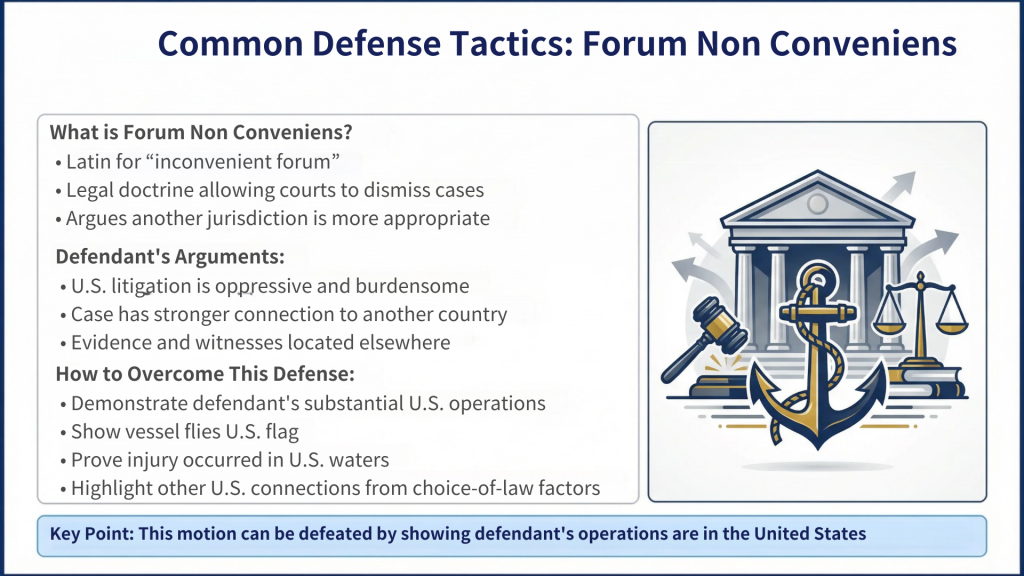
Forum non conveniens (Latin for “inconvenient forum”) is a legal doctrine that allows a court to dismiss a case if it believes another court or jurisdiction is a more appropriate and convenient venue for the litigation. A defendant bringing a motion to dismiss on forum non conveniens grounds will likely argue that litigating in the U.S. is oppressive and that the case has a stronger connection to another country.
To decide this motion, courts weigh a series of “private interest” factors (e.g., access to evidence and witnesses) and “public interest” factors (e.g., court congestion, the local interest in the dispute). However, this defense can be overcome.
“…these motions can be defeated by showing that the defendant’s operations are in the United States and they could also be defeated by other arguments such as the flag of the vessel or the place of the injury.”
If an experienced maritime attorney can demonstrate that the shipowner has a substantial base of operations in the U.S., or that other factors from the choice-of-law test weigh heavily in favor of applying U.S. law, a court will often deny the defendant’s motion and refuse to dismiss the case.
2. Forum-Selection Clauses
A more modern and increasingly common defense involves forum-selection clauses. These are provisions buried in a seaman’s employment contract that require any legal dispute to be filed in a specific, pre-selected country (e.g., the Philippines, Cyprus, or England). Unlike forum non conveniens, which is a discretionary doctrine, these clauses are contractual and are presumptively valid in maritime cases.
Federal maritime policy strongly favors the enforcement of these clauses, even if they conflict with state laws designed to protect employees. A seaman seeking to overcome such a clause must make a “strong showing” that it is unreasonable because:
- It was the product of fraud or overreaching
- Enforcement would, for all practical purposes, deprive the seaman of their day in court
- The chosen law in the foreign forum is fundamentally unfair and would deprive the plaintiff of an appropriate remedy
- Enforcement would contravene a strong public policy
Challenging these clauses is difficult, but not impossible. An attorney must meticulously analyze the facts of the case and the contract itself to determine if one of these narrow exceptions applies.
Why Pursuing a Claim in the U.S. Matters
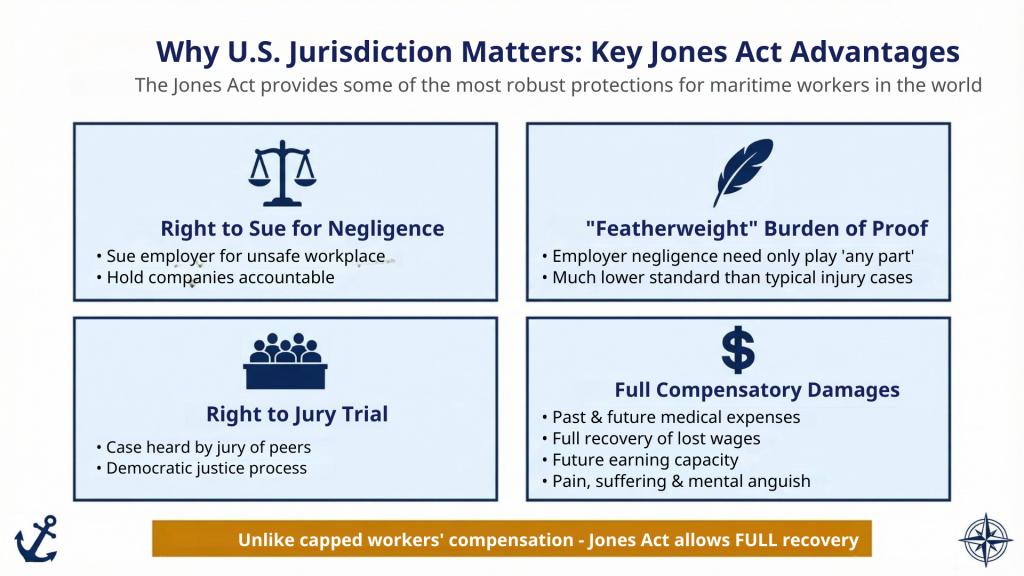
The reason shipowners fight so hard to avoid facing litigation in U.S. courts is simple: the Jones Act provides some of the most robust protections for maritime workers anywhere in the world. Maritime workers’ rights under the Jones Act are often far superior to those of their foreign counterparts, as well as to the rights of U.S. land-based workers covered under standard worker’s compensation systems.
Key advantages the Jones Act confers on covered workers include:
- The Right to Sue for Negligence: You can sue your employer for failing to provide a reasonably safe place to work.
- A “Featherweight” Burden of Proof: You only need to prove that your employer’s negligence played any part, even the slightest, in causing your injury. This is a much lower standard than in typical personal injury cases.
- The Right to a Jury Trial: You have the right to have your case heard by a jury of your peers.
- Full Compensatory Damages: Unlike capped workers’ compensation benefits, a Jones Act claim allows you to recover a full range of damages, including past and future medical expenses, full recovery of lost wages and future earning capacity, and compensation for pain, suffering, and mental anguish.
Injured at Sea? Know Your Rights.
The laws governing maritime injuries are complex, especially for foreign seamen. Don’t let an employer or insurance company tell you that you have no rights. You may be entitled to significant compensation under U.S. law. Schedule a Free Consultation now.
What to Do If You Are a Foreign Seaman Injured at Sea
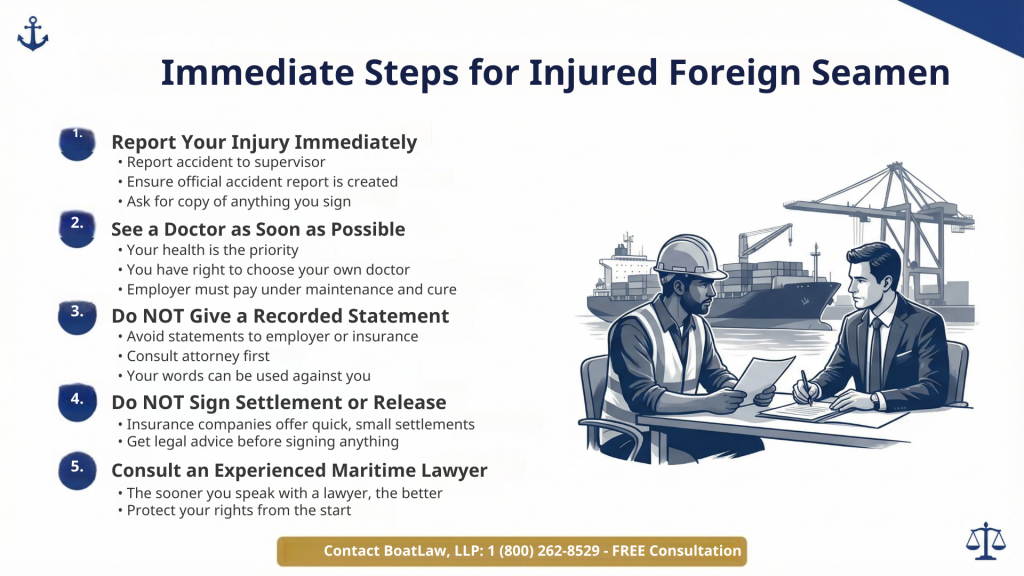
The moments after an injury are chaotic and stressful. The actions you take can have a significant impact on your health and your ability to bring a legal claim. If you are injured, remember these critical steps:
- Report Your Injury Immediately. Report the accident to your supervisor and ensure an official accident report is created. Ask for a copy of anything you sign.
- See a Doctor as Soon as Possible. Your health is the priority. Under maritime law, you have the right to choose your own doctor, and your employer is obligated to pay for your medical care under the doctrine of maintenance and cure.
- Do NOT Give a Recorded Statement. Do not give a statement to your employer or their insurance company without first consulting an attorney. They are not on your side, and your words can be used against you.
- Do NOT Sign a Settlement or Release. Insurance companies will try to offer a quick, small settlement to make your claim go away. Do not sign anything without legal advice.
- Consult an Experienced Maritime Lawyer. The sooner you speak with a dedicated maritime lawyer, the more effectively you can protect your rights.
Need Legal Help After an Offshore Injury?
Nicholas J. Neidzwski is a partner and accomplished trial attorney at BoatLaw, LLP, where he dedicates his practice to handling all types of maritime and personal injury litigation. He has successfully resolved numerous Jones Act, general maritime law, and product liability cases on behalf of injured individuals and their families. Nick has established a reputation as a dedicated and persuasive advocate, appearing for plaintiffs in state and federal courts throughout Washington, California, Oregon, and Alaska. He has been recognized as a “Rising Star” by SuperLawyers every year from 2016-2025 and is committed to fighting for justice for members of the maritime community.
“I am very pleased that I chose the right law firm that will stand up for me with integrity and respect. My heartfelt appreciation to Nick Neidzwski my lead lawyer… Not only their expertise and extensive knowledge, but they also have a client-focused philosophy.” – Jonathan Cabading, former client
If you are a foreign seaman who has been injured at work, contact the experienced admiralty attorneys at BoatLaw, LLP today. Call 1 (800) 262-8529 for a FREE, no-obligation claim review to learn more about your legal options.
Do not settle for less than what your case is worth!
Legal Disclaimer: The information provided on this website is for informational purposes only and is not intended as legal advice. The outcome of any legal matter depends on the specific facts and laws that apply. Prior results do not guarantee a similar outcome. Contacting our firm does not create an attorney-client relationship. Please do not send any confidential information to us until such time as an attorney-client relationship has been established.

Douglas R. Williams was raised in a military family. After retiring from the armed forces, his father sailed as the chief medical officer with many of the most popular cruise lines, including Holland America Line, Carnival Cruise Line, Disney Cruise Line, and Norwegian Cruise Line. When not in school, Doug spent a good part of his youth in the crew quarters sailing with his father on cruise ships. He developed a practical knowledge of the maritime industry from a young age. Learn More here.