

What is Jones Act Negligence?
Jones Act Negligence is a legal standard that allows “seamen” to sue their employers for personal injury damages caused by the employer’s failure to provide a reasonably safe work environment. Unlike standard workers’ compensation, which is “no-fault,” a Jones Act claim requires proving that the employer’s negligence played a part—no matter how small—in causing the injury.
The Jones Act was passed by Congress in 1920 with a clear purpose: to recognize that maritime workers face unique, life-threatening hazards that merit special protection. It was designed to give deckhands, engineers, and fishermen an adequate recourse to address the dangers of their profession.
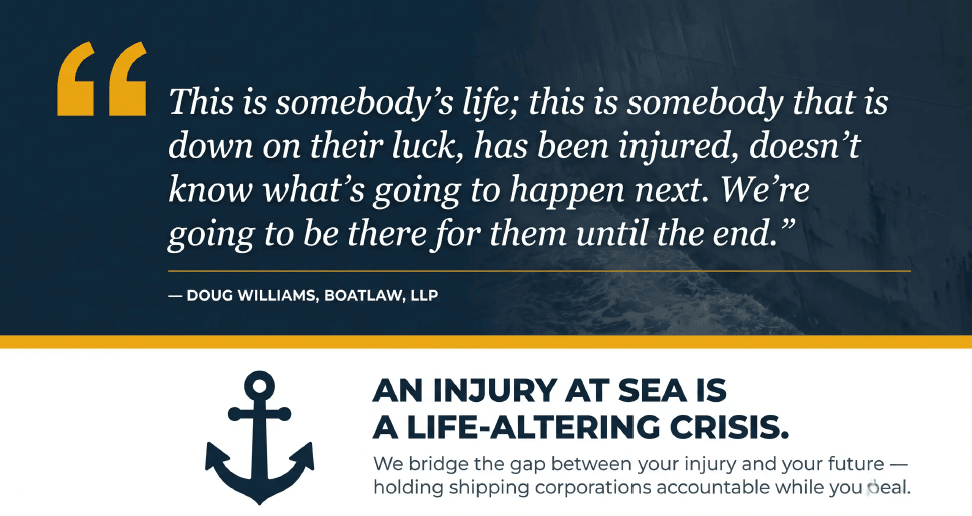
At BoatLaw, LLP, we understand that an injury at sea isn’t just a medical event; it’s a life-altering crisis. Many workers don’t know where their next paycheck is coming from or how they will support their families. Our mission is to bridge that gap, holding massive shipping corporations accountable while helping you start the next chapter of your life.
The Four Pillars of a Jones Act Negligence Claim
To establish a successful claim for a maritime injury, you must prove four specific legal elements. While the burden of proof is lower than in typical personal injury cases, the evidence must be meticulously gathered.
1. Duty
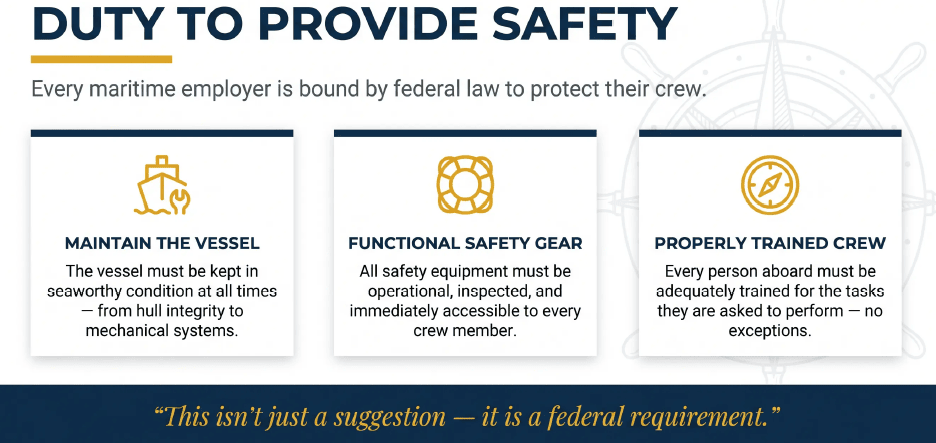
Every maritime employer has a fundamental legal duty to provide a reasonably safe place to work. This isn’t just a suggestion; it is a federal requirement. This duty includes maintaining the vessel, ensuring all safety equipment is functional, and providing a crew that is properly trained for the task at hand.
2. Breach
A breach occurs when the employer fails to meet that duty. Common examples of a breach include unsafe working conditions, failing to implement safe work methods, or providing defective equipment. Whether it is a slippery deck that should have been gritted or a winch that wasn’t properly inspected, any failure in safety constitutes a breach.
3. Causation
In a standard personal injury case, you often have to prove the defendant was the primary cause of the injury. However, under Jones Act negligence, the standard is “featherweight.” You only need to show that the employer’s breach caused your injury “in any degree, no matter how slight.”
4. Damages
Finally, you must show that the incident resulted in actual harm. This includes physical pain, financial loss, and emotional distress.
“This is somebody’s life; this is somebody that is down on their luck, has been injured, doesn’t know what’s going to happen next. We’re going to be there for them until the end.”
— Doug Williams, BoatLaw, LLP
Economic vs. Non-Economic Damages
When you are injured on a commercial fishing boat, barge, or tug, the damages you seek are generally split into two categories:
- Economic Damages: These include past and future medical expenses, as well as lost wages. If your injury prevents you from returning to the sea, we fight to ensure you are compensated for your lost earning capacity.
- Non-Economic Damages: This covers pain, suffering, and the “loss of enjoyment of life.” This looks at whether you can return to your job, help your family as you once did, or perform simple household tasks. It’s about the life you lived before the incident vs. the life you are forced to live now.
Maximum Medical Improvement and Your Recovery
One of the most critical milestones in your case is reaching Maximum Medical Improvement (MMI). This is the point where a doctor determines that your condition is as good as it is going to get. Once you reach this point, our team at BoatLaw, LLP helps you put together a comprehensive plan to get back on your feet and ensure your family remains fed and protected.
Remember, until you reach MMI, you are entitled to Maintenance and Cure—daily living stipends and medical coverage—regardless of who was at fault.
Why You Need a Fierce Advocate
Maritime law is a specialized field that requires more than just general legal knowledge; it requires a deep understanding of the maritime way of life. Our firm has been representing injured individuals and their families for over 45 years. With offices in Seattle, Bellingham, Portland, Los Angeles, and San Francisco, we have a dominant presence across the U.S. West Coast.
We operate on a contingency-fee basis. This means there are no upfront costs to you. We don’t get paid unless we win your case. If you or a loved one has been injured in Washington, Alaska, Oregon, or California, don’t face the shipping companies alone.
Contact a Jones Act Lawyer Today
Don’t let medical bills and lost wages sink your future. Contact the experienced maritime attorneys at BoatLaw, LLP for a free, confidential review of your case.
Call us at 1-800-262-8529 or fill out our Online Contact Form.

Douglas R. Williams was raised in a military family. After retiring from the armed forces, his father sailed as the chief medical officer with many of the most popular cruise lines, including Holland America Line, Carnival Cruise Line, Disney Cruise Line, and Norwegian Cruise Line. When not in school, Doug spent a good part of his youth in the crew quarters sailing with his father on cruise ships. He developed a practical knowledge of the maritime industry from a young age. Learn More here.