


When an injury occurs on the water, one of the first questions our legal team will ask is: where did it happen? We don’t ask this question only out of curiosity – in maritime law, where an incident takes place is critical to the determination of whether the injured party’s case will be governed by federal admiralty and maritime law or the laws of a particular state. The answer hinges on a legal concept known as navigable waters of the United States.
Understanding this definition is the gateway to accessing powerful federal protections, such as those provided by the Jones Act. As a maritime attorney, I’ve seen firsthand how this single determination can fundamentally shape the outcome of a case.
Defining Navigable Waters
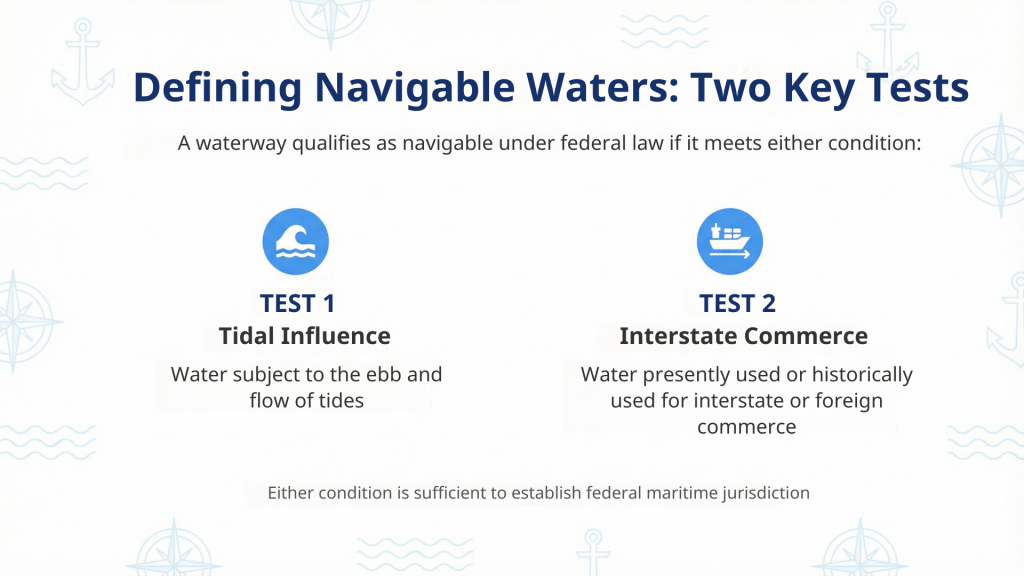
The legal test for what constitutes a navigable waterway may seem straightforward, but its application can be incredibly complex. Over time, U.S. courts have established an “either-or” standard for determining whether a given waterway qualifies as “navigable water”:
“A definition used by courts is water that is subject to the ebb and flow of tides or water that is presently used or historically used for interstate or foreign commerce.”
Let’s break this down. Under federal law, a body of water qualifies as “navigable” if it 1) is influenced by tidal patterns or 2) currently serves, or has served at any point in history, as a channel for commerce between states or between countries. This “either-or” test is the foundation of admiralty jurisdiction.
Obvious Examples of Navigable Waters
Major rivers that flow into oceans are classic examples of navigable waters. Their connection to the sea and role in commerce are undeniable.
“For example the Columbia river flows out into the Pacific Ocean it is navigable water it’s been used for commerce for many many years it’s subject to the ebb and flow of tides it is navigable water.”
Waterways like the Columbia River, the Mississippi River, and the coastal waters of the United States are unquestionably navigable waters. They are subject to tides and have been arteries of interstate and foreign commerce for centuries, making them subject to federal maritime laws.
Do Inland Lakes Count as “Navigable Waters”?
The analysis becomes more nuanced with inland bodies of water, such as lakes. The key test of whether a given lake qualifies as “navigable waters” is whether the lake facilitates interstate activity.
“Most lakes within a state that don’t span state lines are not governed by maritime law instead they’re governed by state law for example Lake Chelan in Washington is governed by Washington state law instead of maritime law because it doesn’t span state lines a lake however like Lake Tahoe which spans California and Nevada is navigable water because it spans state lines and is presently used and has historically been used for interstate commerce.”
This is a crucial distinction. An injury on Lake Chelan, which is located entirely within Washington State, would likely be governed by Washington’s personal injury laws. However, an identical incident on Lake Tahoe, which straddles the border of California and Nevada, would be subject to federal maritime law because the lake itself is an avenue for interstate commerce.
Why This Definition Matters for Your Injury Claim
The “navigable waters” determination is far from a mere academic exercise. It is the jurisdictional key that unlocks critical protections for injured maritime workers and others hurt on the water. If your injury occurred on navigable waters, you may be entitled to file claims under powerful federal statutes.
The most significant of these is the Jones Act. This federal law allows qualified “seamen” who are injured due to their employer’s negligence to sue for damages, including lost wages, medical expenses, and pain and suffering. To qualify for these protections, a worker’s duties must contribute to the mission of a vessel in navigation on navigable waters. You can learn more about your rights by reading our comprehensive Jones Act claims guide.
Other vital maritime doctrines, such as claims for unseaworthiness (arising from a vessel owner’s absolute duty to provide a safe vessel) and maintenance and cure (arising from a vessel owner’s obligation to provide a seaman injured in service of their vessel with money for room and board and to pay for the injured seaman’s medical bills until they reach “maximum medical improvement”), also depend on this jurisdictional foundation. The complexity of where maritime laws apply underscores the need for an attorney who specializes in this field.
Is Your Injury a Maritime Claim?
Determining whether an incident falls under federal admiralty jurisdiction is a complex legal analysis that requires deep knowledge of maritime law and precedent. An incorrect assessment can jeopardize your right to fair compensation.
If you or a loved one has been injured on any body of water, don’t make assumptions about which laws apply. The experienced attorneys at BoatLaw, LLP can evaluate the specifics of your situation, investigate the history of the body of water you or your loved one was injured on, and determine the best legal path forward. Contact our team today for a free, confidential consultation.
Call us 24/7 at 1-800-262-8529 or visit our admiralty law firm page to schedule your case review.

Nicholas J. Neidzwski is a trial attorney who handles maritime and personal injury litigation. Appearing for plaintiffs in state and federal courts throughout Washington, California, Oregon, Alaska, and other jurisdictions. Nick’s litigation experience includes the successful resolution of various Jones Act, general maritime, and product liability cases on behalf of many different individuals. Nick was named a Rising Star annually by Super Lawyers from 2016 through 2025, and was named a Super Lawyer in 2026. Learn more here.