

Suffering an injury aboard a commercial vessel is a jarring, chaotic experience. Out on the water, whether you are pulling pots in Alaska, handling lines on a Columbia River tug, or working the deck of a factory trawler in the Pacific Northwest, the line between a minor mishap and a career-ending injury is razor-thin.
An offer that arrives quickly is usually built on what the company knows and you don’t. Comparing it against the categories a Jones Act claim can cover costs nothing.
Knowing exactly what to do in the hours and days following an onboard accident can mean the difference between securing your future or getting cut loose by the shipping company with nothing.
Maritime workers operate in one of the most physically punishing and legally complex environments in the world. Unlike shoreside employees, commercial mariners are completely excluded from traditional state workers’ compensation systems. Instead, your rights are carved out of federal statutes: the Jones Act, general maritime law, the doctrine of unseaworthiness, and maintenance and cure.
These rights are incredibly powerful but they are only as strong as the steps you take immediately after you are hurt.
The 7 Critical Steps to Protect Your Rights and Your Family
Step 1: Report the Injury Immediately (And Fill Out an Accident Report)
No matter how minor the injury seems at first, report it to the Captain, Mate, or Chief Engineer before your shift ends. Demand to fill out a formal Shipboard Accident Report.
- The Trap: “Toughing it out” or waiting until you get to port to mention it plays right into the hands of corporate claims adjusters.
- The Reality: If it isn’t documented in the ship’s log or an official report within 24 to 48 hours, the company’s lawyers will later claim the injury happened shoreside, or that you are fabricating the timeline. Write down exactly what happened, what equipment failed, and what slick or unsafe condition caused the incident. Take a photo of the report on your phone before handing it over.
Step 2: Seek Immediate Medical Care Onboard
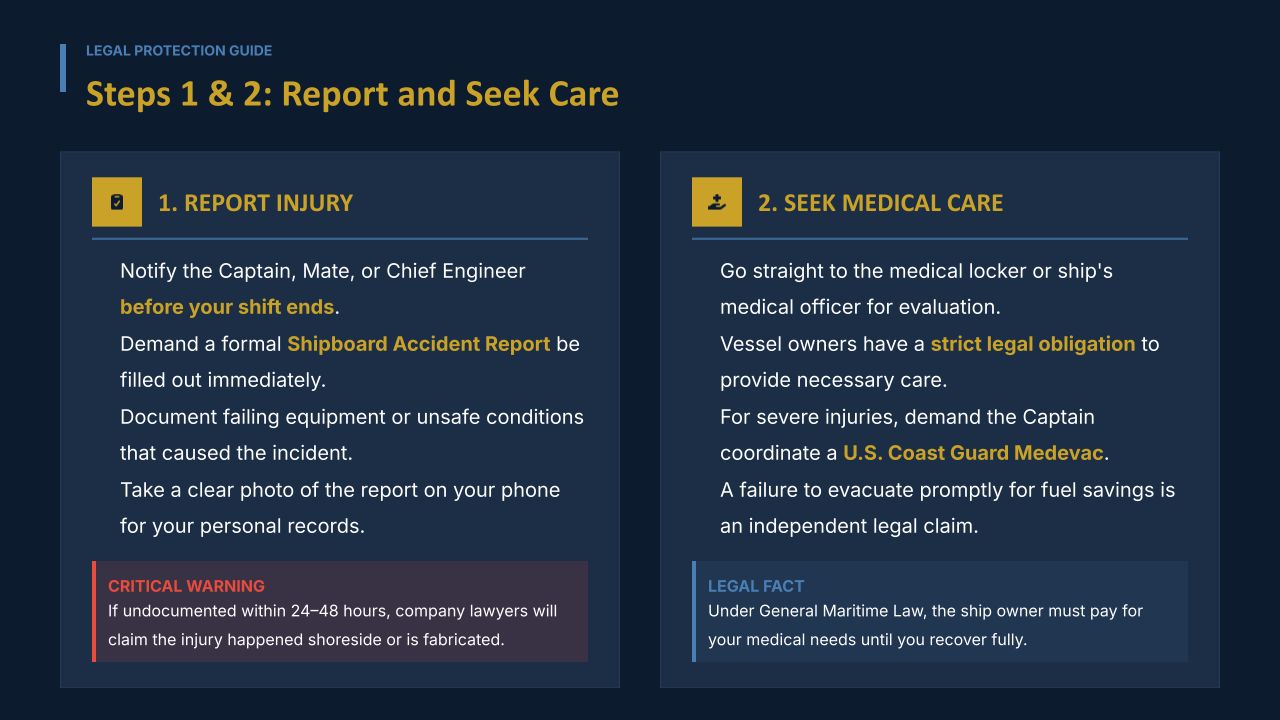
Go straight to the medical locker or ship’s medical officer. Under general maritime law, a vessel owner has a strict legal obligation to provide necessary medical care to crew members injured in the service of the vessel.
- For severe or life-threatening injuries, the Captain has a duty to alter course to the nearest port or coordinate a U.S. Coast Guard Medevac. If the officers delay your medical evacuation to save fuel or keep the vessel on schedule, that failure constitutes an independent legal claim against the owner.
Step 3: Choose Your Own Doctor on Shore
When the vessel hits port, the company will likely try to steer you to a “company doctor” or a clinic they contract with. You have the absolute legal right to choose your own independent treating physician.
- Why it matters: Company-hired doctors are frequently incentivized to minimize your restrictions, clear you for light duty prematurely, and rush you back to the boat to keep the company’s lost-time incident metrics low. See a doctor who answers to you, not the vessel’s insurance provider, to establish an honest, unbroken chain of medical documentation.
Step 4: Refuse to Give a Recorded Statement
Shortly after you get to shore, an insurance claims adjuster will call you. They will sound friendly, express sympathy, and ask to take a quick recorded statement “just to get your side of the story and process your checks.” Say no.
- The Reality: Recorded statements are designed to trap you. Adjusters use clever phrasing to get you to admit fault, downplay your pain, or agree that the vessel equipment was working fine. Under maritime law, you are required to report the accident to your employer, but you are under no legal obligation to provide a recorded statement to an insurance company. Tell them to speak with your attorney.
Step 5: Demand Your “Maintenance and Cure” Benefits
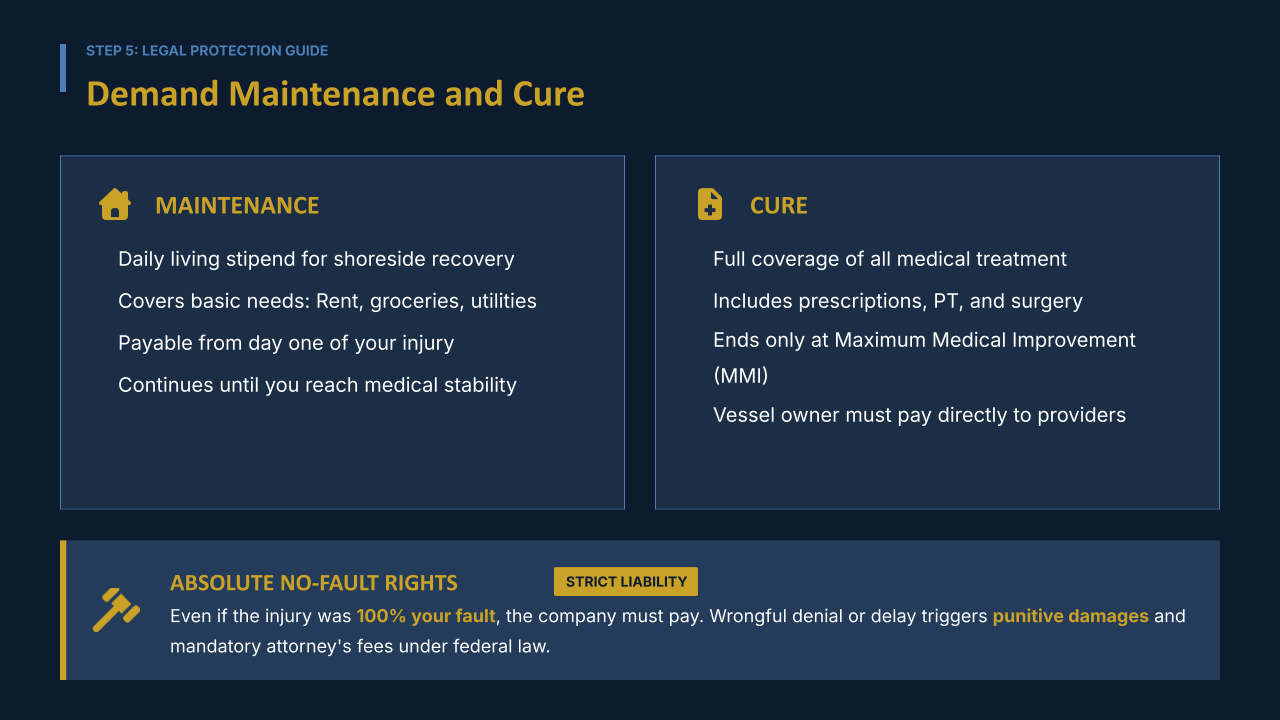
As an injured seaman, you are entitled to Maintenance and Cure from the day you are hurt until you reach Maximum Medical Improvement (MMI).
- Maintenance: A daily living stipend to cover room and board shoreside (rent/mortgage, groceries, utilities).
- Cure: Complete coverage of all reasonable and necessary medical treatments, prescriptions, physical therapy, and surgeries.
- This is a no-fault right. Even if the injury was 100% your fault, the company must pay maintenance and cure. If they unreasonably delay or wrongfully deny these payments, they can be held liable for punitive damages and attorney’s fees.
Step 6: Do Not Sign Any “Releases” or Settlement Offers
If the company knows they are at fault for a broken winch, a rotten line, or an undermanned crew, they may try to offer you a quick cash settlement or have you sign a pile of paperwork while you are still on pain medication.
- These documents often contain “Release of All Claims” clauses. Once you sign, you legally forfeit your right to ever sue the company or seek further compensation—even if your injury worsens and requires a career-ending spinal fusion a year later. Never sign anything without a maritime lawyer reading it first.
Step 7: File Your Claim Before the Statutory Deadlines
Maritime injury lawsuits are governed by strict federal statutes of limitations.
- The Jones Act Statute of Limitations: Generally, you have three (3) years from the date of the accident to file a formal lawsuit.
- Important Exception: If you were injured aboard a vessel owned or operated by the U.S. Government (such as a Military Sealift Command or NOAA vessel), the window under the Public Vessels Act or Suits in Admiralty Act shrinks drastically to two (2) years, with administrative notice requirements that must be met much earlier.
- Note: Delaying action causes evidence to disappear. Crew members scatter to other vessels, surveillance footage is overwritten, and maintenance logs are “lost.” Act while the evidence is fresh.
Why a Standard Personal Injury Lawyer Won’t Cut It
Many injured deckhands or processors make the mistake of hiring a local car accident lawyer or a general personal injury firm. Maritime law is an entirely different beast.
To win a maritime case, your legal team must understand the actual mechanics of a ship. They need to know how a trawl winch operates, what constitutes an unseaworthy crew ratio, and how to read a vessel’s logs.
Standing Up for the Men and Women Who Work the Sea
For more than 45 years, the attorneys at BoatLaw, LLP have stood shoulder-to-shoulder with commercial fishermen, deckhands, tug engineers, and longshoremen. Founded in 1977, our firm was built on a deep, lifelong love of the sea and an unshakeable respect for the people who make their living on it.
Led by veteran maritime advocates Doug Williams and Nick Neidzwski, BoatLaw, LLP handles cases across the West Coast—including Washington, Oregon, Alaska, and California—as well as Florida and nationwide. We know the tactics big shipping conglomerates and processing corporations use to stall claims, and we don’t back down.
Our Contingency-First Guarantee
We operate strictly on a contingency-fee basis. This means there are absolutely no upfront costs, no hourly fees, and no out-of-pocket expenses for you. We advance all the costs of investigating your accident and building your case. If we don’t win a settlement or a jury verdict for you, you owe us absolutely nothing.
Speak to an Authentic Maritime Advocate
Don’t let an insurance adjuster dictate your physical and financial recovery. Contact BoatLaw, LLP today at 1-800-BOATLAW or fill out our secure online contact form for a 100% free, confidential case evaluation.
Legal Disclaimer
The information provided is for educational and informational purposes only. The information on this website is not intended as legal advice and should not be used as a substitute for consulting a licensed attorney. Legal outcomes and laws can vary by jurisdiction, and only a qualified lawyer can provide guidance tailored to your situation.

Nicholas J. Neidzwski is a trial attorney who handles maritime and personal injury litigation. Appearing for plaintiffs in state and federal courts throughout Washington, California, Oregon, Alaska, and other jurisdictions. Nick’s litigation experience includes the successful resolution of various Jones Act, general maritime, and product liability cases on behalf of many different individuals. Nick was named a Rising Star annually by Super Lawyers from 2016 through 2025, and was named a Super Lawyer in 2026. Learn more here.