


 What is Maintenance and Cure?
 What is Maintenance and Cure?
Maintenance and cure is an ancient maritime law doctrine that requires a vessel owner or maritime employer to provide daily living expenses (maintenance) and comprehensive medical treatment (cure) to a seaman who becomes ill or injured while in the service of a vessel, regardless of who was at fault for the injury.
For decades, deckhands, commercial fishermen, barge workers, and tug crew members across the West Coast have climbed aboard vessels knowing the work is rugged and dangerous. Yet, when a catastrophic snap-back injury occurs on a trawler or a worker slips on a slick deck in the Gulf of Alaska, many are met with a harsh surprise. Shipping corporations and vessel operators often hand injured crew members standard state workers’ compensation forms, treating them like land-based factory employees.
This is not just an administrative oversight; it is a direct violation of federal maritime law. If you are a true seaman, you do not belong under state workers’ comp. You are entitled to ancient, powerful federal protections that offer far greater financial and medical security. Understanding the deep divide between traditional workers’ compensation and your maritime rights to maintenance and cure is the first step toward protecting your livelihood.
Why Traditional Workers’ Compensation Does Not Apply to Seamen
State workers’ compensation systems were built for landlocked jobs—office workers, construction crews, and factory lines. These programs are heavily regulated by individual state statutes, such as those in Washington, Oregon, California, or Alaska. They operate on a strict “no-fault” compromise: the employee receives fixed, limited benefits for medical bills and a fraction of lost wages, and in exchange, they completely surrender their right to sue their employer for negligence.
The federal government recognized long ago that the perils of the sea demand much tougher, more protective laws. Under federal maritime law, specifically the Jones Act and general maritime doctrine, true seamen are entirely excluded from state workers’ compensation programs. The law understands that you cannot simply walk away from a dangerous vessel at sea, nor can you choose your own doctor when you are hundreds of miles offshore.
Because of this, maritime law provides a dual track for recovery. First, it guarantees absolute, automatic rights through maintenance and cure. Second, unlike land-based employees, it preserves your right to file a powerful lawsuit against your employer for negligence or vessel unseaworthiness to recover full compensation for pain, suffering, and lost earning capacity.
The Two Core Pillars of Maintenance and Cure Defined
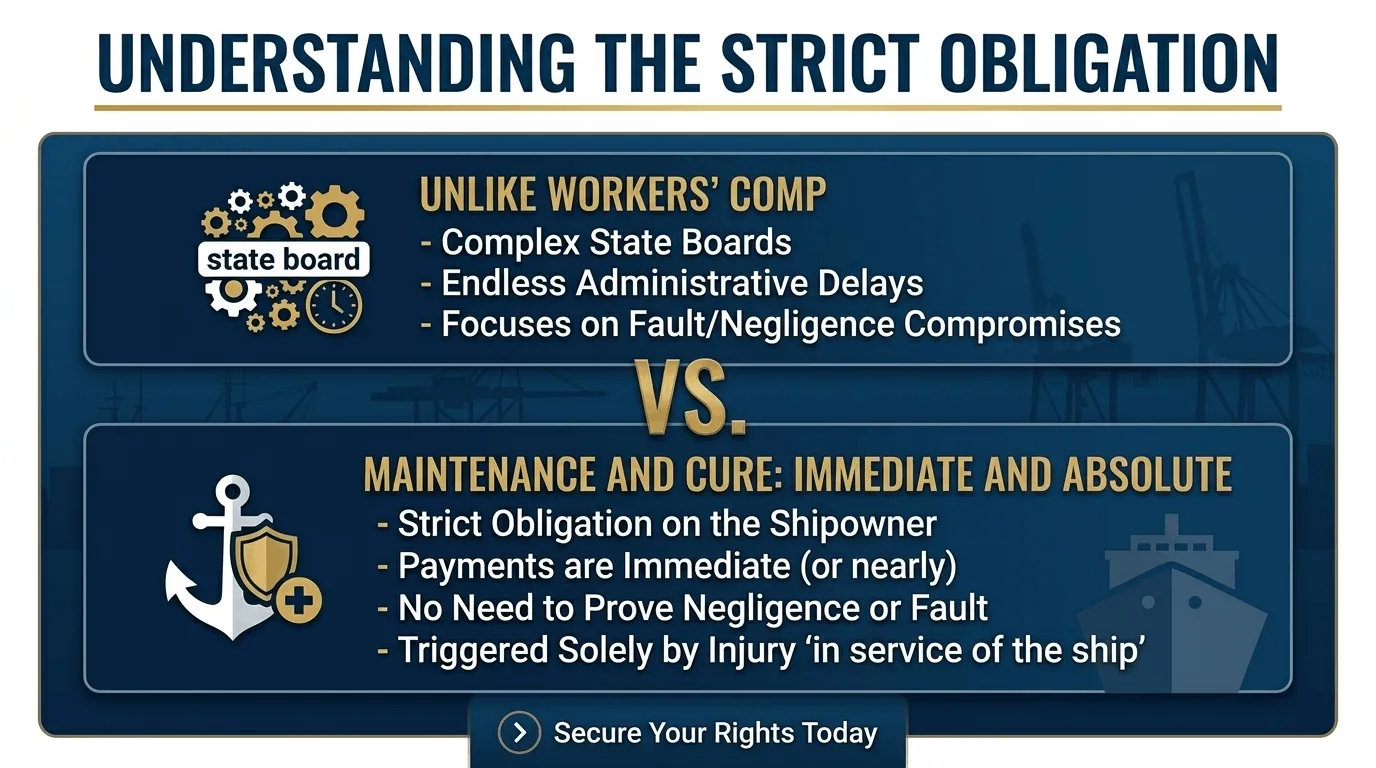
Unlike workers’ comp, which requires navigating complex state boards and enduring endless delays, maintenance and cure is a strict, immediate obligation placed on the shipowner. It does not matter if your injury was a pure accident, or even if your own temporary carelessness contributed to it. If it happened while you were in the service of the ship, the owner must pay.
Understanding Your Right to Daily Maintenance
Maintenance is a daily living allowance meant to cover the basic costs of food and shelter that you would have received while living aboard the vessel. Historically, maritime employers tried to pay an archaic, flat rate of $8.00 a day which is a number that has not been realistic for generations.
Today, experienced maritime attorneys aggressively fight to ensure your daily maintenance rate reflects the actual, modern cost of living on land in your specific market, whether that is Seattle, Bellingham, Portland, Los Angeles, or San Francisco. This allowance must cover your real expenses, including:
- Rent or mortgage payments
- Homeowners insurance and property taxes
- Utilities (gas, electricity, water)
- Groceries and essential food items
Securing Complete and Uncompromised Cure
Cure represents the obligation of the vessel owner to pay for all necessary medical care related to your injury or illness. Under standard workers’ comp, your employer’s insurance company often forces you to see “company doctors” who are incentivized to minimize your injuries and rush you back to work.
Under maritime law, your right to cure gives you the absolute freedom to choose your own independent doctors, specialists, and rehabilitation therapists. The shipowner must pay for 100% of your medical expenses, including surgeries, emergency transport, medications, physical therapy, and diagnostic imaging, with zero deductibles or co-pays out of your pocket.
“Under general maritime law, a seaman who becomes ill or injured while in the service of a vessel is entitled to maintenance and cure from the vessel owner. Maintenance is a daily allowance for food and lodging, equivalent to what the seaman would have received on board. Cure is the payment of necessary medical care.”
Key Differences: Maintenance and Cure vs. Workers’ Comp
| Feature / Right | Maritime Maintenance & Cure | Standard Land-Based Workers’ Comp |
|---|---|---|
| Applicable Law | Federal General Maritime Law / Admiralty Law | Individual State Statutes (WA, OR, CA, AK, etc.) |
| Fault Requirement | Absolute No-Fault: Automatic entitlement unless the injury was caused by willful misconduct. | No-Fault System. |
| Choice of Doctor | Full Autonomy: The injured seaman retains the legal right to choose their own independent physician. | Frequently limited or restricted to employer-approved medical networks or “company doctors.” |
| Daily Living Allowance | Maintenance: Must cover the actual, localized market costs of rent/mortgage, utilities, and groceries on land. | Wage replacement caps calculated strictly as a fixed percentage of your average weekly land wages. |
| Right to Sue Employer | Fully Preserved: You can file a powerful additional Jones Act negligence or unseaworthiness lawsuit for full pain and suffering. | Stripped Completely: Immediate statutory immunity is granted to the employer in exchange for standard benefits. |
When Does the Obligation to Pay Maintenance and Cure End?
When Does the Obligation to Pay Maintenance and Cure End?
A vessel owner cannot simply cut off your living expenses and medical payments because they feel too much time has passed. By law, the employer’s obligation to provide maintenance and cure continues until you reach a point known as Maximum Medical Cure (MMI)—sometimes referred to as maximum medical improvement.
MMI is reached only when your injury or illness has healed completely, or when further medical treatment will no longer improve your condition. If you require permanent, ongoing care simply to manage pain rather than improve your physical state, the employer’s obligation for cure may conclude, but your right to pursue permanent disability and future medical costs through a broader Jones Act negligence claim remains fully intact.
Crucially, the decision of whether you have hit MMI is a medical determination, not a corporate one. It must be declared by a qualified medical professional—ideally your own independent doctor—not a doctor hired by the insurance company to save them money.
What to Do If Your Employer Refuses Your Maritime Rights
Corporate shipping lines, commercial fishing conglomerates, and their insurance adjusters are well aware that maintenance and cure obligations are expensive. To protect their profit margins, they frequently employ tactics designed to delay, minimize, or outright deny your benefits. They may falsely claim you were not a true “seaman,” argue that your injury was a pre-existing condition, or stop payments prematurely.
If a shipowner willfully and arbitrarily refuses to pay your rightful maintenance and cure, federal maritime law allows for severe penalties. You have the right to file a lawsuit seeking not only the back-due benefits but also compensatory damages for any worsening of your medical condition caused by the delay, your attorney fees, and substantial punitive damages.
Frequently Asked Questions About Maintenance and Cure
How much is daily maintenance?
Historically, maritime companies tried to pay an outdated, fixed rate of $8.00 per day. Today, however, the law requires maintenance to reflect the actual, realistic cost of providing food and shelter on land. An experienced attorney will compile your actual household bills—including rent or mortgage, utilities, and groceries—to calculate a customized daily maintenance rate tailored to your specific local market (such as Seattle, Portland, or Los Angeles).
What happens when my employer denies maintenance and cure?
If your employer wrongfully minimizes, delays, or outright denies your benefits, they are in direct violation of federal maritime law. By partnering with a maritime law firm, you can file a formal claim to force compliance. If the denial is found to be willful and arbitrary, the court can penalize your employer by ordering them to pay your back-due benefits, your attorney fees, extra compensatory damages for any unnecessary physical suffering, and punitive damages.
Can I receive maintenance and cure if the accident was my fault?
Yes. Maintenance and cure is an absolute, no-fault obligation. Unless your injury was caused by intentional, gross misconduct (such as strict intoxication or starting a physical fight), you are fully entitled to receive living allowances and medical coverage. Even if your own ordinary negligence or temporary slip-up contributed to the accident, the shipowner is legally mandated to pay your benefits until you hit Maximum Medical Improvement (MMI).
Contact BoatLaw, LLP: Your Powerful Maritime Advocates
If you have been hurt while working on the water, do not let a corporate representative force you into a land-based workers’ compensation system that minimizes your injuries. At BoatLaw, LLP, our legal team shares a lifelong love of the sea and possesses nearly 50 years of unbroken experience holding massive maritime companies accountable. We understand the unique laws that govern the maritime way of life and stand as a powerful advocate for blue-collar mariners throughout Washington, Oregon, Alaska, and California.
The Reality of Maritime Danger & Financial Cost
According to extensive industry safety tracking data, maritime injuries impose a massive economic burden on the industry, with a comprehensive six-year analysis revealing that maritime worker injuries cost the sector more than $85 million in direct expenditures. To understand more about these safety patterns, see the full maritime safety cost data analysis.
Call 1-800-BOATLAW today for a free review of your case. If our attorneys determine that BoatLaw may be able to assist you, a member of our legal team will reach out shortly to schedule a free, no-obligation consultation with an experienced maritime attorney.
Legal Disclaimer
The information provided is for educational and informational purposes only. The information on this website is not intended as legal advice and should not be used as a substitute for consulting a licensed attorney. Legal outcomes and laws can vary by jurisdiction, and only a qualified lawyer can provide guidance tailored to your situation.

Douglas R. Williams was raised in a military family. After retiring from the armed forces, his father sailed as the chief medical officer with many of the most popular cruise lines, including Holland America Line, Carnival Cruise Line, Disney Cruise Line, and Norwegian Cruise Line. When not in school, Doug spent a good part of his youth in the crew quarters sailing with his father on cruise ships. He developed a practical knowledge of the maritime industry from a young age. Learn More here.