

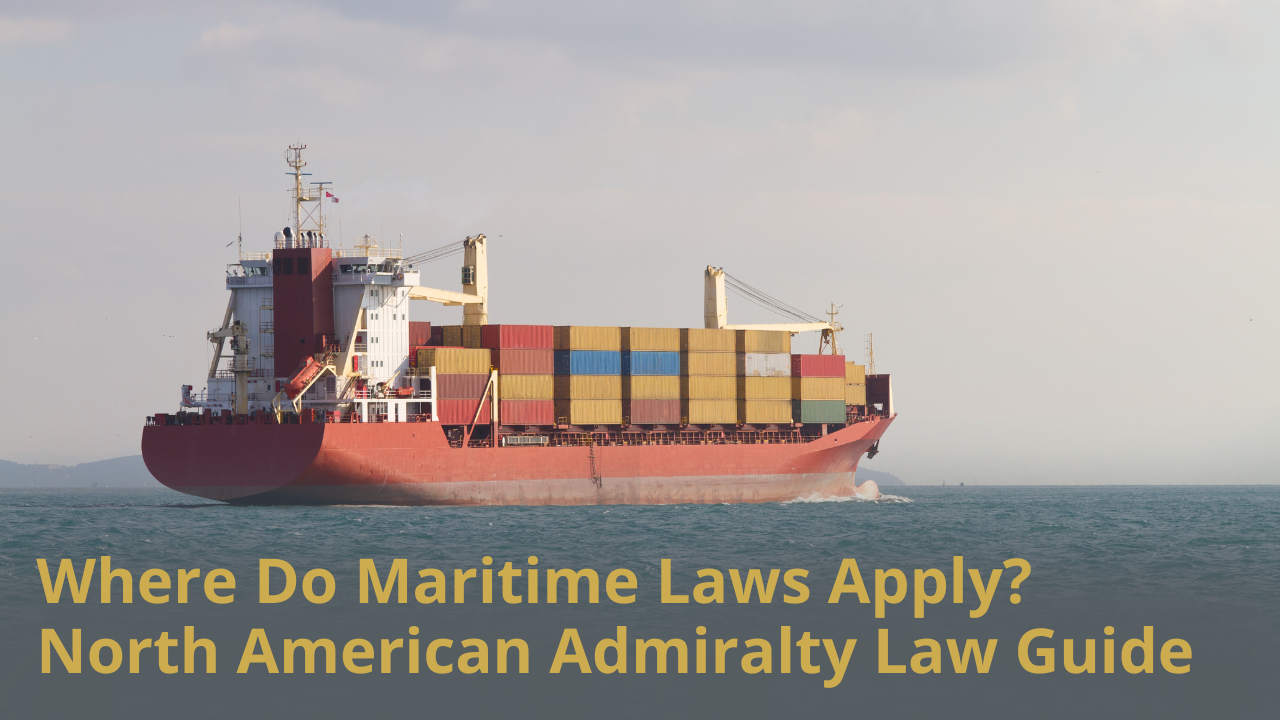
 Understanding where maritime laws apply is one of the most confusing and important questions injured maritime workers and their families face. Maritime law does not follow simple state boundaries. Instead, it depends on geography, vessel status, worker classification, and the specific statute involved. The answer can change dramatically based on whether an injury happens on a river, nearshore, offshore, or on the high seas.
This guide explains the most important maritime and admiralty laws in North America, where each law applies, and how courts determine which legal protections are available after a maritime injury or death.
Most Important Maritime Laws and Where They Apply
| Law / Doctrine | Where it applies (geographically) | Key Notes / Limits |
|---|---|---|
| Jones Act (46 U.S.C. § 30104) Personal injury to seamen | U.S. territorial sea (0–12 nm, sometimes 9 nm off the Gulf Coast) – U.S. navigable waters (rivers, Great Lakes, intracoastal waterways) – Vessels registered/flagged in the U.S. (even on the high seas) |
|
| Death on the High Seas Act (DOHSA) | Injuries or deaths occurring more than 3 nautical miles (formerly 1 marine league) from the U.S. coast |
|
| Longshore & Harbor Workers’ Compensation Act (LHWCA) | Injuries occurring upon navigable waters of the United States (including piers, docks, terminals, wharves, and areas adjoining), and the worker meets the “status” test and “situs” test |
|
| Unseaworthiness (General Maritime Law) | Any U.S.-flag vessel anywhere in the world; foreign-flag vessels only when the injury occurs in U.S. territorial waters or sometimes in U.S. ports |
|
| Maintenance & Cure (General Maritime Law) |
|
Paid by the employer until maximum medical cure is reached; very broad application. |
| Outer Continental Shelf Lands Act (OCSLA) | Injuries on oil platforms, rigs, or artificial islands on the U.S. Outer Continental Shelf (generally beyond 3–9 nm offshore, out to 200+ nm) | Makes adjacent state law (e.g., Louisiana or Texas law) apply as surrogate federal law on fixed platforms |
| U.S. Coast Guard Regulations & Safety Standards(SOLAS, Load Line, etc.) | U.S.-flag vessels worldwide; foreign vessels when in U.S. ports or navigable waters (Port State Control) | Foreign ships in U.S. waters must comply or be detained. |
When Does the Jones Act Apply?
The Jones Act (46 U.S.C. § 30104, officially the Merchant Marine Act of 1920, Section 27) provides a negligence cause of action (and sometimes unseaworthiness + maintenance & cure enhancements) only to a very specific group of maritime workers categorized as “Seamen.”
Examples of who would be considered a seaman include:
| Category | Covered by the Jones Act? | Explanation / Disclaimer |
|---|---|---|
| Seamen (captain, deckhands, engineers, cooks, etc., on cargo ships, tankers, tugboats, supply boats, fishing vessels, etc.) | YES (but see disclaimer) | Must meet the Chandris / Dutile test (see below) |
| Offshore oil & gas workers (on drillships, semi-submersibles, jack-ups, liftboats, OSVs) | Often YES | Many are Jones Act seamen if assigned to a vessel or identifiable fleet for a significant period |
| Longshoremen, ship repairers, harbor workers | NO | Covered instead by the Longshore & Harbor Workers’ Compensation Act (LHWCA) |
| Fixed platform workers (traditional oil rigs, spar platforms, etc.) | NO | They are not “seamen” because the platform is not a vessel (covered by OCSLA or state workers’ comp) |
| Pilots (harbor pilots, river pilots) | Almost never | Considered independent contractors temporarily on board, not members of the crew |
| Temporary workers, contractors, and catering staff are flown out for a single hitch | Usually NO | Connection to vessel or fleet not substantial in duration or nature |
| Deadheads/riding crew (traveling to or from the vessel) | Sometimes | Depends on whether they contribute to the vessel’s mission while aboard |
| Casino boat workers (if the vessel never leaves state waters) | NO (usually) | Many “boats” are permanently moored or don’t meet the “vessel in navigation” test |
| Non-U.S. citizens / foreign seamen | YES, if injured in U.S. navigable waters or on a U.S.-flag vessel | U.S. courts routinely allow foreign seamen to sue under the Jones Act if the injury occurs in U.S. territory |
Learn more about Jones Act Claims ->
When Does the LHWCA Apply?

The LHWCA is a federal workers’ compensation statute covering maritime workers who are not Jones Act seamen. Coverage depends on both the situs test and the status test.
To be covered, a worker must pass both the situs test and the status test:
- Situs test: Injury must occur upon navigable waters of the United States or any adjoining pier, wharf, dry dock, terminal, building way, marine railway, or other adjoining area customarily used for loading, unloading, repairing, dismantling, or building a vessel.
- Status test: Employee must be engaged in maritime employment. i.e., work directly related to loading/unloading vessels, ship repair, shipbuilding, or ship breaking.
See the following table for examples of who would be considered for LHWCA claims and who would be excluded.
| Job / Situation | LHWCA Coverage? | Reason / Notes |
|---|---|---|
| Longshoreman unloading containers on a pier | YES | Classic coverage |
| Shipyard welder repairing a vessel in dry dock | YES | Ship repair is core maritime employment |
| Crane operator on a floating crane next to a ship | YES | Situs and status satisfied |
| A truck driver who only picks up containers inside the terminal | YES (post-1984) | Supreme Court (Herb’s Welding → Northeast Marine Terminal → Caputo) broadened it |
| Office clerk working in the marine terminal office | NO | Excluded as “clerical.” |
| Security guard at the terminal gate | NO | Explicitly excluded unless the employer has no non-excluded employees |
| Worker injured while walking across a pier to board a vessel as a passenger | Usually NO | Not engaged in maritime employment at the moment |
When Does DOHSA Apply?
DOHSA is a federal wrongful-death statute that applies only when all of the following conditions are met:
| Condition | Exact Rule (as of 2025) | What It Means in Practice |
|---|---|---|
| Death ( not just injury) | The person must die from the incident | If the victim survives even briefly, DOHSA does not apply → general maritime law or the Jones Act instead |
| Wrongful act, Neglect or Default | Negligence, unseaworthiness, products liability, etc., on the part of a vessel, owner, operator, etc. | Almost any maritime tort qualifies |
| Occurring on the “high seas.” | Beyond 3 nautical miles from the coast of the United States (the old “marine league” rule) | 0–3 nm → DOHSA does not apply (state wrongful-death law or general maritime law applies instead) – >3 nm → DOHSA applies almost automatically |
| No commercial aviation exception (post-2022) | For deaths on commercial passenger aircraft, the trigger is now beyond 12 nautical miles (2022 amendment) | Private boats, cruise ships, cargo ships, helicopters, supply vessels, etc. → still the 3-nm rule – Scheduled airline or charter flight → 12-nm rule |
DOHSA applies only to deaths that occur more than 3 nautical miles from the U.S. coast (12 nm for commercial passenger aircraft).
If the death happens inside that 3-nm line, DOHSA does not apply at all; the family gets much more generous remedies under state law or general maritime law.
When Do Unseaworthiness and Maintenance and Cure Apply?
The doctrines of unseaworthiness and maintenance & cure come from U.S. general maritime law (judge-made law, not a statute). Unseaworthiness claims often accompany maintenance & cure claims, but they are separate claims with different triggers.
| Requirement | Unseaworthiness | Maintenance & Cure |
|---|---|---|
| Who gets it? | Only seamen (the same people who qualify for the Jones Act) | Only seamen (identical test) |
| Injury or illness | Any injury caused (even in part) by an unseaworthy condition | Any injury or illness – even if not work-related and even if caused by the seaman’s own fault or pre-existing condition |
| Vessel status | Must be a vessel in navigation (or at least capable of navigation) | Same – vessel in navigation (temporary removal for repairs usually still counts) |
| Geographic scope |
|
Exactly the same geographic reach as unseaworthiness |
| Employer/shipowner liability | Strict liability (no specific negligent action required) – shipowner warrants the vessel is reasonably fit for its intended purpose | Strict liability – no fault required at all |
| Time limit | Until the end of the voyage or employment (sometimes longer if the condition caused permanent issues) | Until maximum medical cure (or maximum medical recovery) is reached, it can be months or years after the voyage ends |
“Maritime law applies based on the location of the incident, the status of the worker, and the nature of the vessel involved.”
If you qualify to bring a Jones Act negligence claim, you typically also have the ability to bring both unseaworthiness and maintenance & cure claims.
On a U.S.-flag vessel, those rights follow you anywhere on earth.
On a foreign-flag vessel (99% of cruise ships, most cargo ships calling U.S. ports), you only get them if the injury/illness occurs inside U.S. navigable waters. Even then, the case is often thrown out on forum non conveniens grounds.
Consult with a Top-Rated Maritime Law Firm
Interested in consulting with a maritime lawyer about your potential claim? BoatLaw’s top-rated maritime lawyers litigate injury and wrongful death claims on behalf of workers in Washington, California, Alaska, Oregon, Arizona, and Florida.
Contact us online or call us at (800) BOATLAW to schedule a free initial consultation.
Maritime Law Statistic: The U.S. Coast Guard reports over 4,000 commercial vessel injuries annually in U.S. navigable waters. Source: U.S. Coast Guard
Legal Disclaimer
The information provided is for educational and informational purposes only. The information on this website is not intended as legal advice and should not be used as a substitute for consulting a licensed attorney. Legal outcomes and laws can vary by jurisdiction, and only a qualified lawyer can provide guidance tailored to your situation.

Nicholas J. Neidzwski is a trial attorney who handles maritime and personal injury litigation. Appearing for plaintiffs in state and federal courts throughout Washington, California, Oregon, Alaska, and other jurisdictions. Nick’s litigation experience includes the successful resolution of various Jones Act, general maritime, and product liability cases on behalf of many different individuals. Nick was named a Rising Star by Super Lawyers 2016 through 2024. Learn more here.