

Oil rig accidents are some of the most dangerous workplace incidents in the world. Operating miles offshore, crews face constant risks from explosions, blowouts, and equipment failures. Despite advancements in safety technology, history has seen several catastrophic oil rig disasters that have forever changed the industry. These tragic oil rig accidents not only resulted in the loss of countless lives but also brought about major changes in safety regulations, corporate accountability, and maritime law.
We’ll take an in-depth look at the worst oil rig accidents and disasters in U.S. history, examining their causes, the human toll they took, and how each tragedy led to significant changes in safety standards and maritime law that continue to shape offshore drilling today.
10 Worst Oil Rig Accidents in US History
The 10 worst oil rig accidents in U.S. history shed light on the extreme dangers faced by offshore workers. These catastrophic events, marked by devastating explosions, environmental destruction, and tragic oil rig deaths, forever changed the nation’s approach to drilling safety. Each disaster brought painful lessons that reshaped federal regulations, improved emergency response systems, and strengthened maritime law to protect those who risk their lives on the open sea, where the oil rig worker life expectancy is often shortened by exposure to hazardous conditions and the constant threat of accidents.
| # | Incident / Year | Location | Fatalities / Injuries | Cause / Summary | Aftermath / Legal Impact |
| 1. Deepwater Horizon | 2010 | Gulf of Mexico (Macondo Prospect) | 11 dead, 17 injured | The blowout preventer failed after poor well cementing, which led to a catastrophic explosion and oil spill | Largest marine oil spill in history (~4.9M barrels); over $60B in fines for BP; new federal safety rules (SEMS II, Well Control Rule) |
| 2. Lake Peigneur Blowout | 1980 | Jefferson Island, Louisiana | 0 dead, major property loss | Texaco drilling miscalculated the depth and punctured a salt mine beneath the lake | The entire lake drained into mine, causing a massive sinkhole and geological shock; stricter geotech surveying laws followed |
| 3. C.P. Baker Drilling Barge Explosion | 1964 | Gulf of Mexico | 22 dead | Gas blowout ignited while the crew was preparing to cap the well | One of the earliest modern offshore disasters led to the development of emergency shutdown procedures |
| 4. Black Elk Energy Explosion | 2012 | West Delta 32 platform, Gulf of Mexico | 3 dead, 11 injured | Welding sparked an explosion during maintenance; inadequate safety supervision | Criminal charges filed; $4.2M fine; reinforced contractor safety accountability |
| 5. Vermilion Block 380 Explosion | 2010 | Gulf of Mexico | 13 workers rescued, no deaths | Fire and explosion due to a natural gas leak | Strengthened offshore fire suppression and BSEE inspection rules |
| 6. Ship Shoal 134A (Forest Oil) Explosion | 1984 | Gulf of Mexico | 5 dead, 3 injured | Gas buildup ignited during maintenance | Sparked new hot-work permit systems offshore |
| 7. Ocean Odyssey Blowout | 1988 | Pacific Ocean (California) | 1 dead | Explosion after control system failure | Reinforced the importance of redundant BOP systems |
| 8. Paragon Offshore Rig Fire | 2015 | Gulf of Mexico | 0 dead, multiple injuries | Fire in the drilling mud system | Drew BSEE scrutiny on maintenance recordkeeping |
| 9. High Island 563A (Mobil) Explosion | 1977 | Gulf of Mexico | 10 dead, 7 injured | Gas leak during workover operation | Influenced early federal safety oversight by the U.S. Geological Survey (predecessor to BSEE) |
| 10. Usumacinta Jack-up Collision (Mexico-U.S. legal overlap) | 2007 | Bay of Campeche (operated by U.S. contractors) | 22 dead | Rig struck a fixed platform during a storm; failed evacuation | Though in Mexican waters, U.S. lawsuits followed under maritime law |
“Offshore oil and gas extraction remains one of the most hazardous industries in the United States, with a fatality rate seven times higher than that of all U.S. workers.” — Centers for Disease Control and Prevention (CDC)
1. Deepwater Horizon Explosion
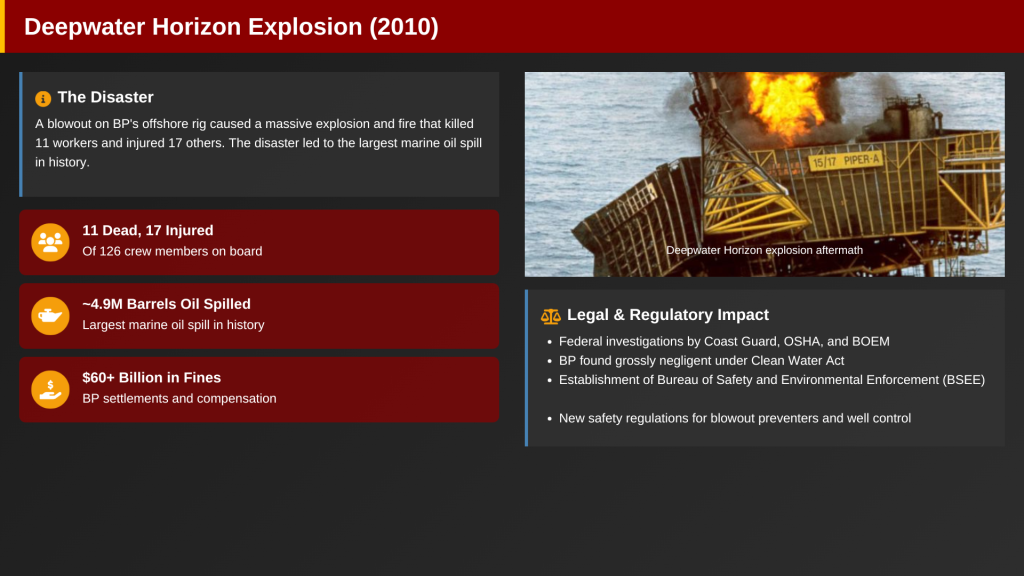
The Deepwater Horizon Explosion in April 2010 remains one of the deadliest oil rig accidents in U.S. history. A blowout on BP’s offshore rig caused a massive explosion and fire that killed 11 workers and injured 17 others. The disaster led to billions in fines and sweeping reforms in offshore drilling safety and environmental regulations.
Deepwater Horizon Explosion Injuries & Fatalities
The Deepwater Horizon disaster resulted in 11 oil rig deaths and 17 serious injuries out of 126 crew members on board. The explosion and fire left survivors battling intense heat and smoke before being rescued from the burning platform.
Legal Ramifications of the Deepwater Horizon Explosion
Following the Deepwater Horizon explosion, extensive federal investigations were launched by the U.S. Coast Guard, OSHA, and the Bureau of Ocean Energy Management. BP was found grossly negligent under the Clean Water Act and agreed to pay over $20 billion in fines and settlements, the largest environmental penalty in U.S. history.
The disaster also led to new safety regulations, including stricter blowout preventer standards, improved emergency response protocols, and the establishment of the Bureau of Safety and Environmental Enforcement (BSEE) to oversee offshore drilling operations.
2. Lake Peigneur Blowout
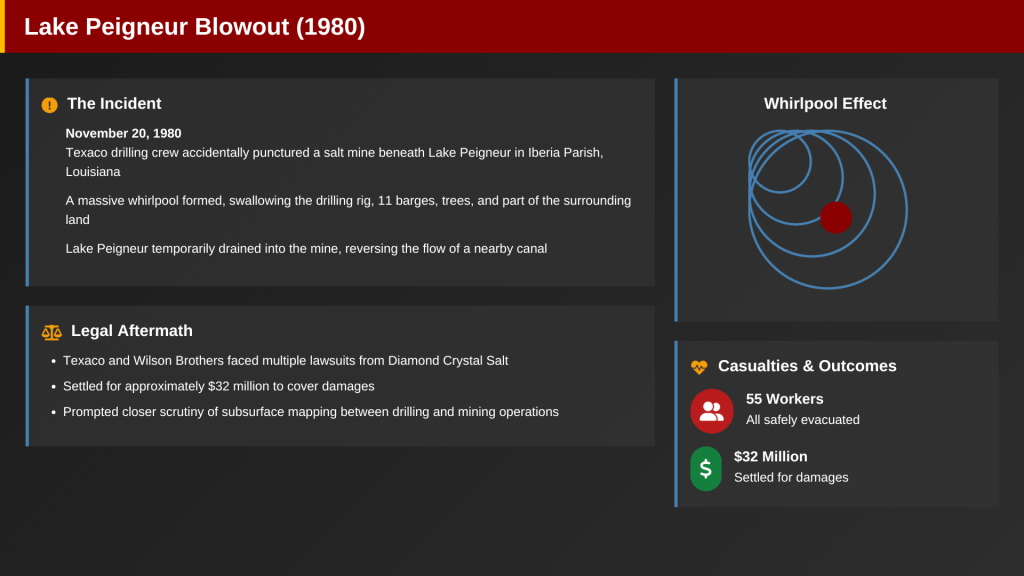
The Lake Peigneur Blowout occurred on November 20, 1980, in Iberia Parish, Louisiana, when a Texaco drilling crew accidentally punctured the roof of a salt mine beneath the lake. The breach created a massive whirlpool that swallowed the drilling rig, eleven barges, trees, and part of the surrounding land. Miraculously, all 55 workers escaped unharmed, but the lake temporarily drained into the mine, reversing the flow of a nearby canal and causing extensive environmental and property damage.
Lake Peigneur Blowout Injuries & Fatalities
Remarkably, no one was killed or seriously injured in the Lake Peigneur Blowout. All 55 workers from the drilling rig and salt mine escaped safely before the lake completely drained into the cavern below.
Legal Ramifications of the Lake Peigneur Blowout
In the aftermath of the Lake Peigneur disaster, Texaco and its drilling partner, Wilson Brothers, faced multiple lawsuits from the salt mining company, Diamond Crystal Salt, and local property owners. After years of litigation, Texaco settled the case for approximately $32 million to cover damages to the mine and surrounding land. The incident prompted closer scrutiny of subsurface mapping and coordination between drilling and mining operations. It also influenced future regulatory requirements for geological surveys to prevent similar industrial accidents in shared underground zones.
3. C.P. Baker Drilling Barge Explosion (1964)
The C.P. Baker Drilling Barge Explosion in the Gulf of Mexico was one of the earliest offshore oil rig disasters in modern U.S. history. The explosion occurred when a gas blowout ignited while the crew attempted to cap a well, causing a violent fire that engulfed the platform and surrounding waters.
C.P. Baker Drilling Barge Explosion Injuries & Fatalities
The accident resulted in 22 deaths, marking it as one of the deadliest offshore incidents of the 20th century. Several other workers sustained severe burns and injuries during rescue efforts as the rig burned for hours.
Legal Ramifications of the C.P. Baker Explosion
At the time, offshore safety regulations were minimal, but the tragedy became a turning point for the oil industry. It led to the development of emergency shutdown procedures, improved firefighting training, and the establishment of blowout prevention standards that would later be adopted across all U.S. offshore drilling operations.
4. Black Elk Energy Explosion (2012)
The Black Elk Energy Explosion occurred on the West Delta 32 platform in the Gulf of Mexico during routine maintenance on November 16, 2012. Welding operations ignited flammable oil vapors, causing a massive explosion that tore through the platform and set it ablaze.
Black Elk Energy Explosion Injuries & Fatalities
The blast killed three workers and injured 11 others, several of whom sustained critical burns. Investigators found that proper safety procedures were not followed before the welding began.
Legal Ramifications of the Black Elk Energy Explosion
Black Elk Energy and its contractors faced criminal charges for violating federal safety regulations. The company was fined $4.2 million, and the case underscored the accountability of offshore contractors under U.S. maritime law. The disaster also led to reinforced contractor oversight, mandatory hot-work safety training, and stricter BSEE safety audits.
5. Vermilion Block 380 Explosion (2010)
The Vermilion Block 380 Explosion occurred in September 2010 on a platform operated by Mariner Energy, just months after the Deepwater Horizon disaster. A natural gas leak triggered a massive fire, forcing the crew to abandon the rig and leap into the Gulf of Mexico.
Vermilion Block 380 Explosion Injuries & Fatalities
Remarkably, all 13 workers were rescued, and no fatalities occurred. The platform, however, suffered extensive damage from the fire.
Legal Ramifications of the Vermilion Block 380 Explosion
While no lawsuits for wrongful death were filed, the incident prompted regulatory scrutiny from BSEE, leading to updates in offshore fire suppression standards and enhanced gas detection systems. It also emphasized the importance of emergency evacuation readiness in offshore facilities.
6. Ship Shoal 134A Explosion (1984)
The Ship Shoal 134A Explosion happened in 1984 during maintenance work on a platform operated by Forest Oil Corporation. A buildup of gas in the production area ignited, causing a fiery explosion that engulfed the rig.
Ship Shoal 134A Injuries & Fatalities
The explosion killed five workers and injured three others, highlighting how routine maintenance could turn deadly without proper safety controls.
Legal Ramifications of the Ship Shoal 134A Explosion
The tragedy led to the creation of the hot-work permit system, a safety protocol requiring pre-authorization, gas testing, and supervision during any welding or cutting operations offshore. The new standards were later adopted industry-wide and remain a key part of offshore safety compliance today.
7. Ocean Odyssey Blowout (1988)
In 1988, the Ocean Odyssey drilling rig off the coast of California suffered a catastrophic blowout after its control system failed. The resulting explosion caused a fire that destroyed much of the rig and forced the evacuation of its crew.
Ocean Odyssey Injuries & Fatalities
One worker was killed during the explosion, while others sustained minor injuries during the emergency evacuation.
Legal Ramifications of the Ocean Odyssey Blowout
The event highlighted the need for redundant blowout preventer (BOP) systems and better real-time pressure monitoring. Regulators responded by implementing stricter BOP maintenance standards and redundancy requirements, ensuring that multiple backup systems are in place during high-pressure drilling operations.
8. Paragon Offshore Rig Fire (2015)
A Paragon Offshore rig operating in the Gulf of Mexico caught fire in 2015 after a malfunction in the drilling mud system caused overheating and ignition. Workers scrambled to shut down the system and contain the flames.
Paragon Offshore Rig Fire Injuries & Fatalities
While no deaths occurred, multiple workers were injured during the fire and evacuation process.
Legal Ramifications of the Paragon Offshore Rig Fire
The BSEE investigated the incident and found inadequate maintenance documentation. This led to stricter enforcement of maintenance recordkeeping, equipment inspection logs, and preventive maintenance compliance, reinforcing accountability for both rig operators and contractors.
9. High Island 563A Explosion (1977)
The High Island 563A Explosion, operated by Mobil, occurred in 1977 when a gas leak during a workover operation ignited, resulting in a powerful blast that destroyed much of the platform.
High Island 563A Injuries & Fatalities
The explosion killed 10 workers and injured 7 others, making it one of the deadliest offshore incidents of its decade.
Legal Ramifications of the High Island 563A Explosion
The tragedy spurred early government oversight of offshore drilling, with the U.S. Geological Survey initiating safety inspections that later evolved into today’s BSEE regulations. It also led to the first federal mandates for gas detection, pressure control, and emergency response training on offshore platforms.
10. Usumacinta Jack-Up Collision (2007)
The Usumacinta Jack-Up Collision occurred in the Bay of Campeche on October 23, 2007, when the rig collided with the Kab-101 platform during a violent storm. The collision caused gas leaks, explosions, and the eventual abandonment of the rig in extreme weather conditions.
Usumacinta Jack-Up Injuries & Fatalities
A total of 22 workers died, many from failed evacuation efforts and exposure to rough seas. The tragedy remains one of the worst offshore accidents in the Gulf region.
Legal Ramifications of the Usumacinta Jack-Up Collision
Although the disaster occurred in Mexican waters, U.S. contractors faced lawsuits in American courts under maritime law. The legal proceedings exposed jurisdictional gaps in cross-border offshore safety enforcement. The incident led to closer international cooperation and new safety agreements between Mexico and the United States for joint Gulf operations.
Get Assistance After an Oil Rig Accident
Oil rig accidents can change lives in an instant, leaving victims and families facing medical bills, emotional trauma, and uncertainty about the future. Understanding your legal rights is the first step toward recovery. At BoatLaw, LLP, our experienced maritime injury lawyers have helped countless offshore workers and their loved ones obtain compensation for injuries, wrongful death, and unsafe working conditions.
If you or a loved one has been injured or killed in an oil rig accident, the law is on your side. Let the experienced, compassionate oil rig lawyers at Boatlaw review your case and guide you in the right direction.
Injured in an Offshore Oil Rig Accident?
Call 1-800-BOATLAW today for a free review of your case. If our attorneys determine that BoatLaw may be able to assist you, a member of our legal team will reach out shortly to schedule a free, no-obligation consultation with an experienced maritime attorney.
Stat: Between 2008 and 2017, more than 1,500 offshore oil and gas workers were seriously injured or killed in U.S. waters — highlighting the ongoing risks that impact oil rig worker life expectancy.
The information provided is for educational and informational purposes only. The information on this website is not intended as legal advice and should not be used as a substitute for consulting a licensed attorney. Legal outcomes and laws can vary by jurisdiction, and only a qualified lawyer can provide guidance tailored to your situation.

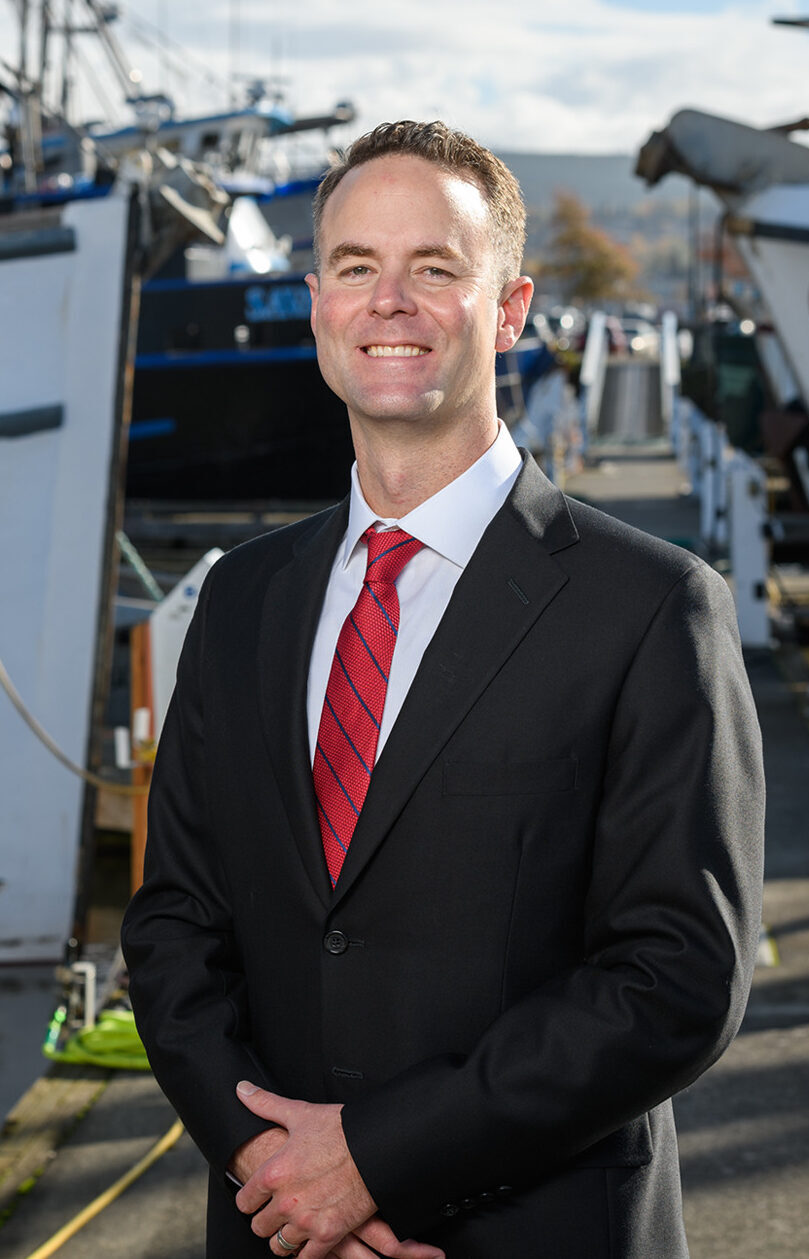
Douglas R. Williams was raised in a military family. After retiring from the armed forces, his father sailed as the chief medical officer with many of the most popular cruise lines, including Holland America Line, Carnival Cruise Line, Disney Cruise Line, and Norwegian Cruise Line. When not in school, Doug spent a good part of his youth in the crew quarters sailing with his father on cruise ships. He developed a practical knowledge of the maritime industry from a young age. Learn More here.