


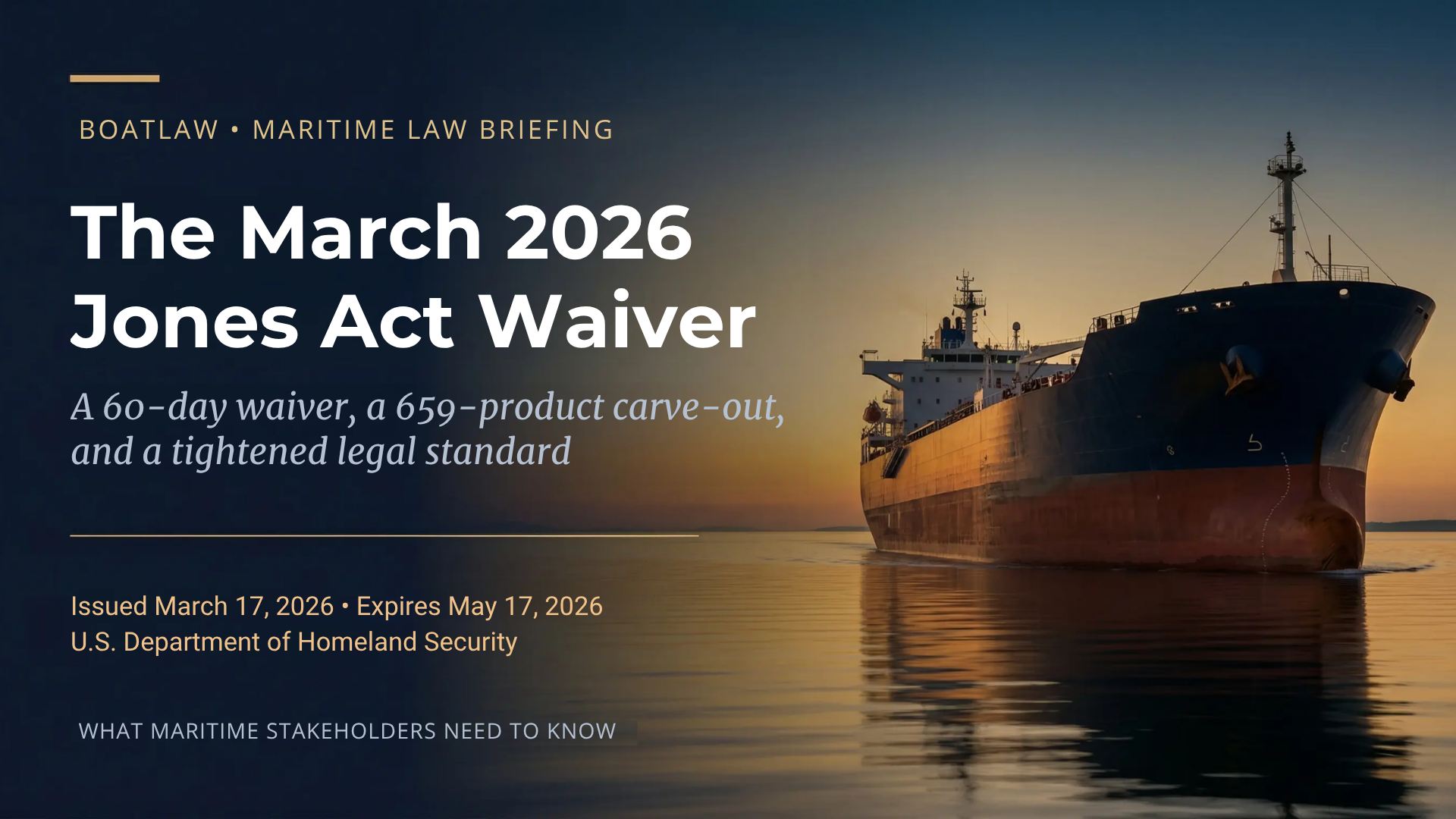
A 60-day waiver, a 659-product carve-out, and a tightened legal standard — what maritime stakeholders need to understand about the most significant Jones Act action in years.
On March 17, 2026, the U.S. Department of Homeland Security, acting on a request from the Department of War, issued a 60-day limited waiver of the Jones Act in response to energy supply disruptions stemming from the U.S.-Israel war with Iran that began February 28. The waiver expires at 11:59 p.m. ET on May 17, 2026, and permits foreign-flagged vessels to move certain covered commodities between U.S. ports. For the maritime industry, it is the most consequential coastwise trade action in years. This post walks through what the waiver actually does, what it doesn’t do, the legal mechanism behind it, and the practical implications for the stakeholders affected.
A brief refresher on the Jones Act
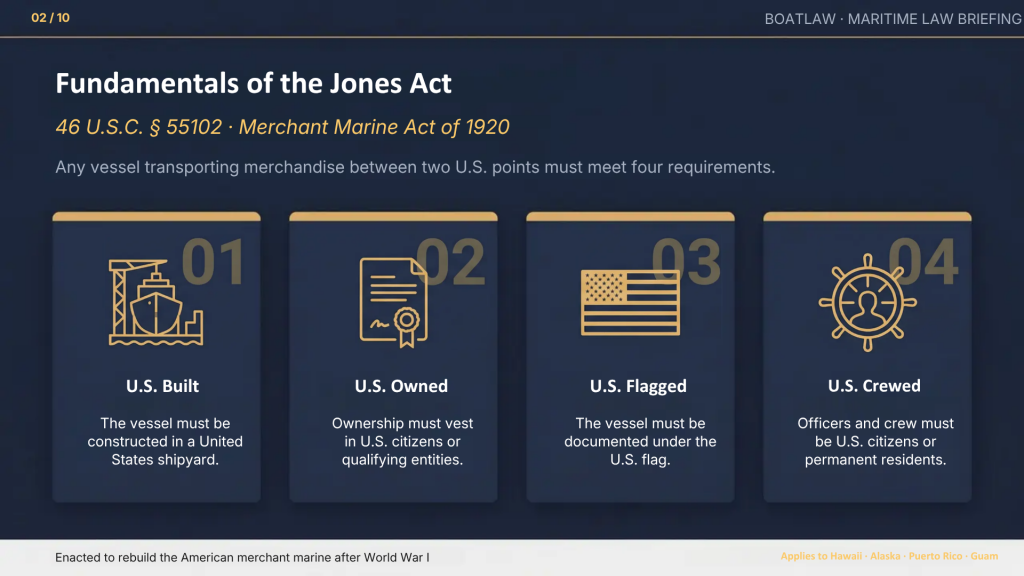
The Jones Act, codified at 46 U.S.C. § 55102, is the coastwise trade provision of the Merchant Marine Act of 1920. At its core, it requires that any vessel transporting merchandise between two U.S. points be U.S.-built, U.S.-owned, U.S.-flagged, and U.S.-crewed. Enacted to rebuild the American merchant marine after World War I, the statute has long served as the legal backbone of the domestic shipping, shipbuilding, and maritime labor industries. For more than a century it has shaped how cargo moves along U.S. coasts and to non-contiguous jurisdictions like Hawaii, Alaska, Puerto Rico, and Guam.
The legal mechanism behind the waiver
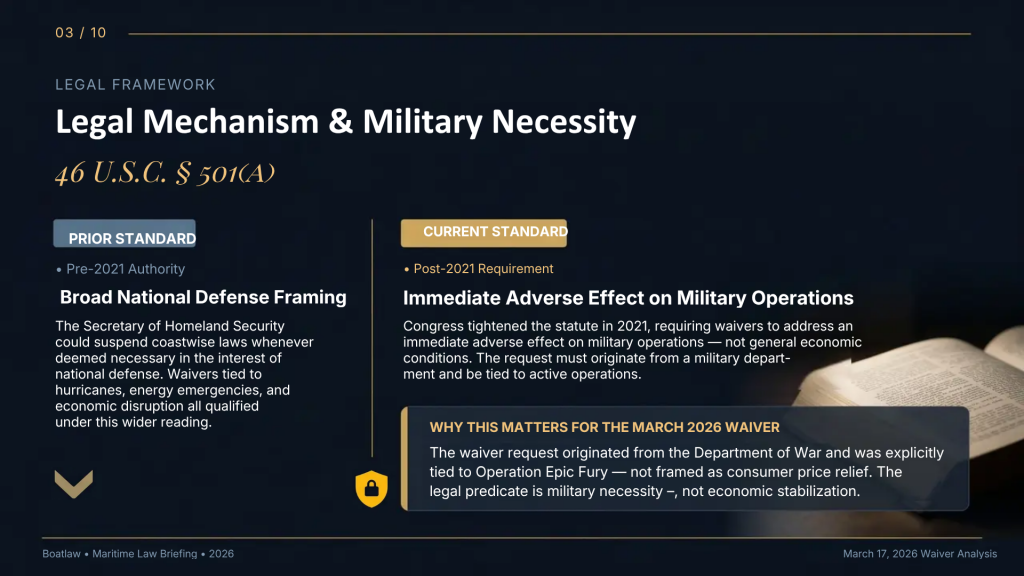
Waiver authority comes from 46 U.S.C. § 501(a), which permits the Secretary of Homeland Security to suspend the coastwise laws when doing so is necessary in the interest of national defense. That standard matters more than it used to. In 2021, Congress tightened the statute to require that waivers be issued “in the interest of national defense to address an immediate adverse effect on military operations” — narrower language than the broader national-defense framing that had previously supported waivers tied to hurricanes and other emergencies.
That tightening explains the structure of the current action. The request had to originate from the Department of War and be tied to ongoing military operations — in this case, Operation Epic Fury — rather than framed as consumer price relief or general economic stabilization. The administration’s public messaging has emphasized energy market volatility and gas prices, but the legal predicate is military necessity. Practitioners reading the CBP bulletin will notice the careful framing reflects that constraint.
What the Jones Act waiver actually covers
Three operational points define the scope.
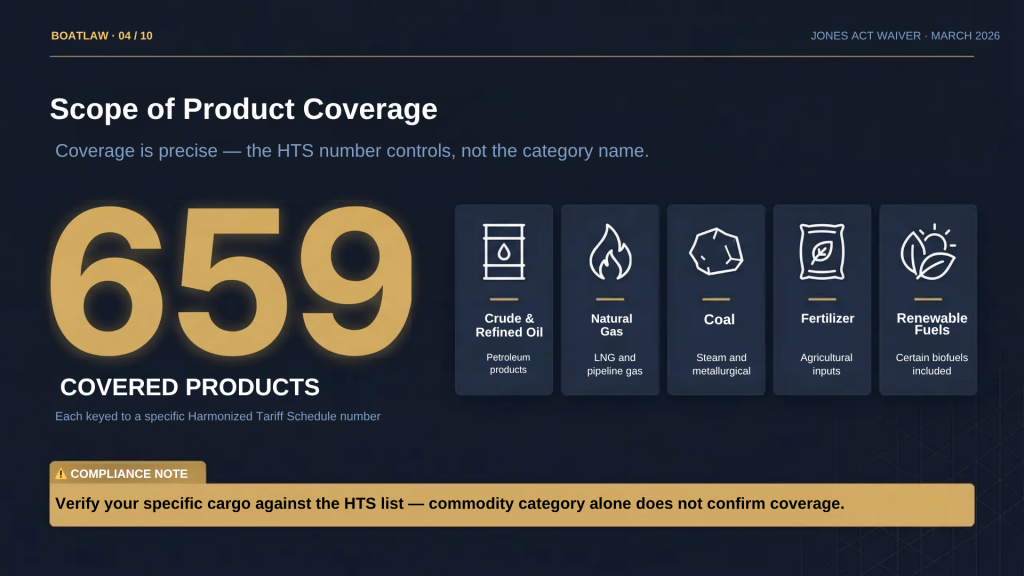
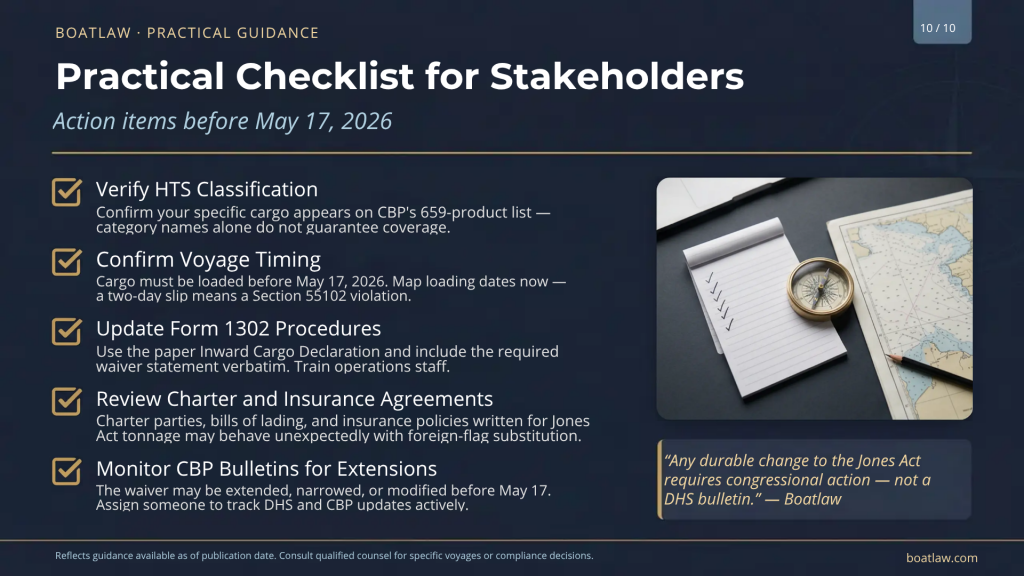
First, product coverage is not unlimited. CBP’s March 19 bulletin identifies roughly 659 covered products, each keyed to a specific Harmonized Tariff Schedule number. The list emphasizes oil, natural gas, coal, fertilizer, and certain renewable fuels, but the HTS number — not the general category — controls.
Second, vessel eligibility is the core relief. For the duration of the waiver period, foreign-flagged vessels may transport covered cargo between U.S. ports without violating Section 55102. This is the substantive change.
Third, and most easily overlooked, is the cargo timing rule. This waiver departs from prior practice in a meaningful way: cargo must either have been at sea when the waiver period began on March 17, or must be loaded before the May 17 expiration. Cargo that is loaded before the deadline may still be discharged at a U.S. port after the waiver period ends. Voyage planners should map this against their schedules carefully — the difference between a loading date of May 16 and May 18 is the difference between a compliant move and a Section 55102 violation.
What the waiver does not do
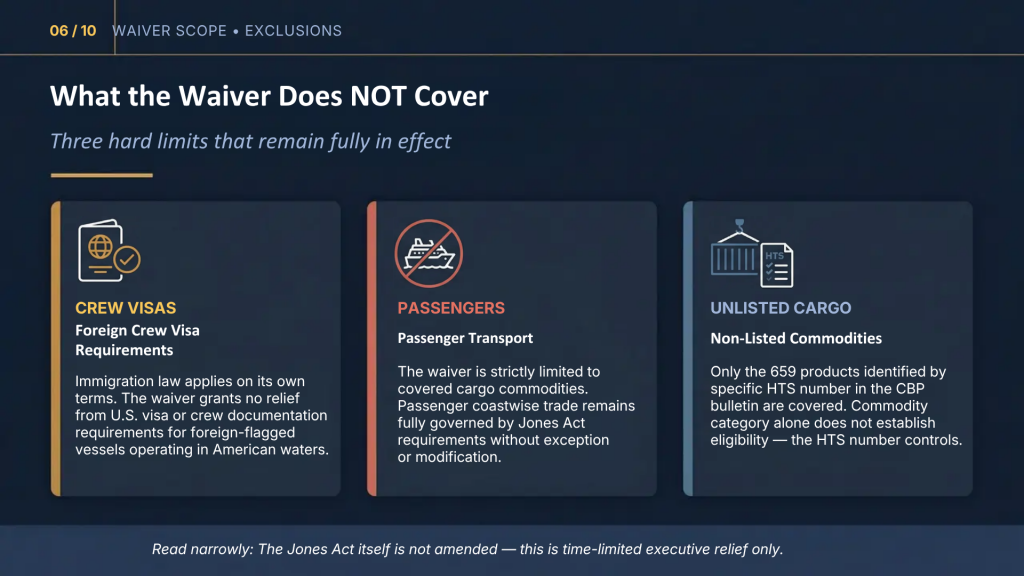
Equally important is what remains unchanged. The waiver does not affect visa requirements for foreign crews operating in U.S. waters, as immigration law continues to apply on its own terms. It does not amend the Jones Act itself; this is executive relief, time-limited and narrowly scoped. And it does not extend to passenger transport, non-listed commodities, or any activity outside the HTS list. Operators tempted to read the waiver expansively should resist that instinct.
Compliance and documentation requirements
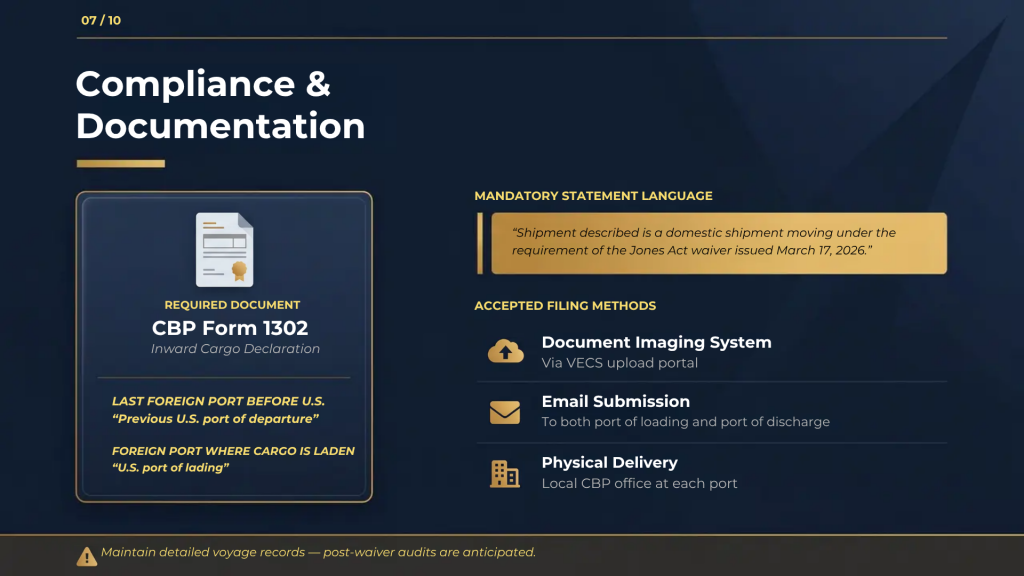
Carriers operating under the waiver have specific paperwork obligations. CBP requires a paper Form 1302 (Inward Cargo Declaration) for domestic cargo moved under the waiver, with the “Last Foreign Port Before U.S.” field listing the previous U.S. port of departure and the “Foreign Port Where Cargo is Laden on Board” field listing the U.S. port of lading. The form must include the statement: “Shipment described is a domestic shipment moving under the requirement of the Jones Act waiver issued March 17, 2026.”
CBP accepts the form through three channels: upload to the Document Imaging System via VECS, email to both the port of loading and the port of discharge, or physical delivery to the local CBP office at each port. Carriers should also maintain detailed voyage records in case of post-waiver audits. Charterers and cargo interests should review their existing contracts as well — charter parties, bills of lading, and insurance policies drafted around Jones Act-compliant tonnage may behave unexpectedly when foreign-flag vessels are substituted. Indemnity, liability, and coverage provisions deserve a fresh read.
Industry implications
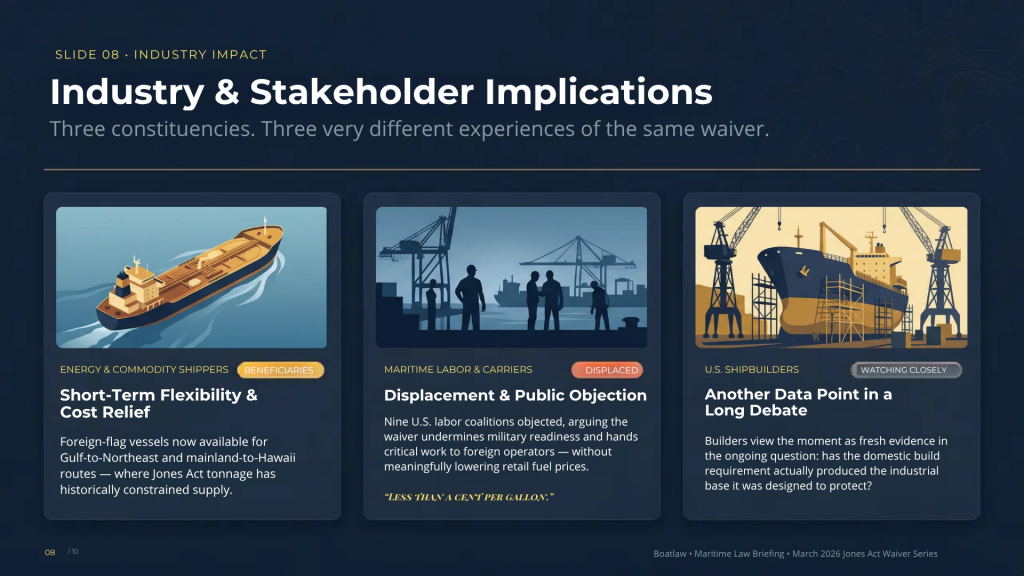
The waiver’s effects break differently across constituencies, and a fair survey requires acknowledging each.
- Energy and commodity shippers gain short-term flexibility and probable cost relief on intra-U.S. moves, particularly on Gulf-to-Northeast and mainland-to-Hawaii or mainland-to-Puerto Rico routes where Jones Act tonnage has historically been the binding constraint on supply.
- Domestic carriers and maritime labor face displacement. A coalition of nine U.S. maritime labor groups has objected publicly, arguing that the waiver undermines national security and military readiness, hands critical work to foreign operators, and will not meaningfully lower retail fuel prices. They cite analyses suggesting that domestic shipping accounts for less than a cent per gallon of pump prices.
- U.S. shipbuilders view the moment as another data point in the long-running debate over whether the domestic build requirement has produced the industrial base it was designed to protect.
- Non-contiguous jurisdictions, Hawaii, Puerto Rico, Guam, and Alaska, are watching especially closely given their structural dependence on shipped fuel. Guam has already requested specific waiver attention through its congressional delegation.
What happens after the May 17 deadline?
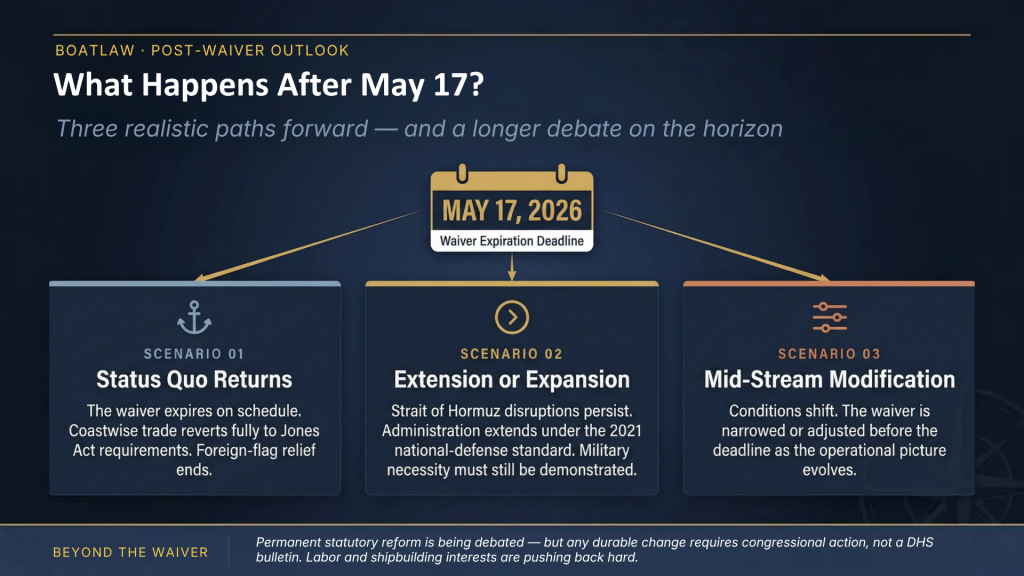
Three paths are realistic. The waiver could expire on schedule and the coastwise status quo returns. The administration could extend or expand it if Strait of Hormuz disruptions persist — though any extension still has to clear the 2021 national-defense standard. Or the waiver could be narrowed or modified mid-stream as conditions evolve.
Outside the executive branch, some commentators are using the moment to argue for permanent statutory reform, while labor and shipbuilding interests are pushing equally hard the other direction. Any durable change, however, would require congressional action — not a DHS bulletin.
Practical takeaways
During the suspension period, the number of foreign seamen in/at U.S. ports may increase. Foreign seamen visiting U.S. ports may be covered under the Jones Act and may have legal rights in the U.S. court system. Additionally, the suspension does not affect Jones Act seamen’s ability to pursue claims against their own employers (46 USC § 30104).
This post reflects guidance available as of its publication date. The waiver landscape is evolving, and readers should consult qualified counsel before relying on it for specific voyages, contracts, or compliance decisions.

Douglas R. Williams was raised in a military family. After retiring from the armed forces, his father sailed as the chief medical officer with many of the most popular cruise lines, including Holland America Line, Carnival Cruise Line, Disney Cruise Line, and Norwegian Cruise Line. When not in school, Doug spent a good part of his youth in the crew quarters sailing with his father on cruise ships. He developed a practical knowledge of the maritime industry from a young age. Learn More here.