

Working at sea carries inherent risks, but seamen should never have to put their lives on the line due to unsafe, defective, or poorly maintained equipment. Under general maritime law, shipowners owe an absolute, non-delegable duty to provide crew members with a seaworthy vessel. When an unseaworthy condition leads to an accident, the vessel owner can be held strictly liable for the resulting damages. If you or a loved one suffered an injury on the water, consulting an experienced maritime injury attorney is the most critical step toward securing full compensation.
What is an Unseaworthiness Claim Under Maritime Law?
An unseaworthiness claim is a distinct cause of action under general maritime law that holds a vessel owner strictly liable if a ship, its equipment, or its crew is not reasonably fit for its intended purpose, resulting in injury to a seaman. Unlike standard personal injury lawsuits or Jones Act negligence claims, proving fault or negligence is not required. The owner’s legal duty to provide a seaworthy vessel is absolute.
Understanding the Shipowner’s Absolute Duty to Provide a Seaworthy Vessel
To understand unseaworthiness, it helps to recognize that a ship does not have to be in danger of sinking to be legally “unseaworthy.” In maritime law, the term “seaworthy” refers to the overall safety, operational readiness, and fitness of the vessel and everything on it.
Shipowners cannot escape this obligation by delegating maintenance tasks to independent contractors, captains, or crew members. Whether a vessel is a commercial fishing trawler operating in the Bering Sea, a tug and barge transiting Puget Sound, or a cargo ship docking in San Francisco, the vessel owner bears sole responsibility for ensuring every component of the operation is safe.
According to the landmark U.S. Supreme Court decision in Mitchell v. Trawler Racer, Inc. (1960):
“A shipowner’s duty to provide a seaworthy vessel is absolute, but that duty is limited to furnishing ‘a vessel and appurtenances reasonably fit for their intended use.” As the Court explained, “the standard is not perfection, but reasonable fitness.“
Common Examples of Unseaworthy Conditions on Maritime Vessels
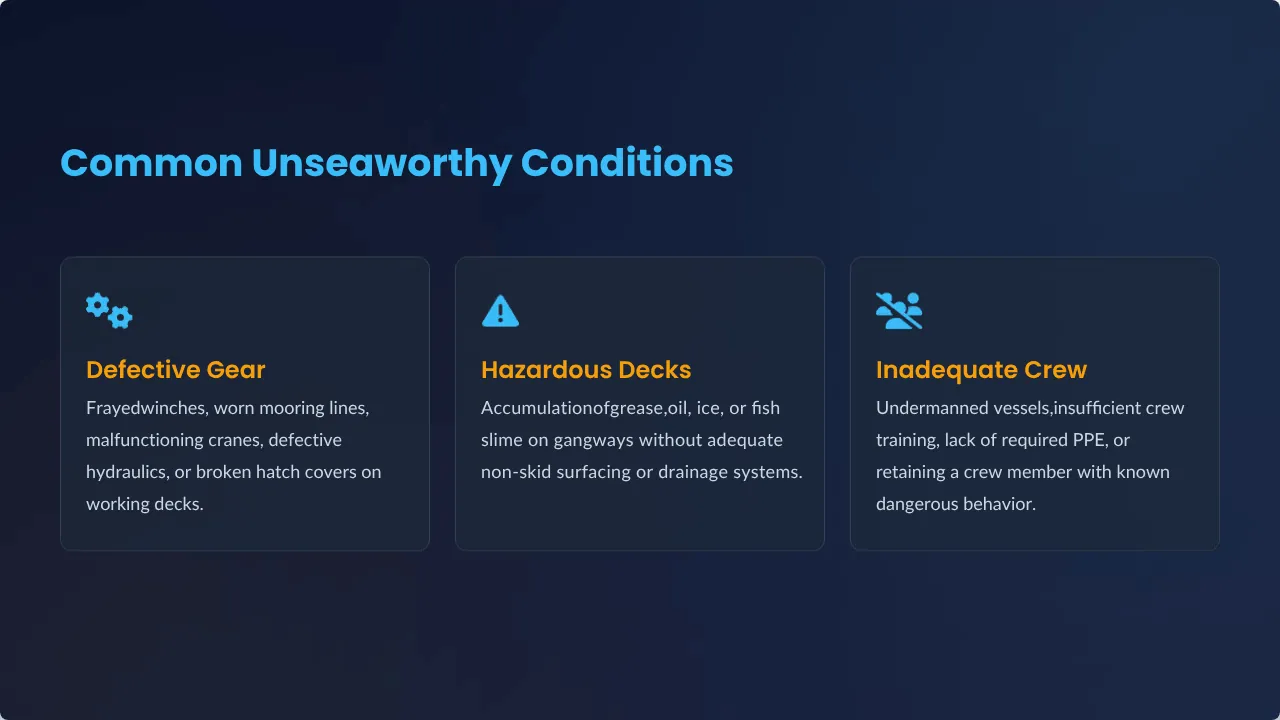
Unseaworthiness can manifest in many forms. An unsafe condition may exist before the vessel leaves the dock, or it can develop dynamically while the vessel is underway. Common hazardous conditions leading to a legal determination of unseaworthiness include:
- Defective or Broken Gear: Frayed winches, worn-out mooring lines, malfunctioning cranes, defective hydraulics, or broken hatch covers.
- Slippery or Hazardous Decks: Accumulations of grease, oil, ice, or fish slime on gangways and working decks without adequate non-skid surfaces or drainage.
- Inadequate Safety Gear: Missing or defective personal protective equipment (PPE), non-functioning lifeboats, inadequate fire suppression systems, or lack of proper guardrails.
- Undermanned Vessels or Incompetent Crew: Operating a ship with an insufficient crew size, failing to properly train deckhands, or retaining a captain or crew member with a known history of dangerous and/or violent behavior.
- Unsafe Work Methods: Requiring crew members to perform heavy lifting without proper mechanical assistance or mandating unsafe operational procedures during heavy weather.
Unseaworthiness vs. Jones Act Negligence: Key Differences
Injured seamen often have the right to pursue recovery under both the Jones Act and general maritime law for unseaworthiness. While these legal doctrines frequently overlap in a single lawsuit, they rest on fundamentally different legal principles.
| Jones Act Negligence | Unseaworthiness | |
|---|---|---|
| Legal Basis | Federal Statute (46 U.S.C. § 30104, commonly known as the Jones Act) | General Maritime Law |
| Core Requirement | Employer negligence (even slight negligence counts) | Defective/unreasonably unsafe condition of vessel |
| Target Party | Direct Employer | Vessel Owner |
| Proof of Fault Needed? | Yes, must prove employer failed to exercise reasonable care | No, liability is strict regardless of whether the owner had knowledge of the dangerous condition |
Because these legal paths complement one another, skilled maritime attorneys evaluate injured workers’ cases under both doctrines to maximize financial recovery.
Who Qualifies to File an Unseaworthiness Claim?
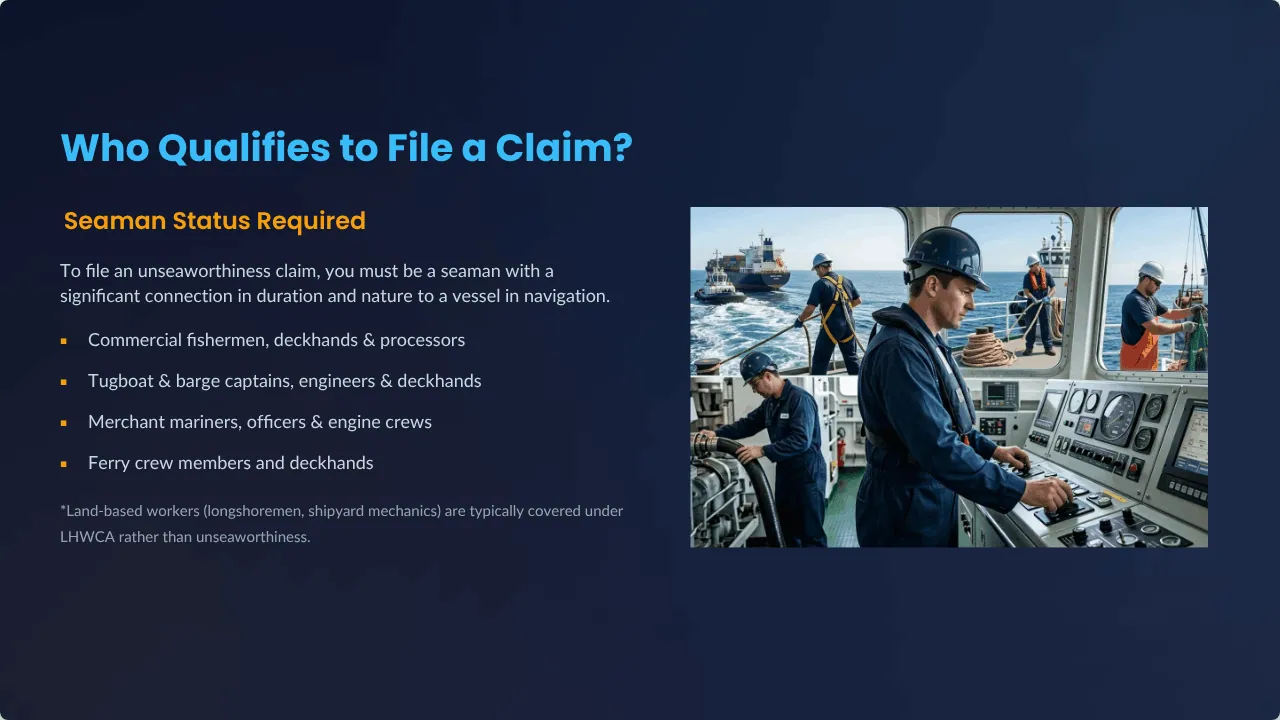
To bring a claim for unseaworthiness, you must qualify as a seaman. Generally, a seaman is a worker who maintains a significant connection in duration and nature to a vessel (or an identifiable fleet of vessels) in navigation and contributes to the vessel’s function or mission.
Maritime workers who routinely file unseaworthiness claims include:
- Commercial fishermen, deckhands, and processing workers
- Tugboat captains, engineers, and deckhands
- Barge workers and deckhands
- Merchant mariners, officers, and engine room crews
- Ferry crew members and deckhands
If you are a land-based maritime worker, such as a longshoreman, harbor worker, or shipyard mechanic, your primary remedy usually falls under the Longshore and Harbor Workers’ Compensation Act (LHWCA) rather than an unseaworthiness claim. However, third-party liability claims may still apply depending on the specifics of the incident.
Compensation Available in Unseaworthiness Lawsuits
When an unseaworthy vessel causes severe or catastrophic injuries—such as traumatic brain injuries, spinal cord damage, crushed limbs, or amputations—the financial impact on a mariner’s life can be devastating. An unseaworthiness claim allows injured seamen to seek comprehensive compensation, including:
- Past and Future Medical Expenses: Coverage for surgeries, hospitalizations, rehabilitation, specialized physical therapy, and home medical adjustments.
- Lost Wages and Loss of Earning Capacity: Recovery of lost earnings during recovery, as well as compensation for the loss of future earning potential if you can no longer return to maritime work.
- Pain and Suffering: Compensation for physical pain, mental distress, emotional anguish, and loss of enjoyment of life caused by the accident.
- Disability and Disfigurement: Financial recovery for permanent scarring, loss of bodily function, or permanent disability.
This financial recovery exists in addition to your basic maritime right to Maintenance and Cure, which pays for daily living expenses and medical treatment during your recovery process.
How BoatLaw, LLP Protects Injured Maritime Workers
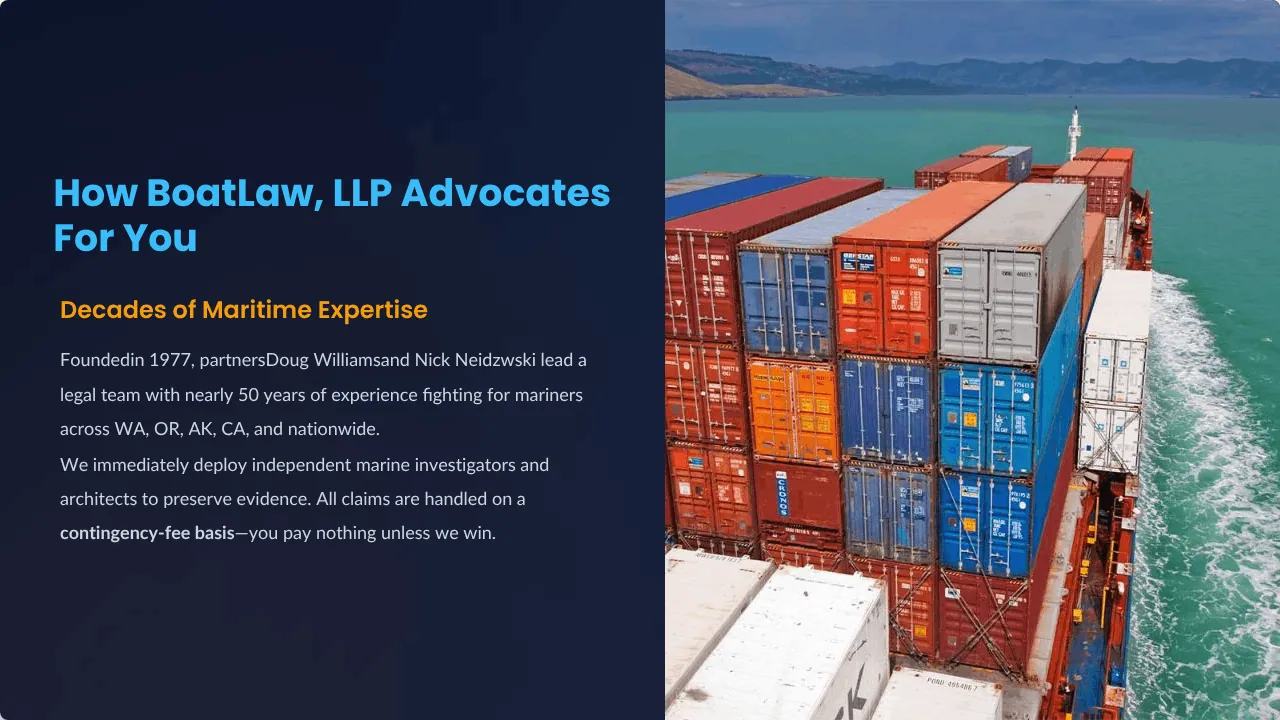
At BoatLaw, LLP, our legal team brings almost 50 years of dedicated experience fighting for injured mariners across Washington, Oregon, Alaska, California, and nationwide. Founded in 1977, our firm is built on a deep respect for the maritime way of life. Partners Douglas R. Williams and Nicholas J. Neidzwski, along with our entire legal team, share a lifelong connection to the water and understand the physical demands and hazards of working on commercial vessels.
Shipping companies, commercial fishing operators, and their insurance underwriters employ teams of adjusters and defense lawyers to minimize payouts after an accident. We level the playing field. Our firm immediately deploys independent maritime investigators, naval architects, and marine engineers to inspect defective equipment, analyze vessel maintenance logs, and preserve crucial evidence before it disappears.
We handle all maritime injury claims on a contingency-fee basis. You pay no upfront costs and no attorney fees unless we successfully secure compensation for your claim.
Take Action After a Maritime Injury
If you were injured due to unsafe equipment, poor maintenance, or hazardous working conditions on a vessel, do not navigate the complex legal system alone. Protect your rights under general maritime law by speaking with a firm that understands the sea.
Maritime Safety Snapshot
According to commercial fishing safety studies published by the National Institute for Occupational Safety and Health (NIOSH), vessel disasters and machinery injuries remain leading causes of severe fatalities and injuries among mariners, with equipment failure and unstable vessel conditions contributing significantly to catastrophic incidents at sea.
Contact BoatLaw, LLP today at 1-800-BOATLAW or reach out through our online contact form to schedule a free, confidential case evaluation. If our attorneys determine that BoatLaw may be able to assist you, a member of our legal team will reach out shortly to schedule a free, no-obligation consultation with an experienced maritime attorney.
Legal Disclaimer
The information provided is for educational and informational purposes only. The information on this website is not intended as legal advice and should not be used as a substitute for consulting a licensed attorney. Legal outcomes and laws can vary by jurisdiction, and only a qualified lawyer can provide guidance tailored to your situation.

Nicholas J. Neidzwski is a trial attorney who handles maritime and personal injury litigation. Appearing for plaintiffs in state and federal courts throughout Washington, California, Oregon, Alaska, and other jurisdictions. Nick’s litigation experience includes the successful resolution of various Jones Act, general maritime, and product liability cases on behalf of many different individuals. Nick was named a Rising Star by Super Lawyers every year from 2016 through 2025, and was named a Super Lawyer in 2026. Learn more here.