

Working on the open water is one of the most demanding, vital, and physically punishing occupations in the United States. Whether you are hauling commercial catch off the coast of Alaska, handling lines on a tugboat navigating the Columbia River, or maintaining heavy machinery on a barge in Puget Sound, your daily life is defined by heavy equipment, dynamic environments, and unpredictable elements. When a serious injury strikes at sea, maritime workers quickly realize that standard land-based workers’ compensation programs simply do not apply to them. Instead, your recovery, medical care, and legal protection depend on a unique federal statute created specifically for seafarers: the Jones Act.
Navigating maritime law after a debilitating accident can feel overwhelming, especially when your employer and their insurance adjusters begin pushing for quick statements. Understanding your rights under federal admiralty law is the first step toward securing your future and protecting your family’s financial stability. If you or a loved one has suffered an accident on the water, consulting an experienced Jones Act attorney at BoatLaw, LLP ensures that your rights are safeguarded under federal law.
Below is a plain-language guide detailing how the Merchant Marine Act of 1920 protects maritime workers, who qualifies for coverage, and what legal remedies are available to you after a job-site injury.
Understanding the Basics: What Is the Jones Act?
The Jones Act is a federal statute officially coded as 46 U.S.C. § 30104, that grants eligible maritime workers (defined legally as “seamen”) the right to sue their employers for negligence following an injury on the job.
Unlike state-level workers’ compensation systems, which operate on a strict “no-fault” basis but severely cap your total financial recovery, the Jones Act is a fault-based federal law. This means that if your employer’s failure to maintain a safe working environment contributed, even slightly, to cause your injury, you can recover under the Jones Act. Recoverable damages under the Jones Act include lost future earning potential, physical pain, emotional suffering, and long-term disability.
The Historical Context of the Merchant Marine Act of 1920
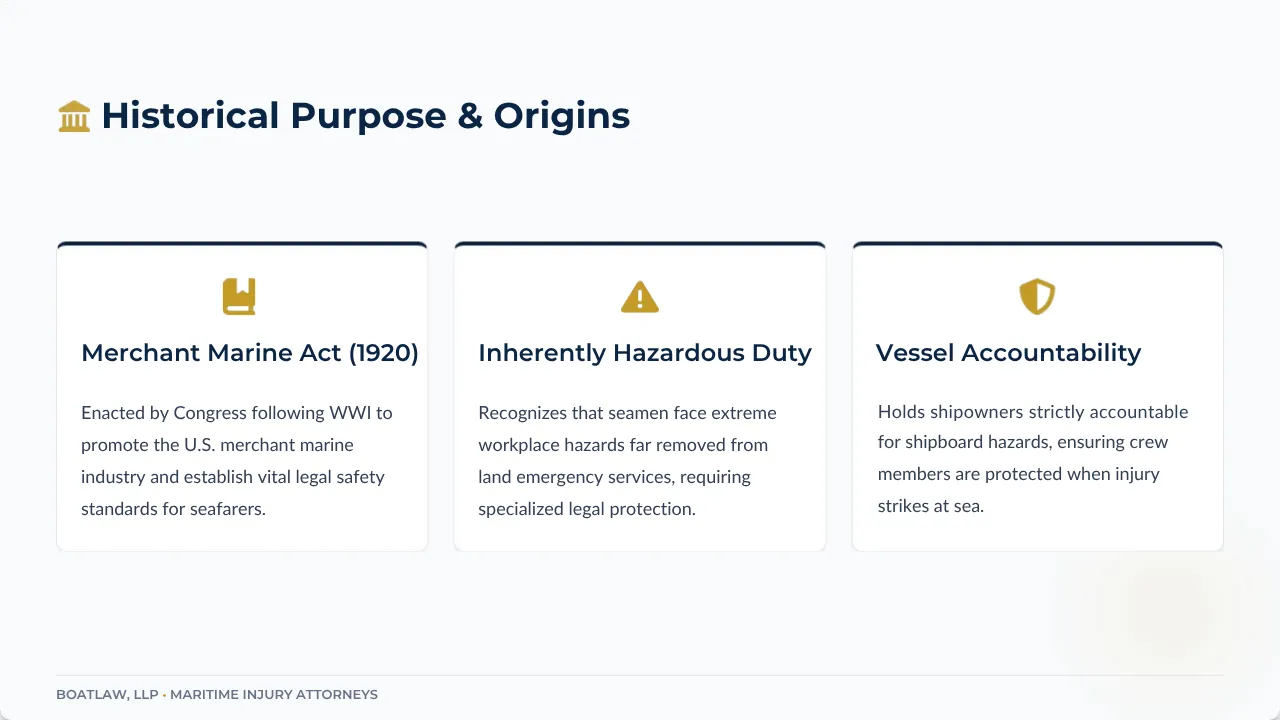
Congress enacted the Merchant Marine Act of 1920, popularly named after Senator Wesley L. Jones of Washington state, to promote and maintain the American merchant marine industry following World War I. Beyond its commercial trade regulations, the statutory framework recognized that seaman perform exceptionally hazardous duty far removed from onshore medical facilities and emergency support systems.
To balance these severe inherent risks, Congress established statutory protections that hold vessel owners accountable for workplace safety, ensuring that commercial deckhands, engineers, and crew members are not left empty-handed when workplace hazards ruin their physical health.
Who Qualifies as a Seaman Under Maritime Law?
Not every individual who works on or near the water automatically qualifies for protection under the Merchant Marine Act of 1920. To file a claim, you must meet the legal status of a “seaman.” Federal courts apply a rigorous two-prong test established by the United States Supreme Court to determine if a worker meets this qualification.
1. The Vessel Connection Test
Your employment duties must contribute to the function of a vessel in navigation or to the accomplishment of its specific mission at sea.
2. The Substantial Relationship Requirement
You must have a connection to a vessel in navigation (or an identifiable fleet of vessels under common ownership) that is substantial in both its duration and its nature. Generally, federal courts utilize a guideline requiring that a worker spend at least 30 percent of their total working time in the service of a vessel on navigable waters.
If you are classified as a land-based harbor worker, longshoreman, or ship repairer who does not meet the 30 percent threshold, your primary remedy usually falls under a separate federal statute known as the Longshore and Harbor Workers’ Compensation Act (LHWCA).
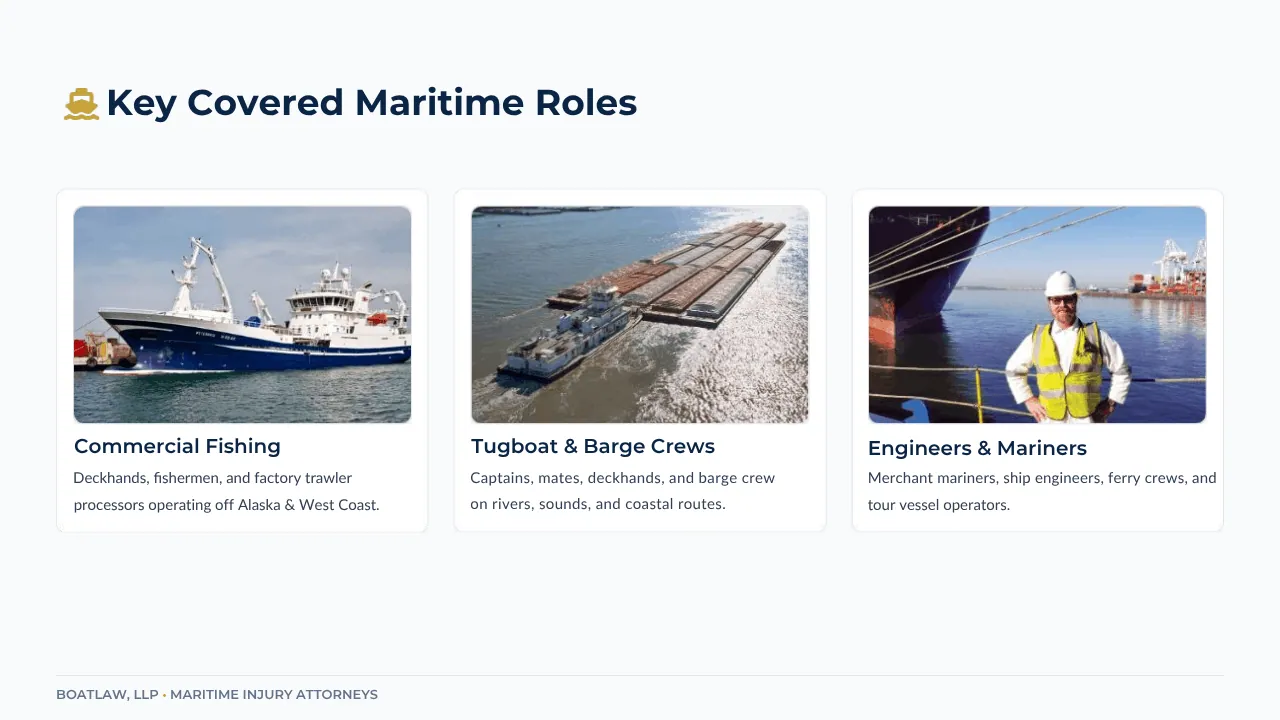
Key maritime roles typically covered under seaman status include:
- Commercial fishermen, deckhands, and factory trawler processors
- Tugboat captains, mates, deckhands, and barge crew members
- Engineers, oilers, and wipers maintaining ship engines
- State ferry workers and commercial tour vessel crew
- Merchant mariners operating cargo ships and oil tankers
Employer Negligence and the Duty of Seaworthiness
To successfully recover damages through a maritime personal injury lawsuit, an injured worker must demonstrate that their injury was caused by negligence or an unsafe condition aboard the ship.
Under federal maritime doctrine, an employer’s burden of care is extraordinarily strict. A vessel owner must provide crew members with a reasonably safe place to work, proper gear, adequate training, and sufficient manpower to perform assignments safely.
Common examples of employer negligence and shipboard hazards include:
- Failing to repair worn winches, frayed cables, or malfunctioning hydraulics
- Allowing oil, grease, or ice to accumulate on deck walking surfaces without proper non-skid coatings
- Failing to provide safety gear, proper immersion suits, or personal flotation devices
- Sending a vessel into heavy storms despite severe weather warnings
The Absolute Legal Duty of Vessel Seaworthiness
In addition to proving employer negligence, injured seamen frequently bring a parallel legal claim known as “unseaworthiness.” Under maritime law, a vessel owner owes an absolute, non-delegable duty to keep the ship, its equipment, and its crew fit for their intended purpose. If a piece of equipment breaks during routine operation, or if a crew member is improperly trained, the ship may be considered unseaworthy as a matter of law.
Essential Remedies: Maintenance and Cure Rights
Regardless of who was at fault for your workplace accident, every injured seaman is entitled to basic statutory benefits under traditional maritime law known as Maintenance and Cure.
These immediate remedies serve as a financial “cushion” while you recover from an injury or illness sustained while in the service of the vessel:
- Maintenance: A daily living allowance paid by the shipowner to cover your basic onshore living expenses, including rent, mortgage, utilities, food, and property taxes until you reach Maximum Medical Improvement (MMI).
- Cure: Complete coverage for all necessary medical care, emergency transport, surgeries, physical therapy, prescription medications, and rehabilitation costs resulting from your injury.
Under federal law, you have the absolute legal right to choose your own treating physicians. Vessel owners and insurance adjusters cannot force you to see a doctor chosen by the maritime company.
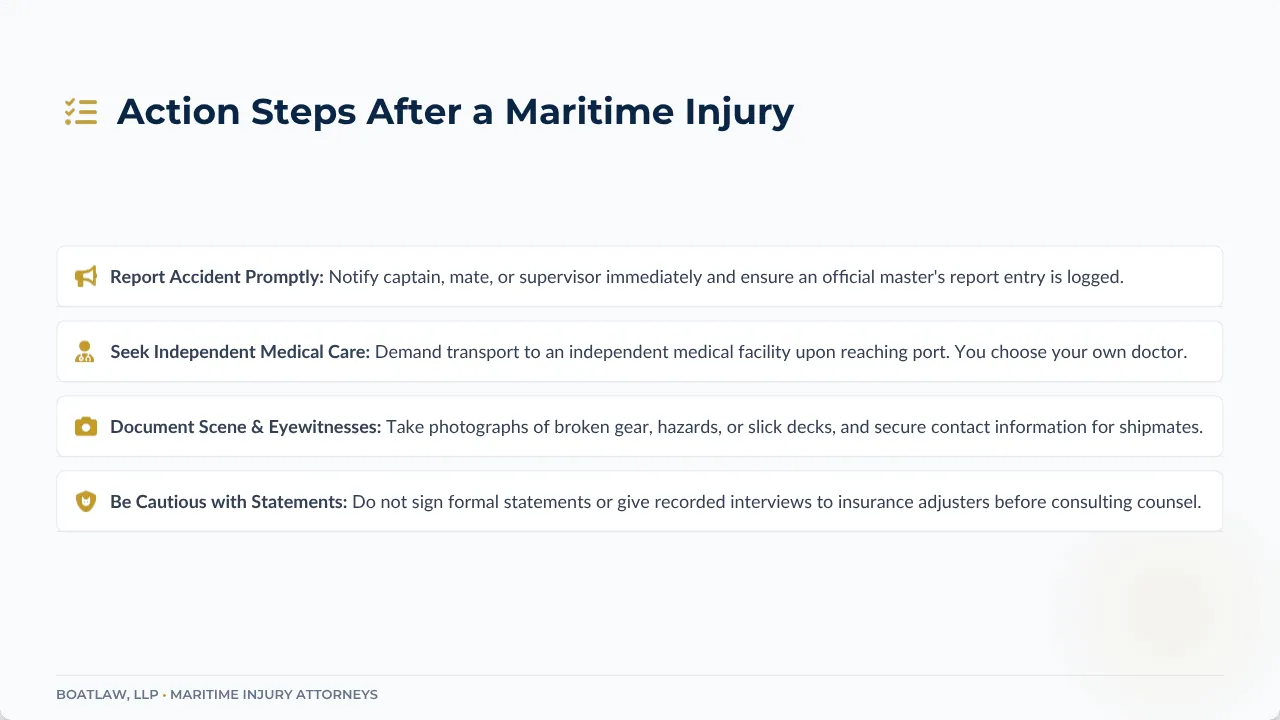
Steps to Take Immediately Following a Maritime Injury
The actions you take immediately following a shipboard injury can fundamentally shape the outcome of your maritime claim. To protect your health and your legal rights, complete the following crucial steps:
- Report the Accident Promptly: Notify the captain, mate, or supervisor immediately and request that an official master’s report or company injury log entry be made.
- Seek Independent Medical Attention: Demand transport to an independent physician or medical facility as soon as the vessel reaches port.
- Document the Scene and Gear: If physically able, take clear photographs of the hazardous condition, broken gear, or unsafe deck area that caused your harm. Collect contact information for onboard eyewitnesses.
- Be Cautious with Written Statements: Do not sign formal statements, releases, or recorded interviews provided by insurance investigators before speaking with an experienced Jones Act injury lawyer.
How BoatLaw, LLP Advocates for Maritime Workers
At BoatLaw, LLP, our maritime injury attorneys have spent almost 5 decades fighting for the rights of blue-collar seamen, fishermen, and offshore workers across Washington, Oregon, Alaska, California, and nationwide. Founded in 1977, our firm was built on a deep respect for maritime traditions and a comprehensive understanding of shipboard operations.
Led by veteran litigators Douglas R. Williams and Nick J. Neidzwski, our legal team brings a lifelong love of the sea and unyielding courtroom dedication to every client we represent. We operate strictly on a contingency-fee basis, meaning you pay zero upfront costs or legal fees unless we successfully recover financial compensation on your behalf.
If you have been hurt on the water, contact BoatLaw, LLP today at 1-800-BOATLAW to schedule a confidential, free consultation regarding your case. If our attorneys determine that BoatLaw may be able to assist you, a member of our legal team will reach out shortly to schedule a free, no-obligation consultation with an experienced maritime attorney.
Legal Disclaimer
The information provided is for educational and informational purposes only. The information on this website is not intended as legal advice and should not be used as a substitute for consulting a licensed attorney. Legal outcomes and laws can vary by jurisdiction, and only a qualified lawyer can provide guidance tailored to your situation.

Douglas R. Williams was raised in a military family. After retiring from the armed forces, his father sailed as the chief medical officer with many of the most popular cruise lines, including Holland America Line, Carnival Cruise Line, Disney Cruise Line, and Norwegian Cruise Line. When not in school, Doug spent a good part of his youth in the crew quarters sailing with his father on cruise ships. He developed a practical knowledge of the maritime industry from a young age. Learn More here.