

Quick Guide: Maritime Salvage & Legal Rights
- Salvage Rights: Rescuers of property in “marine peril” are legally entitled to financial rewards, not just a “thank you.”
- Injury Claims: If you were hurt during a rescue, a maritime injury lawyer can help you file a Jones Act claim for maintenance and cure.
- Expertise Matters: Only a specialized maritime law firm can accurately value salvage awards using the Blackwall Factors.
- Contingency-Based: At BoatLaw, LLP, we operate on a no-win, no-fee basis. You pay nothing unless our maritime accident lawyers win.
When a vessel is in distress on the high seas, the maritime tradition of coming to another’s aid is governed by complex admiralty law standards that date back centuries. If you or your crew rescued another vessel, or if you suffered a vessel accident during a rescue attempt, you need the counsel of a seasoned maritime injury lawyer. At BoatLaw, LLP, our team has spent over 45 years representing fishermen, tug operators, and barge workers, ensuring their bravery and safety are legally protected under federal law.
What is a Maritime Salvage Claim?
In the eyes of an offshore accident lawyer, salvage is a specialized legal service rendered by those who voluntarily save property at sea. Unlike land-based “Good Samaritan” laws, where you generally cannot charge for help, maritime law provides a mandatory right to a financial award. This is designed to encourage seafarers to risk their own safety and equipment to preserve maritime commerce and protect the environment.
The Three Essential Elements of a Salvage Award
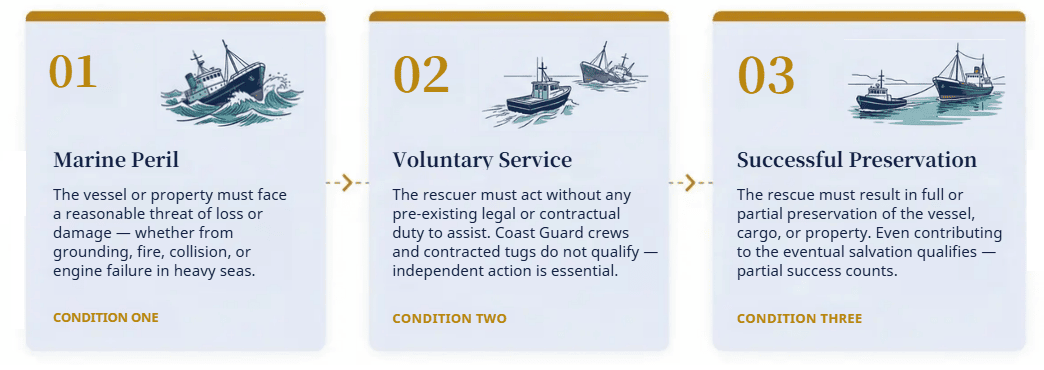
To successfully litigate a salvage case or a related Jones Act lawsuit, three specific conditions must be met. If any of these are missing, your claim may be dismissed:
- Marine Peril: The vessel must be in “reasonable apprehension” of loss or damage. This includes groundings, engine failure in heavy weather, or fire. You do not have to wait for the ship to sink; the threat of loss is enough.
- Voluntary Service: The rescuer must not have a prior legal or contractual duty to assist. For example, a Coast Guard crew cannot claim salvage, but a commercial fishing boat crew that stops their work to assist an adrift barge certainly can.
- Success: The effort must be successful, or at least contribute to the eventual saving of the property. In maritime law, the rule is “no cure, no pay.”
Consult a Leading Maritime Law Firm
Whether you are seeking a salvage award or were injured in an offshore accident, our maritime accident lawyers are ready to fight for your recovery.
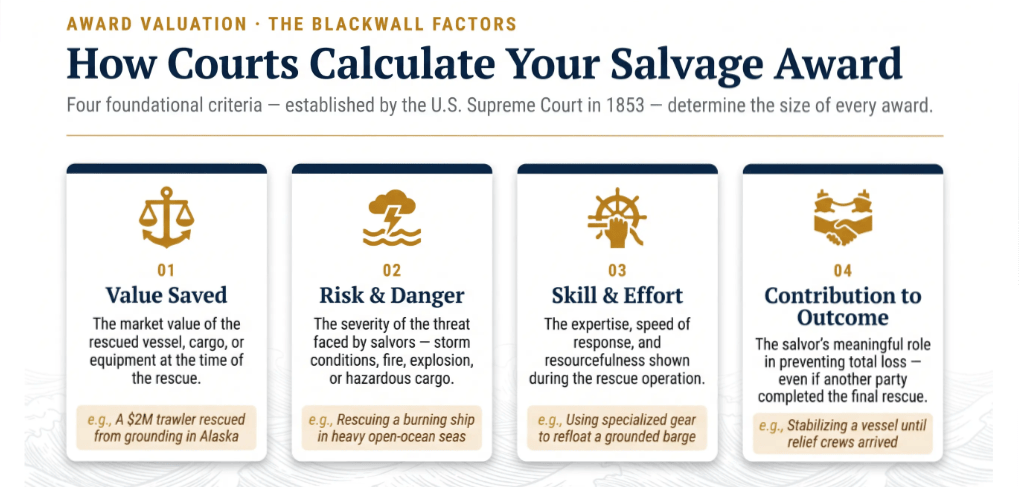
Deep Dive: How the “Blackwall Factors” Determine Your Payday
Courts do not simply pick a number for a salvage award. A maritime law firm must argue your case based on the “Blackwall Factors,” a set of criteria established by the Supreme Court. Understanding these is vital for any offshore accident lawyer building your case:
1. The Degree of Danger to the Rescued Property
Was the vessel minutes away from breaking up on the rocks, or was it simply low on fuel in calm seas? The higher the risk of total loss, the higher the salvage award. Our maritime injury lawyers use weather reports and expert testimony to prove the severity of the peril.
2. The Value of the Property Saved
The award is often a percentage of the total value of the vessel and its cargo. Saving a multi-million dollar crabber in the Bering Sea results in a significantly higher award than saving a recreational sailboat. We work with maritime appraisers to ensure the value isn’t downplayed by insurance companies.
3. The Risk Run by the Rescuers
If you put your own crew or vessel in harm’s way—facing 20-foot swells or fire—the court rewards that bravery. If you were injured during this process, your maritime accident lawyer will also pursue damages for your physical recovery.
4. The Value of the Equipment Used in the Rescue
Using a $5 million tugboat to perform a rescue entitles the owner to a higher award than using a small skiff, as the rescuer risked more capital and specialized equipment.
5. The Skill and Energy Displayed
The court looks at how efficiently the rescue was handled. Professionalism and seafaring expertise are rewarded here. This is where the testimony of seasoned mariners becomes the backbone of the claim.
6. Time and Labor Expended
Even if the rescue was “easy,” the time your vessel spent away from its primary job (like fishing or hauling) is compensable. Your offshore accident lawyer will calculate lost opportunity costs as part of the total claim.
Property Salvage vs. Life Salvage: What’s the Difference?
Under traditional admiralty law, you cannot technically “salvage” a human life for money. However, if you rescue people *and* property simultaneously, the court may increase the property award to recognize the life-saving effort. Furthermore, if you save lives and another party saves the ship, you may be entitled to a share of their property salvage award. This is a highly technical area of law that requires an experienced maritime law firm to navigate.
Statutes of Limitations: Don’t Wait to File
Time is your enemy in maritime law. Under 46 U.S. Code § 80107, you generally have two years from the date of the rescue to file a salvage claim. However, if you were injured during the rescue, the Jones Act provides a three-year window for personal injury claims. Because BoatLaw, LLP operates across the West Coast, we are intimately familiar with the local court requirements in:
- Washington & Alaska: Home to the North Pacific fishing fleet and high-risk salvage opportunities.
- Oregon & California: Busy commercial corridors where barge and shipping traffic frequently require emergency assistance.
Why Choose BoatLaw, LLP?
Salvage claims are rarely straightforward. Shipping corporations and their insurers often try to downplay the “peril” to reduce your award. Our attorneys, including Doug Williams and Nick Neidzwski, understand the maritime way of life because they share a lifelong love of the sea. We provide the “Old Guard” expertise needed to navigate federal courts in Seattle, Portland, Los Angeles, and San Francisco.
We operate on a contingency-fee basis. This means you face no upfront costs while we take on massive shipping companies on your behalf. If we don’t win your case, you don’t owe us an attorney fee.
Stand Up for Your Rights at Sea
Don’t leave your maritime salvage claim or vessel accident case to a general practitioner. Trust a maritime law firm that has protected West Coast mariners since 1977.
Call BoatLaw, LLP today at 360-671-6711 to speak with a maritime injury lawyer.

Douglas R. Williams was raised in a military family. After retiring from the armed forces, his father sailed as the chief medical officer with many of the most popular cruise lines, including Holland America Line, Carnival Cruise Line, Disney Cruise Line, and Norwegian Cruise Line. When not in school, Doug spent a good part of his youth in the crew quarters sailing with his father on cruise ships. He developed a practical knowledge of the maritime industry from a young age. Learn More here.