


What Is Unseaworthiness in Maritime Law?
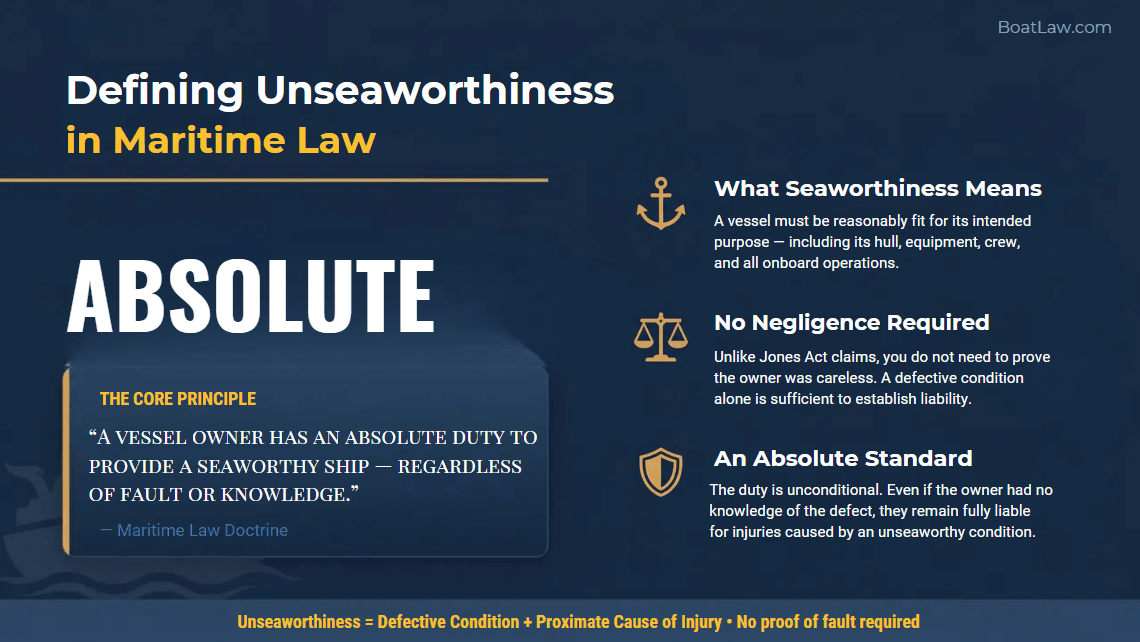
In maritime law, a vessel owner has an absolute duty to provide a seaworthy ship. Unseaworthiness occurs when the vessel—including its equipment, crew, or any part of its operation—is not reasonably fit for its intended purpose.
Unlike negligence claims under the Jones Act (which require proof of employer fault), an unseaworthiness claim does not require you to prove that the vessel owner was careless or negligent. You only need to show that the vessel had a defective condition that caused your injury.
“To prevail on an unseaworthiness claim, the seaman need show that there was a defect in the vessel that was the proximate cause of the injury.”
This is a critically important distinction. Because the duty of seaworthiness is absolute and not merely a standard of reasonable care, recovering for unseaworthiness can be a more straightforward path to compensation for many injured mariners than pursuing Jones Act negligence claims against their employer.
What Counts as an “Unseaworthy” Condition?
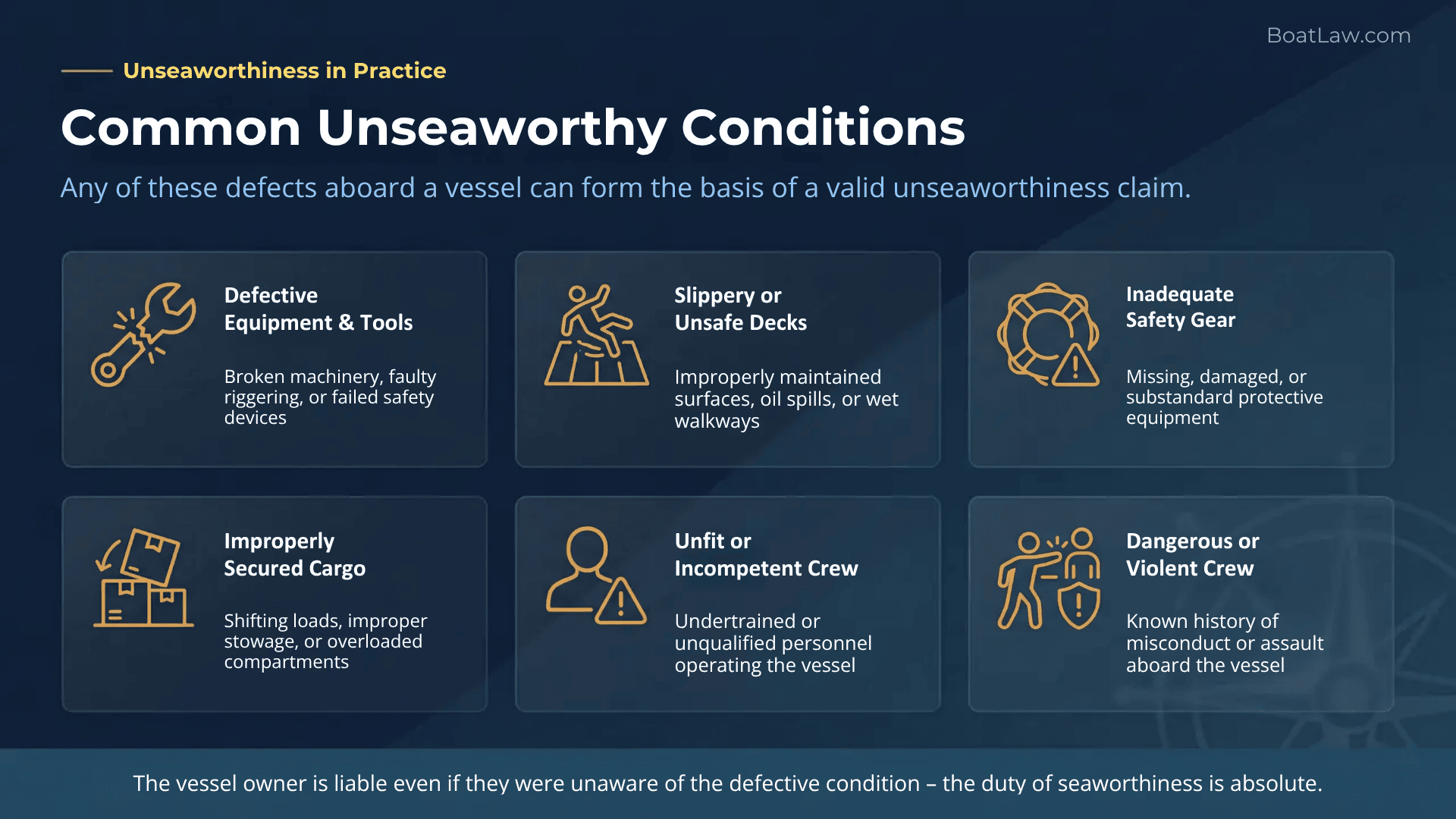
Courts have interpreted unseaworthiness broadly. Common examples include:
- Defective or broken equipment and tools
- Slippery or improperly maintained decks
- Inadequate safety gear or protective equipment
- Improperly loaded or secured cargo
- Unfit or incompetent crew members
- Violent or dangerous co-workers with a history of misconduct
The last above bullet point is especially noteworthy. Maritime law recognizes that the shipboard presence of a crew member with an “inhumane disposition”—a known history of violence—can render a vessel unseaworthy.
The Key Legal Elements You Must Prove
Because of the complexities regarding punitive damages after recent Supreme Court rulings, a qualified unseaworthiness injury attorney can evaluate the full scope of your claim, including whether you may pursue punitive damages if your employer willfully refused to pay maintenance and cure. They’ll need to establish the following:
- A defect existed in the vessel: This includes any part of the ship, equipment, or crew not reasonably fit for its intended purpose.
- The defect was the proximate cause: The condition directly caused—or substantially contributed to—the harm you suffered.
Note that you are not required to prove the vessel owner knew about the defect. The owner is liable for damages caused by the unseaworthy condition even if they were unaware of the problem.
What Damages Can You Recover?
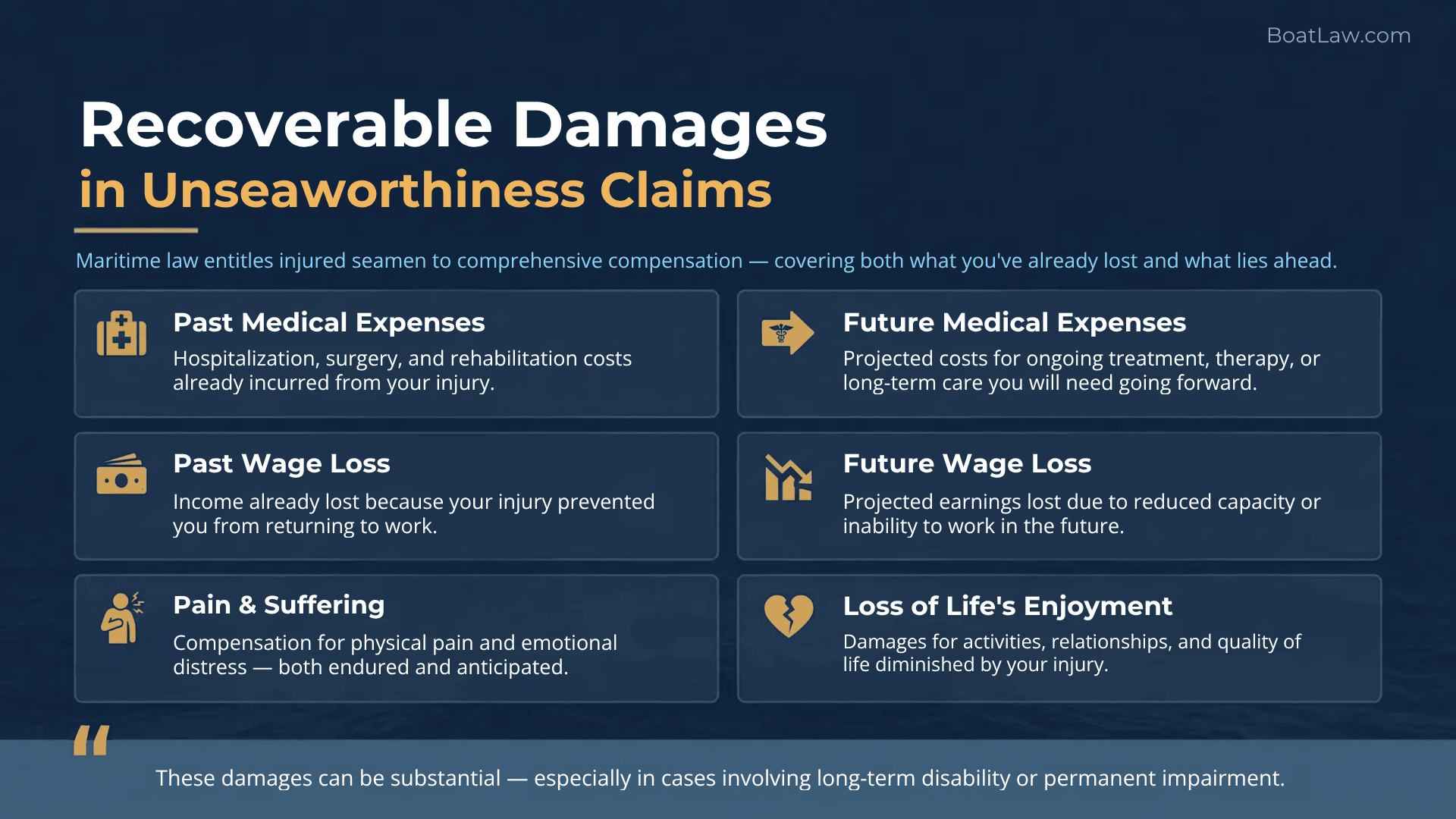
Maritime law provides a comprehensive range of damages under an unseaworthiness claim:
| Damage Category | What It Covers |
|---|---|
| Past & Future Medical Expenses | Hospitalization, surgery, rehab, and projected long-term care. |
| Past & Future Wage Loss | Income already lost and projected earnings due to diminished capacity. |
| Pain and Suffering | Physical pain and emotional distress (past and future). |
| Loss of Life’s Enjoyment | Damages for ways the injury has diminished your quality of life. |
An unseaworthiness injury attorney from our team can help you determine which legal theories—such as unseaworthiness, Jones Act negligence, or both—apply to your case to ensure you receive the maximum compensation allowed by law.

Douglas R. Williams was raised in a military family. After retiring from the armed forces, his father sailed as the chief medical officer with many of the most popular cruise lines, including Holland America Line, Carnival Cruise Line, Disney Cruise Line, and Norwegian Cruise Line. When not in school, Doug spent a good part of his youth in the crew quarters sailing with his father on cruise ships. He developed a practical knowledge of the maritime industry from a young age. Learn More here.