


What Are Jones Act Damages?
Jones Act damages are the financial compensation injured maritime workers, such as fishermen, deckhands, and processors, can legally recover after being hurt at sea due to employer negligence. Unlike standard land-based workers’ compensation, these damages explicitly cover pain and suffering, lost future earning capacity, and past medical expenses.
A serious injury at sea doesn’t just cause physical pain. It can end a lifelong career, upend a family’s finances, and permanently alter your way of life. If you labor on a commercial fishing boat, tug, barge, or processor vessel, you understand the daily risks of the maritime lifestyle. When an employer fails to provide a reasonably safe workplace, and an injury occurs, federal maritime law provides aggressive legal mechanisms to hold them accountable.
Knowing what your claim is worth is just as vital as filing it. At BoatLaw, LLP, we have spent more than 45 years helping injured mariners dissect the true scope of damages available under the Jones Act. We don’t settle for generic personal injury templates; we build cases that account for every single dollar and every ounce of hardship you have endured.
Economic Damages Available to Jones Act Seamen
Economic damages represent the concrete, verifiable financial losses resulting from your injury. These metrics look backward at your immediate losses and project forward into your future economic stability.
1. Past and Future Medical Expenses
This category covers every expense tied to your medical recovery. Because maritime injuries are often complex, ranging from crush injuries to severe orthopedic trauma, the cost of care can quickly skyrocket. Your claim can pursue coverage for:
- Emergency medevac and stabilization.
- Surgeries, hospital stays, and specialist consults.
- Physical therapy and long-term rehabilitation.
- Prescriptions, medical devices, and home modifications for permanent disabilities.
2. Loss of Earning Capacity
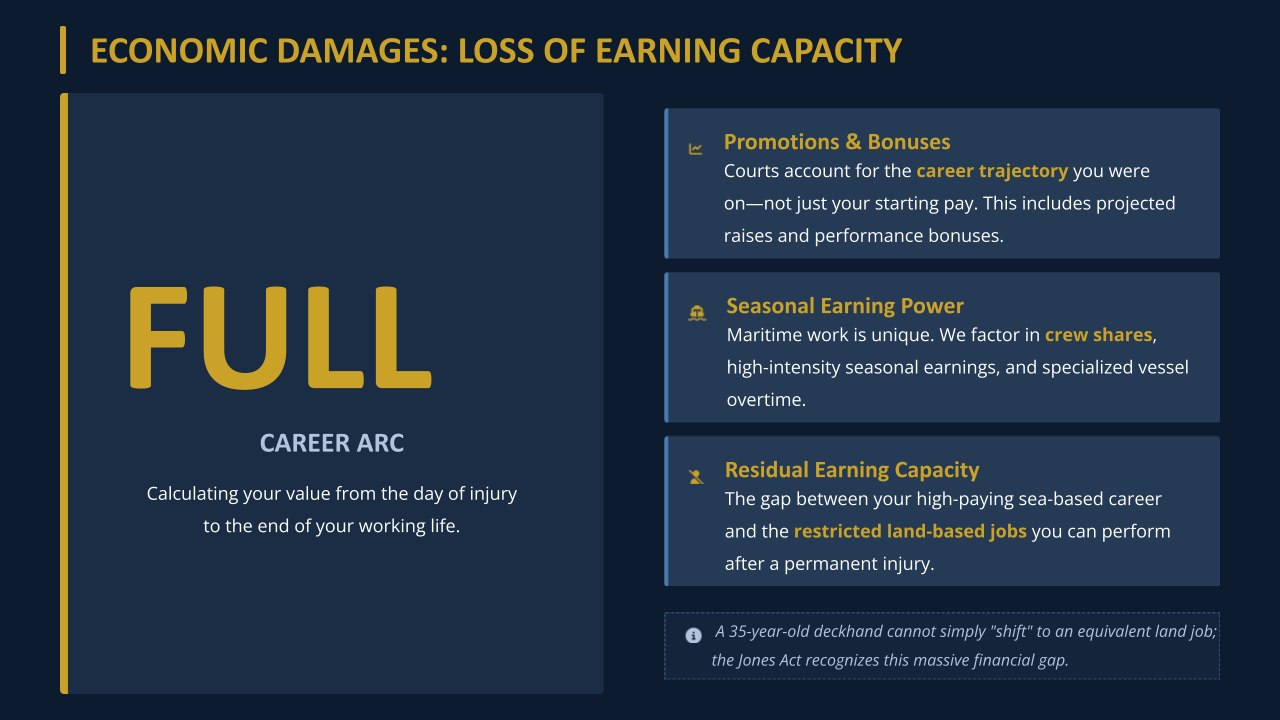
For a lifelong mariner, an injury that prevents a return to sea is a catastrophic financial blow. Loss of earning capacity does not simply look at missed paychecks while you heal; it calculates the destruction of your future career arc.
If a 35-year-old deckhand with fifteen years of experience can no longer handle heavy lifting or withstand the motion of a vessel, they cannot simply slide into an equivalent land-based job. Juries and courts must evaluate what you realistically would have earned over the remainder of your working life. This includes promotions, bonuses, and seafood season longevity, balanced against what you are capable of earning now in a restricted capacity.
3. Vocational Retraining Costs
If your physical limitations force you out of the maritime industry, the law recognizes that you shouldn’t have to fund your career transition out of pocket. You can recover the complete costs of vocational rehabilitation, including tuition, certification programs, trade school fees, and textbook expenses necessary to secure a stable land-based job.
Non-Economic Damages Available to Jones Act Seamen
The most severe impacts of an industrial accident at sea cannot be scanned on a receipt. Non-economic damages compensate you for the profound human toll of an injury.
1. Pain and Suffering
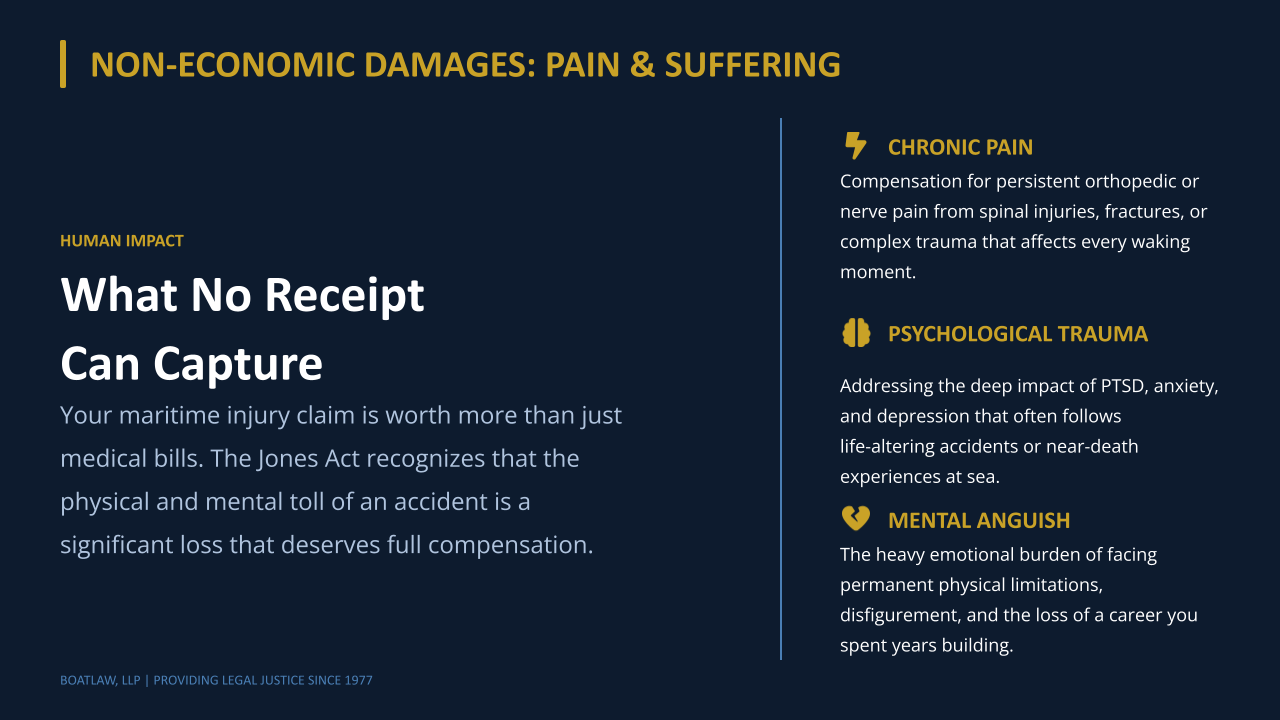
Working a rolling deck with chronic back pain, enduring nerve damage from a crushed limb, or facing the psychological trauma of a vessel sinking are all compensable under the Jones Act. This category covers both physical agony and the mental distress, anxiety, and depression that follow a life-altering maritime accident.
2. Loss of Enjoyment of Life
A maritime injury often strips away the active, blue-collar lifestyle you loved outside of work. Juries analyze how your injuries impair your ability to engage in:
- Hobbies like hunting, recreational fishing, hiking, or working out.
- Interacting and playing actively with your children or grandchildren.
- Performing standard household tasks and maintaining your independence.
3. Permanent Disfigurement and Disability
If an accident results in an amputation, severe scarring from surgical interventions, or permanent structural limitations to your body, the law accounts for the lifetime burden of navigating the world with those permanent modifications.
Why Experience Matters: Calculating the True Value of a Claim
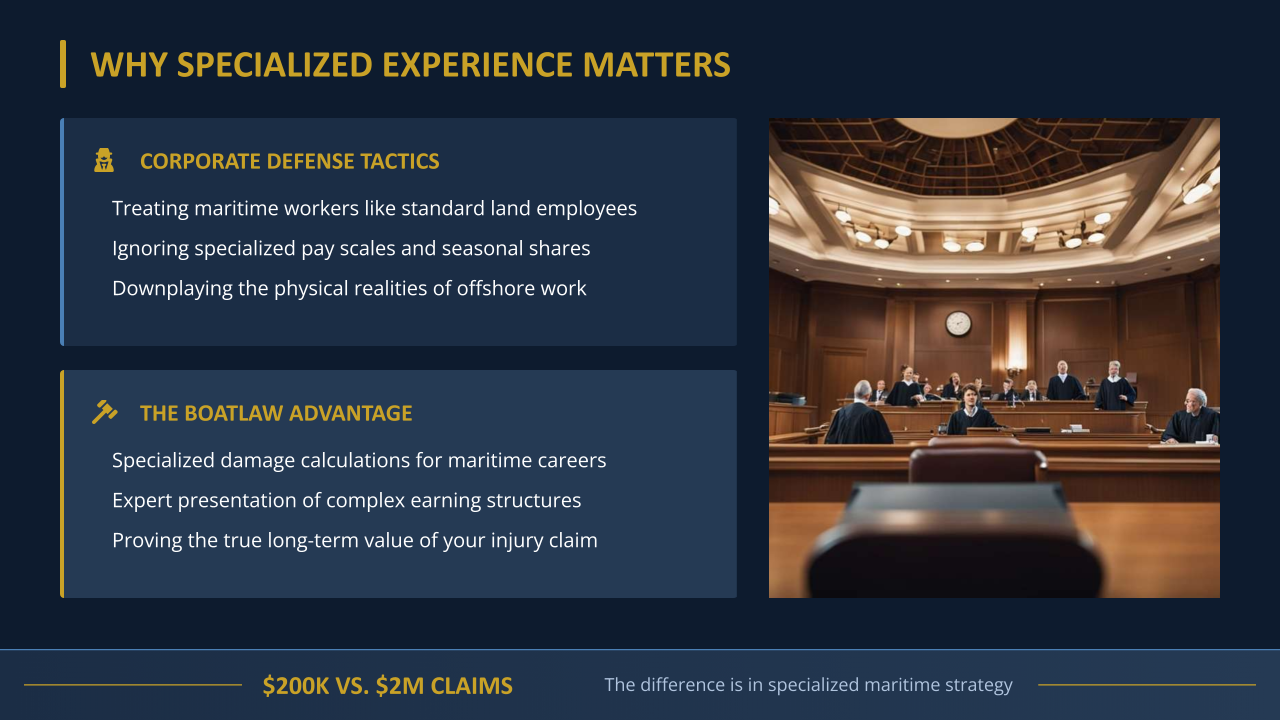
Insurance adjusters and corporate shipping attorneys routinely try to downplay maritime claims by treating injured crew members like standard land-based workers. They often gloss over the unique economic structures of maritime pay scales, seasonal shares, and the physical realities of the work.
Leaving money on the table is a risk you cannot afford when your livelihood is on the line. Securing maximum compensation requires maritime trial lawyers who know how to document, package, and aggressively present these specialized calculations to federal and state courts.
Stand Up to the Shipping Corporations. Contact BoatLaw, LLP
Since 1977, the maritime attorneys at BoatLaw, LLP, led by seasoned advocates Doug Williams and Nick Neidzwski, have stood shoulder-to-shoulder with blue-collar workers. We share a lifelong love of the sea and possess an elite, 45+ year track record of taking on major shipping lines, processing conglomerates, and insurance defense firms.
We protect injured fishermen, tugboat crew, barge workers, and longshoremen throughout the West Coast and across the nation, with deep jurisdictional roots in:
- Washington (Bellingham HQ, Seattle)
- Alaska (Dutch Harbor, Anchorage)
- Oregon (Portland, Astoria)
- California (Los Angeles, San Francisco, San Diego)
- Florida
Our Contingency-First Guarantee: No Win, No Fee
When you are injured and out of work, the last thing you need is a legal bill. BoatLaw, LLP operates on a strict contingency fee structure. We advance all litigation costs, and you pay absolutely nothing upfront. We only collect legal fees if we successfully secure a settlement or trial verdict for you.
Don’t let a corporate claims adjuster dictate what your career is worth. Call our team today at 1-880-BOATLAW or visit our Online Contact Portal for a free, confidential, and completely no-obligation consultation.
Legal Disclaimer
The information provided is for educational and informational purposes only. The information on this website is not intended as legal advice and should not be used as a substitute for consulting a licensed attorney. Legal outcomes and laws can vary by jurisdiction, and only a qualified lawyer can provide guidance tailored to your situation.

Douglas R. Williams was raised in a military family. After retiring from the armed forces, his father sailed as the chief medical officer with many of the most popular cruise lines, including Holland America Line, Carnival Cruise Line, Disney Cruise Line, and Norwegian Cruise Line. When not in school, Doug spent a good part of his youth in the crew quarters sailing with his father on cruise ships. He developed a practical knowledge of the maritime industry from a young age. Learn More here.