

As a maritime lawyer, one of the most common questions I encounter is, “What exactly is maritime law?” It’s a field of law that is as vast and deep as the waters it governs. Unlike laws that are confined by state or even national borders, maritime law, also known as admiralty law, is a unique and complex legal framework with ancient roots, designed to resolve disputes that occur on navigable waters.
An injury at sea is a serious matter, and the legal path to compensation is often far more complex than a typical personal injury claim on land. The rules change depending on where you were, what you were doing, and who owned the vessel. This guide will explain the fundamentals of admiralty law, from its historical roots to its modern application in North American waters, with a special focus on the key statutes that every maritime worker and their family should understand.
A Brief History of Admiralty Law
Maritime law is one of the oldest legal specialties in the world. Its origins can be traced back to ancient seafaring civilizations like the Egyptians, Phoenicians, and Greeks, who developed customs and rules to govern commerce and conduct on the seas. These early codes, such as the Rhodian Sea Law, established principles for handling collisions, cargo loss, and payments to sailors that are still conceptually present in our laws today.
In the United States, the Constitution specifically grants federal courts the power to hear “all cases of admiralty and maritime jurisdiction.” This ensures a uniform body of law across the country for maritime issues, preventing a confusing patchwork of state laws from governing shipping and commerce that is national and international by nature.
Where Do Maritime Laws Apply?
Understanding where maritime laws apply is one of the most confusing and important questions for injured workers. It doesn’t follow simple state boundaries. Instead, jurisdiction is determined by whether an incident occurs on =”navigable waters.”
This generally includes any body of water that can be used for interstate or international commerce. While this obviously covers the oceans and coastal waters, it also extends to major rivers like the Mississippi, the Great Lakes, and other inland waterways that connect states or countries. The key question is not the size of the water, but its function as a highway for commerce. For a more detailed exploration of this topic, you can read our firm’s North American Admiralty Law Guide.
Key US Maritime Laws Every Worker Should Know
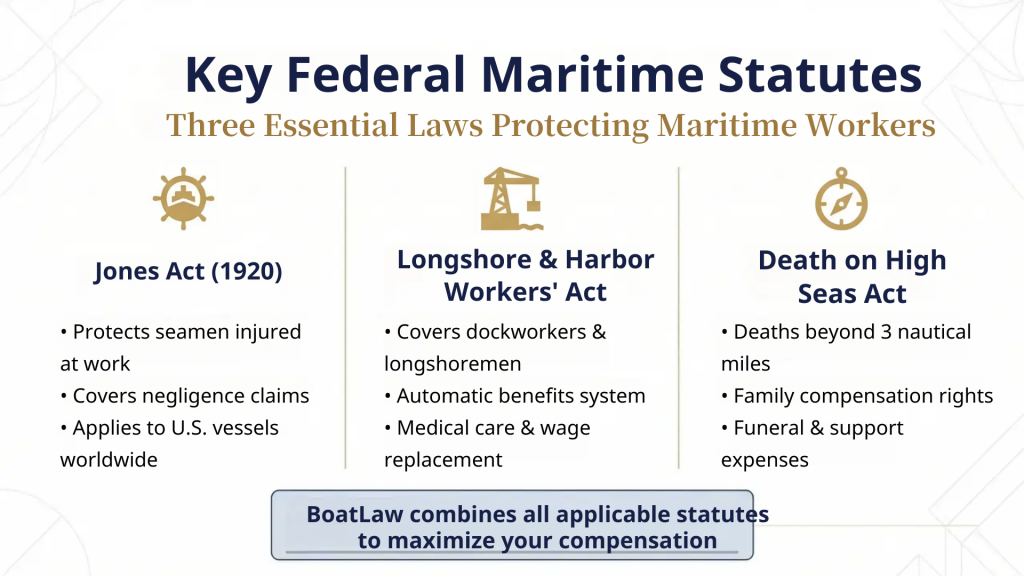
Modern US maritime law is a combination of historic “general maritime law” principles and specific statutes enacted by Congress. These laws provide critical protections and define the rights of seamen, longshoremen, and other maritime employees. The table below outlines some of the most important statutes and legal doctrines in effect today.
| Law / Doctrine | Primary Purpose & Key Features | Learn More |
| The Jones Act | Allows injured seamen to sue their employers for negligence. To qualify as a Jones Act seaman, a worker must have a substantial connection to a vessel or fleet of vessels in navigation. | Explore the Jones Act Claims |
| General Maritime Law | A body of case law providing remedies like “Maintenance and Cure” (living and medical expenses for injured seamen) and claims for “Unseaworthiness” (if the vessel or its equipment was not fit for its intended purpose). | Explore Maintenance and Cure and Unseaworthiness Claims |
| Longshore and Harbor Workers’ Compensation Act (LHWCA) | A federal workers’ compensation system for dockworkers, shipbuilders, and other maritime workers who are not seamen but are injured on or near navigable waters. | Explore LHWCA Claims |
| Suits in Admiralty Act (SIAA) | Waives the U.S. government’s sovereign immunity, allowing lawsuits against the United States for injuries on vessels owned or operated by the government. Features a strict two-year statute of limitations. | Maritime Statute of Limitations Guide |
| Public Vessels Act (PVA) | Works with the SIAA to clarify the right to sue the U.S. for damages caused by a “public vessel,” such as a Navy or Coast Guard ship. | 46 U.S. Code Chapter 311 |
| Death on the High Seas Act (DOHSA) | Provides a cause of action for the families of individuals killed in an accident on the high seas, more than three nautical miles from the shore of any state. | Explore DOSHA Claims |
Claims Against the U.S. Government: A Special Case
While the Jones Act is well-known, many maritime workers are surprised to learn it does not apply to injuries sustained on vessels owned or operated by the United States government. A foundational legal principle called “sovereign immunity” protects the government from being sued without its consent. Fortunately, Congress has provided that consent for maritime claims.
The Suits in Admiralty Act (SIAA) and Public Vessels Act (PVA)
In 1920, the same year it passed the Jones Act, Congress enacted the Suits in Admiralty Act (SIAA). This landmark law waived sovereign immunity and allowed injured seamen to file lawsuits against the United States for injuries sustained on its vessels. Six years later, in 1926, the Public Vessels Act (PVA) was passed to further clarify that individuals could sue for damages caused by a “public vessel.”
Together, these two acts provide the legal framework for holding the government accountable for negligence. If you are injured on a vessel owned by the U.S. Navy, operated by the Maritime Administration , or contracted for government service, your claim will likely fall under the SIAA and PVA, not the Jones Act.
The Critical Two-Year Statute of Limitations
Perhaps the most crucial difference between a standard maritime claim and one against the government is the deadline for filing a lawsuit. While Jones Act and general maritime law claims typically have a three-year statute of limitations, claims under the SIAA are subject to a much stricter two-year statute of limitations. The clock starts ticking from the date of the injury.
This is not a minor detail; it is an absolute bar to recovery. If you miss this two-year deadline, you lose your right to seek compensation forever, no matter how severe your injury or how clear the government’s fault. It is absolutely essential to determine early on if the vessel you were on has any connection to the U.S. government. Waiting too long to consult an attorney can jeopardize your entire claim. You can learn more in our maritime statute of limitations guide.
The “Agency” Complication: Who Is the Real Defendant?
Many government maritime operations are contracted out to private companies. This is where cases become extremely complex due to the SIAA’s “exclusivity provision.” This provision states that if an injury occurs on a vessel operated by a private company acting as an agent of the United States, the injured party’s sole remedy may be a lawsuit against the government. The private operator is shielded from liability.
Determining an Agency Relationship
Whether a private company was acting as a government agent is a fact-intensive inquiry and often the central dispute in a case. The outcome hinges on the degree of control the government exercised over the private operator’s work. At BoatLaw, we have litigated this very issue in a number of cases.
Determining agency requires deep investigation, including:
- Contract Analysis: Scrutinizing the contract between the company and the government to understand the command structure and scope of work.
- Operational Review: Examining daily logs, safety procedures, and communications to see who had ultimate control over the vessel’s operations.
- Depositions: Taking sworn testimony from company managers, government contract officers, and crew members to build a complete picture of the working relationship.
This determination is critical because it dictates who you can sue and what legal strategies are available.
How Your Claim Impacts Your Trial: Bench vs. Jury
The identity of the defendant directly impacts your right to a jury trial, a significant consideration for any injured seaman. The rules are clear and unforgiving:
- If your lawsuit is limited to a suit against the United States the case must be filed in federal court, and you are not entitled to a jury. Your case will be decided in a bench trial where a federal judge acts as both judge and jury.
- If your lawsuit can be pursued against private companies in addition to the United States you retain your right to a jury trial for the claims against the private defendants. However, the portion of your case against the government will still be decided by the judge in a bench trial. This often results in a hybrid trial where a jury and a judge hear the same evidence but decide liability for different parties.
Why You Need an Experienced Maritime Lawyer
As you can see, claims involving maritime law, and especially those against the U.S. government, are fundamentally different from other injury cases. The shorter statute of limitations, the complex issue of agency, and the unique rules regarding bench trials create legal hurdles that require specialized knowledge. As an attorney who focuses exclusively on this area, I know what a maritime lawyer does and the value we bring to these complex cases.
Whether you work in commercial fishing, on an offshore supply vessel, an injury can be devastating. If you have been hurt on a vessel that may be owned, operated, or contracted by the U.S. government, time is of the essence.
Don’t risk your rights by waiting or assuming your case is straightforward. Contact the experienced maritime attorneys at BoatLaw to understand your legal options and ensure your claim is protected.

Nicholas J. Neidzwski is a trial attorney who handles maritime and personal injury litigation. Appearing for plaintiffs in state and federal courts throughout Washington, California, Oregon, Alaska, and other jurisdictions. Nick’s litigation experience includes the successful resolution of various Jones Act, general maritime, and product liability cases on behalf of many different individuals. Nick was named a Rising Star annually by Super Lawyers from 2016 through 2025, and was named a Super Lawyer in 2026. Learn more here.