

An injury at sea is always a serious matter, but when the vessel involved is owned or operated by the United States government, the legal path to compensation becomes significantly more complex. Standard maritime laws like the Jones Act do not apply in the same way. Instead, injured seamen must navigate a different set of federal statutes with unique rules, deadlines, and procedures.
This article explains the critical laws that govern injury claims against the U.S. government, the Suits in Admiralty Act and the Public Vessels Act, and what every maritime worker needs to know to protect their rights.
The Suits in Admiralty Act: Waiving Sovereign Immunity
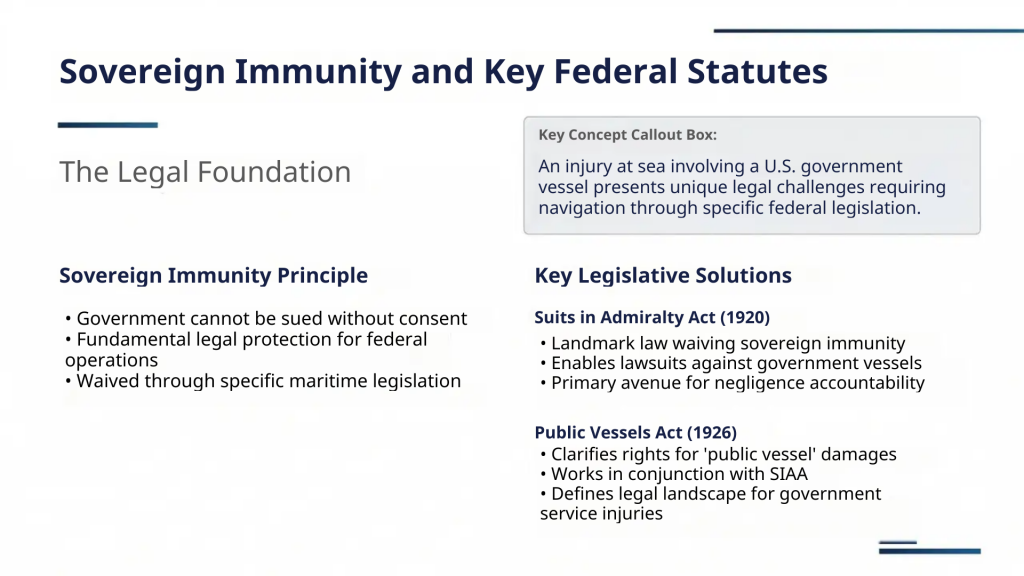
A foundational principle of law is “sovereign immunity,” which means that the government cannot be sued without its consent. In 1920, the same year it passed the Jones Act, Congress gave this consent for maritime claims by enacting the Suits in Admiralty Act (SIAA).
The SIAA was a landmark law that waived sovereign immunity and allowed injured seamen to file lawsuits against the United States for injuries sustained on vessels owned or operated by the United States. This act provides the primary legal avenue for holding the government accountable for negligence that leads to a maritime worker’s injury or death.
A Critical Deadline: The Two-Year Statute of Limitations

Perhaps the most critical difference between a standard maritime claim and one against the government is the deadline for filing a lawsuit. While Jones Act and general maritime law claims typically have a three-year statute of limitations, claims under the SIAA are subject to a much stricter two-year statute of limitations.
This is not a minor detail; it is a crucial deadline that can permanently bar your claim if missed. The two-year clock starts ticking from the date of the injury. It is absolutely essential to determine early on whether the vessel you were on has any connection to the U.S. government, as this shorter deadline could potentially apply to your case.
Waiting too long to consult an attorney can jeopardize your entire claim. If the two-year deadline passes, you lose your right to seek compensation, regardless of the severity of your injury or the strength of your case.
Further Clarification: The Public Vessels Act (PVA)
Six years after the SIAA, Congress passed the Public Vessels Act (PVA) in 1926. This act, along with a later clarification act, further solidified the right of individuals to sue the United States for damages caused by a “public vessel.”
The PVA works in conjunction with the SIAA to provide a comprehensive framework for claims involving injuries or deaths on vessels owned or operated by the United States or on its behalf. Together, these acts define the legal landscape for seamen injured in service to the government, whether directly or indirectly.
The ‘Agency’ Complication: Suing the Government vs. a Private Operator
Many government maritime operations are not handled by federal employees but are instead contracted out to private companies. This is where cases can become extremely complex due to the SIAA’s exclusivity provision.
This provision states that if an injury occurs on a vessel operated by a private company acting as an agent of the United States, the injured party’s sole remedy may be a lawsuit against the government. In such situations, the private company is shielded from liability, and you cannot sue them directly.
What Determines an ‘Agency’ Relationship?
Determining whether a private company was acting as a government agent is a fact-intensive inquiry. It is rarely a simple question and often becomes a central point of legal dispute. The outcome hinges on the degree of control the government exercised over the private operator.
At BoatLaw, we have extensive experience litigating this very issue. To establish or disprove agency, our attorneys conduct a thorough investigation that often includes:
- Contract Analysis: Scrutinizing the contract between the private company and the U.S. government to understand the scope of work and the command structure.
- Operational Review: Examining daily logs, safety procedures, and communications to see who had ultimate control over the vessel’s operations.
- Depositions: Taking sworn testimony from company managers, government contract officers, and crew members to build a complete picture of the working relationship.
The determination of agency is critical because it dictates who you can sue and what legal strategies are available to you.
Impact on Your Trial: Understanding Bench vs. Jury Trials
The identity of the defendant—the government, a private company, or both—directly impacts your right to a jury trial. This is a significant consideration for any injured seaman.
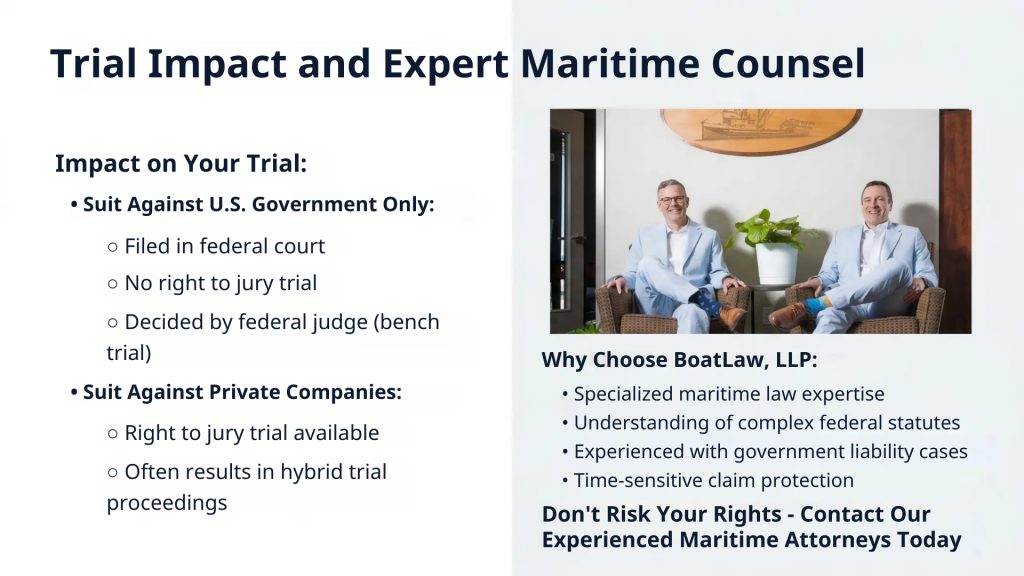
If your lawsuit is limited to a suit against the United States, the case must be filed in federal court Furthermore, you are not entitled to a jury. Instead, your case will be decided in a bench trial where a federal judge acts as both the judge and jury, determining the facts and ruling on the outcome.
If your lawsuit can be pursued against private companies in addition to the United States, the situation changes. You retain your right to a jury trial for the claims against the private defendants. However, the portion of your case against the government will still be decided by a judge in a bench trial. This often results in a hybrid trial where a jury and a judge hear the same evidence but decide liability for different parties.
Areas Our Cruise Ship Lawyers Serve
The legal team at BoatLaw, LLP is ready to help workers injured at sea. Areas we serve include:
| State | Description | Top Ports |
| Washington | Law offices in Bellingham and Seattle. | Port of Seattle |
| Oregon | Maritime law office in Portland. | Port of Portland |
| California | Maritime law offices in San Francisco and Los Angeles. | Port of Los Angeles |
| Alaska | Maritime lawyers serving Alaska | Port of Anchorage
Port of Valdez Port of Seward |
| Florida | Maritime lawyers serving Florida | Port of Miami |
Why You Need Experienced Maritime Counsel
Claims against the U.S. government are fundamentally different from other maritime injury cases. The shorter statute of limitations, the complex issue of agency, and the rules regarding bench trials create legal hurdles that require specialized knowledge and experience.
If you have been injured on a vessel that may be owned, operated, or contracted by the U.S. government, time is of the essence. Don’t risk your rights by waiting. Contact the experienced maritime attorneys at BoatLaw to understand your legal options and ensure your claim is protected.
Request a Free Consultation Today

Douglas R. Williams was raised in a military family. After retiring from the armed forces, his father sailed as the chief medical officer with many of the most popular cruise lines, including Holland America Line, Carnival Cruise Line, Disney Cruise Line, and Norwegian Cruise Line. When not in school, Doug spent a good part of his youth in the crew quarters sailing with his father on cruise ships. He developed a practical knowledge of the maritime industry from a young age. Learn More here.